Kitchen Ratio Lab
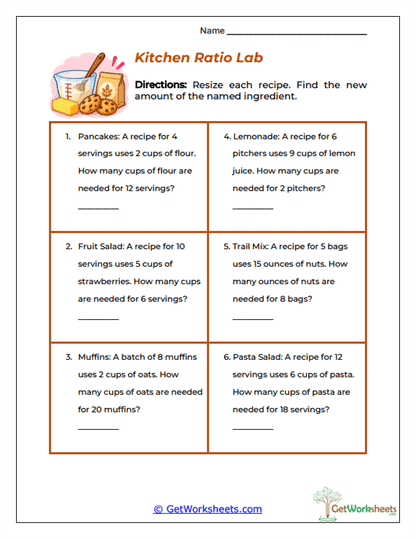
This worksheet gives students practice using ratios to resize recipes while keeping the ingredient amounts in the same relationship. Each problem gives an original recipe amount, such as 2 cups of flour for 4 servings or 5 cups of strawberries for 10 servings, then asks students to find the amount needed for a different number of servings. The situations include pancakes, fruit salad, muffins, lemonade, trail mix, and pasta salad, so students get repeated practice with the same proportional idea in a familiar real-world setting.
For a parent, the easiest way to explain this worksheet is to think about making a recipe for more or fewer people. If a recipe for 4 servings uses 2 cups of flour, then a recipe for 12 servings is three times as large. That means the flour amount must also be multiplied by 3, giving 6 cups. The important idea is that the servings and ingredient amounts must change together.
Learning Goals
- Resize Recipes: Students increase or decrease ingredient amounts based on a new serving size.
- Use Scale Factors: Learners identify how much larger or smaller the new batch is.
- Maintain Equivalent Ratios: Students keep the ingredient-to-serving relationship constant.
- Apply Proportions to Real Life: Learners connect ratio math to cooking and food preparation.
- Strengthen Multiplication and Division: Students use both operations to scale quantities.
Parent-Friendly Teaching Tips
Use this routine:
- Compare the old number of servings to the new number.
- Find the scale factor.
- Multiply or divide the ingredient by that same factor.
- Label the answer with the correct unit.
For example:
4 servings use 2 cups of flour.
12 servings is 3 times as many.
So:
2 × 3 = 6 cups
Answer: 6 cups
Why This Worksheet Helps
- Makes Proportions Easy to Picture: Recipe scaling is something students can understand naturally.
- Builds Scale-Factor Fluency: Students repeatedly practice enlarging and reducing quantities.
- Reinforces Equivalent Ratios: The relationship must stay balanced.
- Connects Math to Everyday Life: Students see how proportional reasoning is used in kitchens.
- Prepares for More Complex Word Problems: The same logic is used in rates, maps, similar figures, and unit pricing.
The real value of this worksheet is that it helps students see proportions as a way to keep a relationship consistent while the total amount changes. Servings, ingredients, multiplication, division, and scale factors all work together. For parents, the best reminder is: “If the servings change by a certain factor, the ingredient has to change by that same factor.”
Bookmark Us Now!
New, high-quality worksheets are added every week! Do not miss out!