Conversion Questions
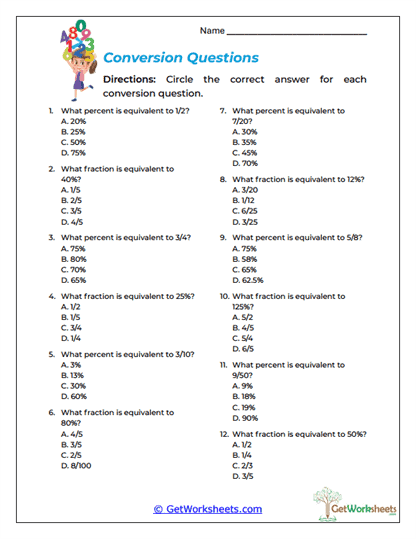
This worksheet gives students a multiple-choice challenge where they must decide which fraction or percent correctly matches the value in each problem. Students move back and forth between fractions and percentages, working with familiar relationships such as 1/2, 3/4, 3/10, 4/5, 7/20, 5/8, and 9/50 while also converting percentages such as 25%, 40%, 50%, 80%, and 125% into fractions. The answer choices are close enough to make students think carefully, which strengthens fraction-percent conversion, equivalent fractions, simplification, number sense, benchmark values, and comparison. It is especially useful for grades 5-6 students who know the basic conversion process and need practice recognizing correct equivalents while avoiding common distractors.
Learning Goals
- Convert in Both Directions: Students determine whether they need to change a fraction into a percent or a percent into a fraction.
- Choose the Correct Equivalent: Learners compare several possible answers and identify the value that truly represents the same quantity.
- Use Benchmark Knowledge: Familiar relationships such as 1/2 = 50% and 3/4 = 75% help students solve efficiently.
- Simplify Fraction Answers: Students practice recognizing lowest-term fraction forms when starting with a percent.
Classroom & Home Use
- Easy for Parents to Support: Ask, “What would this fraction be out of 100, or what fraction does this percent represent?”
- Great for Quick Skill Checks: Multiple-choice responses make it easy to see whether students understand the concept or are guessing.
- Builds Test-Taking Confidence: Students practice eliminating obviously unreasonable answers before choosing the best option.
- Keeps Practice Varied: Fraction-to-percent and percent-to-fraction questions are mixed together throughout the page.
- Useful for Review: The worksheet works well for homework, centers, intervention, test preparation, or homeschool lessons.
This worksheet helps students become more confident choosing between equivalent forms instead of simply following one repetitive conversion rule. Fractions, percents, simplification, benchmark values, equivalent amounts, multiplication, division, and number sense all work together as students evaluate each option. For parents, one helpful strategy is to use familiar anchors first: 50% is 1/2, 25% is 1/4, and 100% is one whole. From those anchors, students can judge whether an unfamiliar answer is sensible. In classroom and homeschool settings, this activity strengthens both conversion fluency and the ability to check whether a fraction-percent relationship makes mathematical sense.
Bookmark Us Now!
New, high-quality worksheets are added every week! Do not miss out!