Fact Checking Values
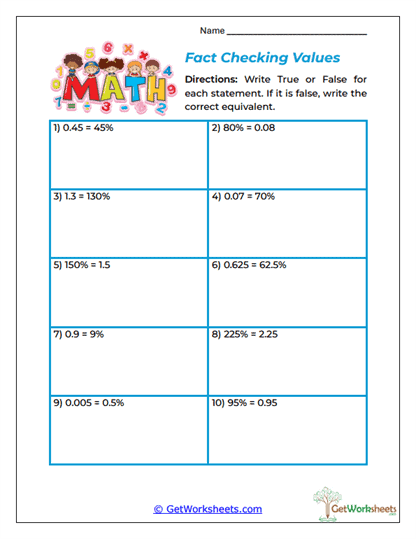
This worksheet asks students to act as math fact-checkers by deciding whether each decimal-percent statement is true or false. Students examine examples such as 0.45 = 45%, 1.3 = 130%, 150% = 1.5, and 225% = 2.25, then correct any statement that is wrong. That error-checking format strengthens decimal-percent conversion, equivalent values, place value, multiplication and division by 100, number sense, and mathematical reasoning because students must judge the relationship instead of simply completing a blank. It is especially useful for grades 5-6 students who understand the basic conversion rules but need practice spotting common errors quickly and explaining why a value does or does not make sense.
Learning Goals
- Judge Equivalence: Students decide whether a decimal and percent represent the same quantity.
- Correct False Statements: Learners rewrite any incorrect decimal-percent pair with the proper equivalent.
- Use Magnitude as a Check: Students recognize that 80% should be 0.8, not 0.08, and that 225% must be greater than 2.
- Strengthen Place-Value Reasoning: The activity reinforces what happens when values are multiplied or divided by 100.
Classroom & Home Use
- Easy for Parents to Discuss: Ask, “Does this pair describe the same amount, or did the decimal point land in the wrong place?”
- Turns Mistakes Into Practice: Incorrect statements become useful examples students can analyze and repair.
- Builds Self-Checking Habits: Students learn to question an answer before accepting it.
- Useful for Quick Assessment: Teachers can quickly identify whether a student is confusing tenths, hundredths, or percent size.
- Flexible for Review: The worksheet works well for homework, centers, intervention, test prep, or homeschool lessons.
This worksheet helps students become more thoughtful with conversions because they have to decide whether an answer is believable. Decimals, percents, equivalence, place value, error analysis, magnitude, and number sense all work together as students inspect each statement. For parents, a strong anchor is still 100% = 1: values below 100% should usually be below 1 as decimals, while values above 100% should be above 1. That simple check can catch a surprising number of mistakes. In classroom and homeschool settings, this activity strengthens accuracy, confidence, and the habit of checking whether a conversion actually makes sense.
Bookmark Us Now!
New, high-quality worksheets are added every week! Do not miss out!