Place Value Worksheets
About This Worksheet Collection
Place value helps students understand that a digit's position determines how much it represents within a number. A 5 might mean 5 ones, 50 tens, 500 hundreds, or 5,000 thousands depending on where it appears. Building this understanding gives learners a strong foundation for reading large numbers, writing expanded form, comparing values, rounding, and performing multi-digit operations.
This collection approaches whole-number place value through a variety of engaging formats. Students identify place names and digit values, build numbers from clues, switch between standard and expanded form, compare and order values, reason with powers of ten, solve mystery-number puzzles, and apply place-value ideas in themed situations. The worksheets can be used for classroom lessons, math centers, independent practice, homework, tutoring, intervention, enrichment, or homeschool instruction.
As learners work through the collection, they strengthen number sense, digit-value reasoning, number composition, number decomposition, comparison, and powers-of-ten understanding. They also practice using zeros as placeholders, reading large numbers carefully, explaining how digit shifts affect value, and applying place-value knowledge to rounding and problem solving. These activities help students see the base-ten system as a connected structure rather than a list of place names to memorize.
Detailed Descriptions Of These Worksheets
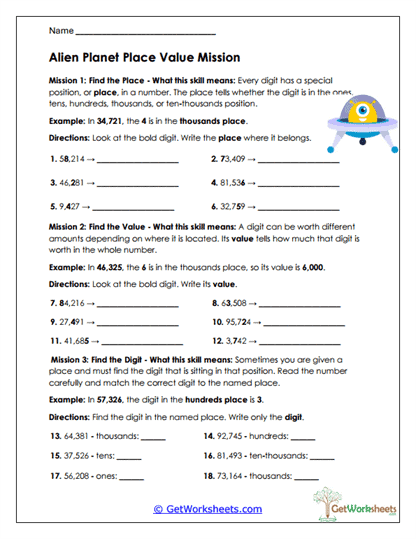
Alien Planet Place Value Mission
A space-themed challenge gives students practice identifying a digit's place, determining its value, and solving missing-digit questions. Learners work with positions from ones through ten-thousands while carefully tracking where each digit appears. The three-part format helps students distinguish between the name of a place and the amount a digit represents. This activity strengthens foundational place-value reasoning in an engaging way.
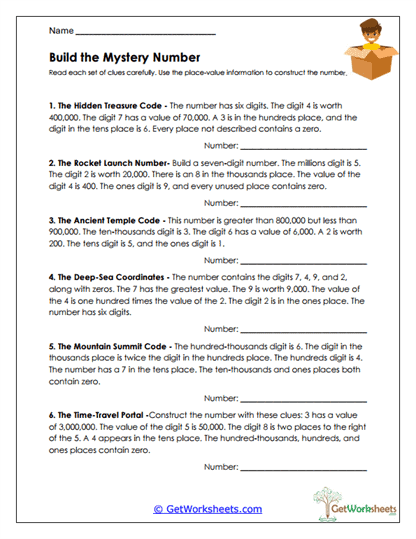
Build the Mystery Number
Place-value clues turn number construction into a puzzle. Students combine information about digit values, positions, zeros, repeated digits, and relationships between places to determine each mystery number. Because several clues must work together, learners need to reason through the entire number rather than solve one isolated step. The activity strengthens careful reading and multi-step thinking. It is especially useful for students ready to move beyond basic place identification.
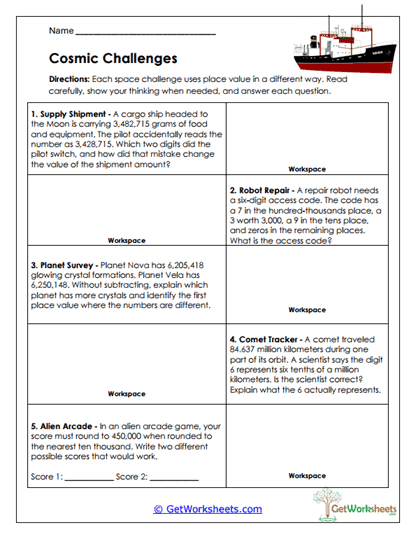
Cosmic Challenges
Space-themed problems ask students to apply place value in less predictable situations. Learners analyze digit values, compare close numbers, reason about digit shifts, and create numbers that meet particular rounding conditions. The variety requires students to decide which place-value idea matters most in each problem. This worksheet works well as enrichment or as a challenge for learners who already understand the basics.
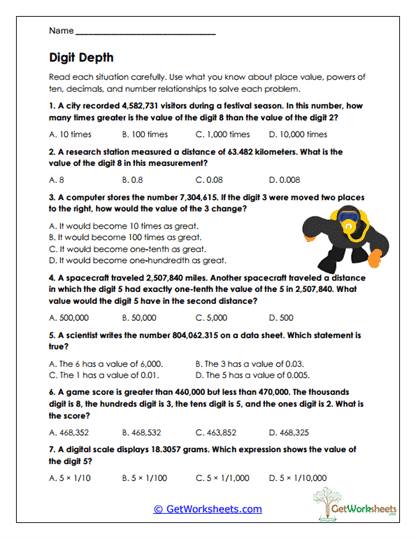
Digit Depth
Advanced questions help students explore how place value connects with powers of ten, large whole numbers, and decimals. Learners compare digit values, reason about moving digits left or right, and identify expressions that represent specific values. Instead of simply naming positions, students think about how one place relates mathematically to another. This strengthens the reasoning needed for later decimal operations, scientific notation, and algebraic thinking. The multiple-choice format also supports assessment practice.
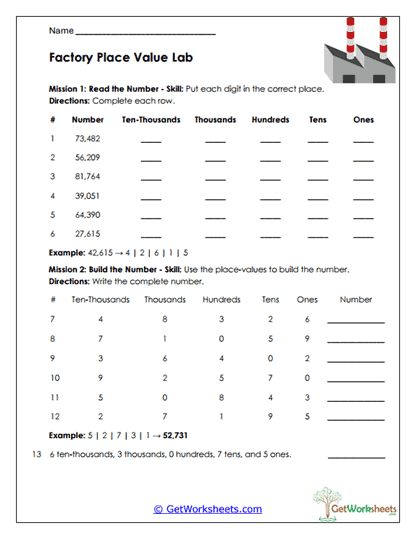
Factory Place Value Lab
A structured place-value chart helps students organize large whole numbers into ten-thousands, thousands, hundreds, tens, and ones. After placing the digits correctly, learners reverse the process by building numbers from place-value clues. The visual format makes each position easier to see and helps clarify the role of placeholder zeros. This activity strengthens both number reading and number construction.
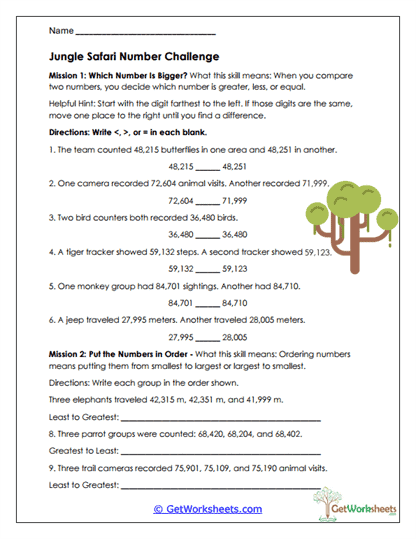
Jungle Safari Number Challenge
Students use place-value reasoning to compare and order large whole numbers. They write comparison symbols between pairs and arrange groups from least to greatest or greatest to least. Looking from the greatest place value toward the right gives learners a dependable strategy for deciding which number is larger. The activity strengthens comparison fluency and overall number magnitude. It also prepares students for later work with rounding and estimation.
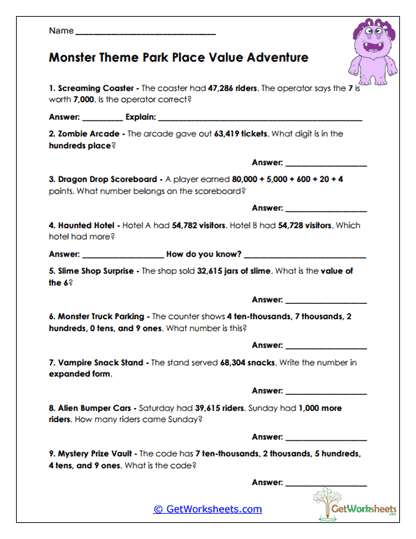
Monster Theme Park Place Value Adventure
Theme-park situations bring several place-value skills together in one lively activity. Learners identify digit values, name places, write expanded form, compare numbers, add place-value amounts, and construct numbers from clues. Because the problem types vary, students must apply the same underlying concept in different ways. This makes the worksheet useful for building flexible understanding rather than rehearsing one routine.
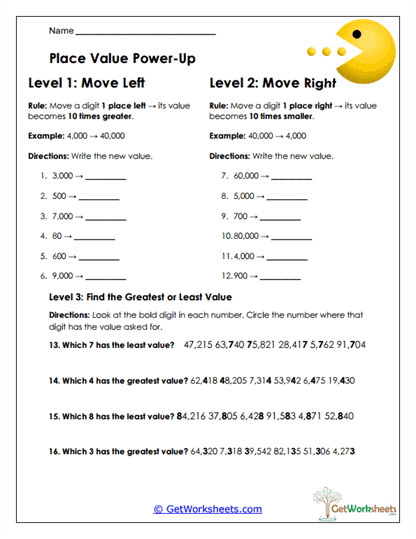
Place Value Power-Up
Students explore the ten-times relationships that connect neighboring place values. Moving a digit one place to the left makes its value ten times greater, while moving one place to the right makes it ten times smaller. Learners also compare the same digit in different numbers to decide where it has the greatest or least value. This activity builds an important bridge between place value and multiplication or division by powers of ten. It is especially useful for students beginning to see the larger pattern of the base-ten system.
Place Value Practice - Multiple Choice
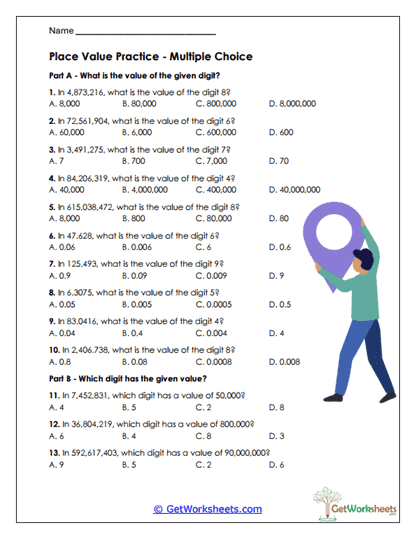
This cumulative multiple-choice review stretches from very large whole numbers into decimal places. Students identify digit values from millions through thousandths and also work backward to determine which digit represents a stated value. Moving across such a wide range reinforces the idea that whole-number and decimal place value belong to the same continuous system. The format also helps learners practice distinguishing among closely related answer choices.
Place Value Review
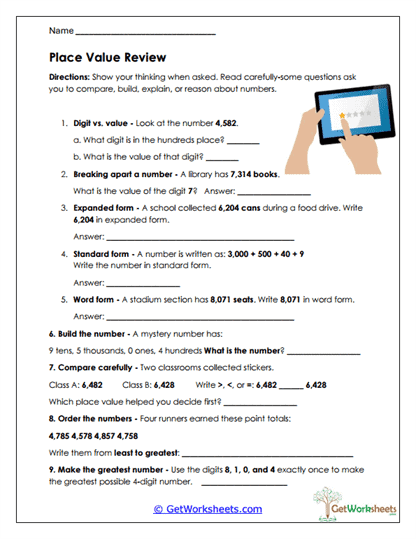
A broad review brings several major place-value skills together on one page. Students work with digit values, expanded form, standard form, word form, number construction, comparison, ordering, and greatest-number challenges. The mixed format requires learners to shift strategies instead of repeating one type of problem. It works well as a final checkpoint or assessment. Teachers and parents can also use the results to identify areas that may need additional review.
Treasure Map Numbers
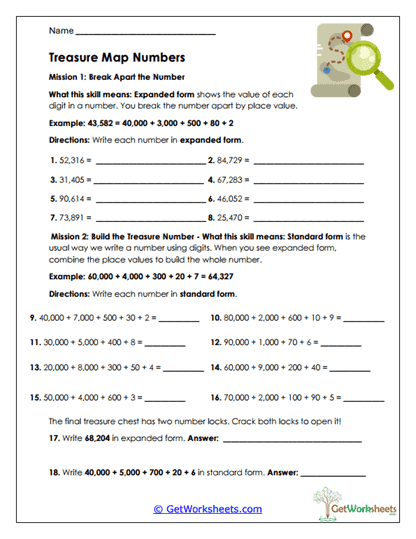
Expanded and standard form are practiced in both directions through a treasure-map theme. Learners first decompose large numbers into the values of their individual digits and then rebuild numbers from separate place-value parts. Working both ways helps students understand how multi-digit numbers are constructed. The activity also reinforces the importance of zero placeholders when a position has no value.
Which Digit Is Worth More?
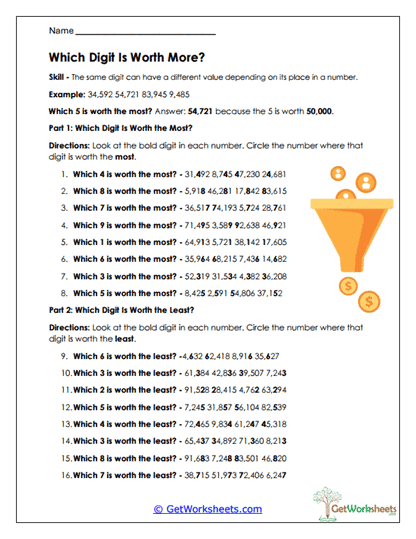
The same digit appears in different positions so students can compare how much its value changes. Learners identify where a highlighted digit is worth the greatest or least amount and use place-value relationships to explain why. Seeing one digit represent 5, 50, 500, or 5,000 makes the power of position especially clear. This practice strengthens comparison and prepares students for working with powers of ten.
Bookmark Us Now!
New, high-quality worksheets are added every week! Do not miss out!