Percent To Decimal
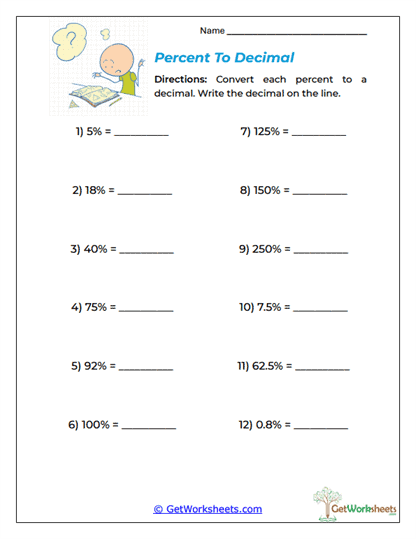
This worksheet reverses the conversion process and asks students to turn percentages into decimals. Students work with familiar percentages such as 5%, 18%, 40%, 75%, 92%, and 100%, then move into more advanced values such as 125%, 150%, 250%, 7.5%, 62.5%, and 0.8%. That variety strengthens percent understanding, decimal place value, division by 100, equivalent values, number magnitude, and conversion fluency while showing students that percentages may be below 1%, equal to 100%, or far above 100%. It is especially useful for grades 5-6 students who need practice reading percentage notation and expressing the same quantity in decimal form.
Key Learning Objectives
- Convert Percents to Decimals: Students learn that dividing by 100, or moving the decimal point two places to the left, changes a percent into a decimal.
- Handle Whole-Number Percents: Values such as 40%, 75%, and 100% give students a strong foundation with common conversions.
- Understand Percents Above 100: Problems such as 125%, 150%, and 250% show that the decimal equivalent can be greater than 1.
- Work With Decimal Percents: Values such as 7.5%, 62.5%, and 0.8% require careful place-value thinking.
Educational Value
- Simple for Parents to Support: Adults can say, “Remove the percent sign and move the decimal two places to the left.”
- Builds Number Sense: Students begin recognizing that 100% equals 1, so anything above 100% must be greater than 1.
- Strengthens Decimal Accuracy: Small percentages help students practice placing zeros correctly when needed.
- Useful for Later Applications: Percent-to-decimal conversion is essential for calculating discounts, taxes, interest, and percent change.
- Works Across Settings: The worksheet fits well into classwork, homework, centers, intervention, review, or homeschool instruction.
This worksheet is valuable because students learn to move comfortably in the opposite direction between two equivalent forms. Percents, decimals, division by 100, place value, equivalence, and number sense all work together as students rewrite each value. For parents, one of the easiest reference points is 100% = 1: from there, 50% is 0.5, 125% is 1.25, and 0.8% is 0.008. Those connections help children understand what the numbers mean instead of simply memorizing a decimal-point trick. In classroom and homeschool settings, this practice builds accuracy and prepares students for the real-world percentage calculations they will encounter later.
Bookmark Us Now!
New, high-quality worksheets are added every week! Do not miss out!