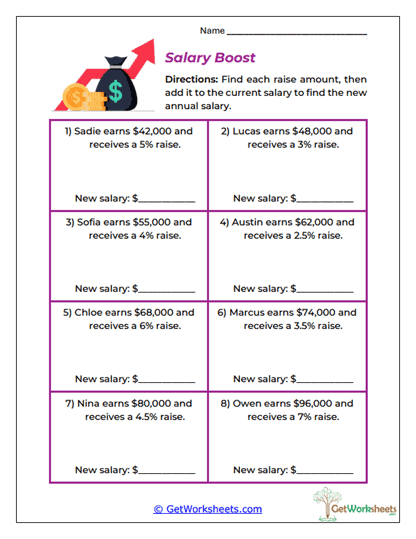
Salary Boost
Salary Boost challenges students to determine updated annual earnings after employees receive percentage-based salary increases. Across eight workplace scenarios, learners first calculate the dollar value of each raise and then add that increase to the original salary to find the employee’s new annual compensation. The activity incorporates percentage multiplication, decimal conversion, addition with monetary values, proportional reasoning, and practical financial problem-solving skills. Appropriate for middle school financial literacy and introductory high school business math, this worksheet builds on foundational percentage knowledge through meaningful, two-step salary calculations.
Skills Reinforced
- Percentage Raise Calculations: Multiply an employee’s current annual salary by the given percentage to determine the amount of the increase.
- Two-Step Financial Problems: Add the calculated raise to the original annual earnings to determine the updated salary.
- Decimal Percentage Operations: Work with whole-number rates and percentages containing decimal values, including 2.5%, 3.5%, and 4.5%.
- Mathematical Reasoning: Evaluate whether an updated salary is reasonable based on the original pay and the size of the increase.
Classroom & Home Use
- Practical Salary Scenarios: Eight employee examples provide realistic opportunities to explore earnings adjustments.
- Multistep Practice: Reinforce the connection between percentage multiplication and addition through a consistent calculation process.
- Independent Skill Application: Students can complete the problems after learning to convert percentages into decimals.
- Flexible Instructional Resource: Suitable for business math lessons, homework assignments, small-group practice, or homeschool learning.
Salary Boost develops students’ ability to interpret percentage raises and calculate the resulting changes in annual compensation. Completing both steps of each problem reinforces arithmetic fluency, decimal multiplication, addition accuracy, financial vocabulary, and organized mathematical thinking. Students also learn to distinguish between the dollar amount of a raise and the employee’s new total salary, an important concept when evaluating changes in earnings. Teachers and parents can extend the activity by discussing employment compensation, salary negotiations, and how percentage increases influence long-term income. These foundational business math skills support future learning about personal budgeting, wage growth, financial projections, and informed money management.
Bookmark Us Now!
New, high-quality worksheets are added every week! Do not miss out!