Raise Check
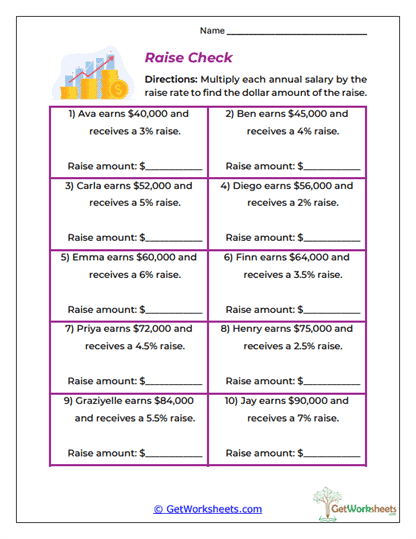
Raise Check introduces students to percentage-based salary increases through ten practical problems involving employees who receive different annual pay raises. Each scenario provides an existing yearly salary and a percentage increase, requiring learners to multiply the salary by the corresponding rate to determine the dollar value of the raise. The problems include whole-number and decimal percentages, reinforcing percentage calculations, decimal multiplication, financial literacy, proportional reasoning, and accurate money computations. Designed for middle school students studying percentages and high school learners exploring business math, this activity connects familiar mathematical operations to realistic workplace compensation decisions.
Key Learning Objectives
- Percentage Increase Calculations: Determine the dollar amount of an employee’s raise by multiplying annual earnings by the percentage expressed as a decimal.
- Decimal Conversion: Translate percentages such as 3.5%, 4.5%, and 5.5% into decimal form before completing calculations.
- Financial Mathematics: Understand how percentage-based salary adjustments translate into actual increases in employee compensation.
- Computational Accuracy: Strengthen multiplication skills and verify the reasonableness of calculated raise amounts.
Educational Value
- Realistic Workplace Examples: Ten employee scenarios show how varying salaries and percentage rates influence raise amounts.
- Progressive Mathematical Practice: Problems involving whole-number percentages and fractional percentage rates provide opportunities for increasingly precise calculations.
- Focused Skill Development: Students concentrate on finding the raise amount rather than calculating a new annual salary.
- Classroom and Home Flexibility: Use for percentage lessons, financial literacy practice, homework, tutoring, or independent review.
Raise Check helps learners understand that the financial impact of a percentage increase depends on both the original salary and the rate of the raise. As students calculate different salary adjustments, they reinforce decimal operations, percent conversions, multiplication fluency, estimation, and financial reasoning. Comparing employee situations can encourage discussions about why identical percentage increases may produce different dollar amounts. Teachers and parents can use these examples to connect arithmetic practice with compensation planning, workplace mathematics, and personal finance. Mastering these calculations prepares students for more advanced applications involving salary growth, commission rates, percentage changes, and financial decision-making.
Bookmark Us Now!
New, high-quality worksheets are added every week! Do not miss out!