Fixed or Flexible Cost
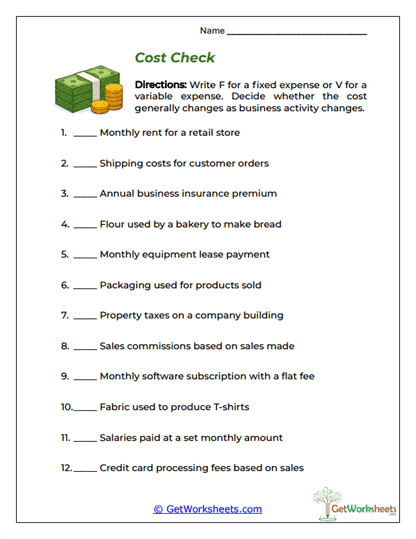
The Fixed or Flexible Cost Worksheet helps students learn the difference between expenses that usually stay about the same and expenses that change depending on how much a business produces or sells. Students examine examples such as monthly rent, shipping costs, insurance premiums, bakery ingredients, equipment leases, packaging, property taxes, sales commissions, software subscriptions, fabric, salaries, and credit-card processing fees, then label each expense as fixed or variable. This is especially useful for grades 7-9 because students are beginning to see that not every cost behaves the same way. For parents, the simple explanation is that some bills stay pretty steady every month, while others get bigger or smaller depending on how busy the business is.
Key Learning Objectives
- Identify Fixed Expenses: Students recognize costs that generally do not change much with sales or production.
- Identify Variable Expenses: Learners spot expenses that rise or fall as business activity changes.
- Connect Costs to Business Activity: Students think about what happens to an expense when the company sells or produces more.
- Strengthen Financial Reasoning: The activity asks students to understand the behavior of a cost instead of just memorizing a definition.
Classroom & Home Use
- Builds an Important Business Concept: Fixed and variable costs are basic ideas in budgeting, pricing, and profit analysis.
- Encourages Real Reasoning: Students have to think about whether the cost changes when business activity changes.
- Easy for Parents to Discuss: Families can compare a fixed monthly rent payment with a supply cost that grows when more products are made.
- Useful for Business Math: The worksheet fits entrepreneurship, accounting basics, consumer math, or homeschool lessons.
Students reinforce fixed costs, variable costs, business expenses, cost behavior, financial planning, and budget reasoning while classifying each example. This matters because a business needs to know which costs will stay in place even during a slow month and which ones will change with sales. In the classroom, teachers can ask students, “If the company sold twice as much next month, would this expense probably change?” At home, parents can compare the idea to household costs such as a fixed rent payment versus groceries that may change depending on how much the family buys. That makes the difference much easier to grasp. With practice, students become more comfortable thinking about how business expenses behave over time.
Bookmark Us Now!
New, high-quality worksheets are added every week! Do not miss out!