Balance Trail
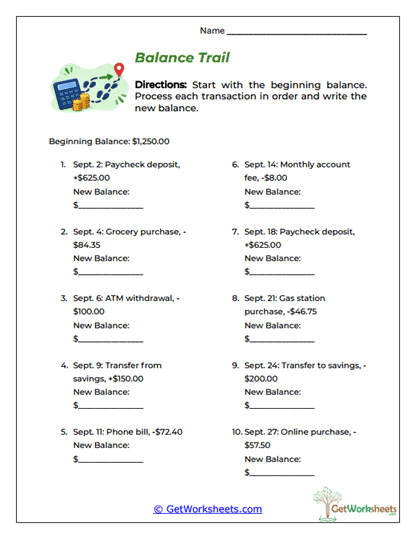
The Balance Trail Worksheet teaches students how a bank balance changes one transaction at a time. Students begin with a starting balance, then process a sequence of deposits, purchases, ATM withdrawals, transfers, fees, and other expenses, writing a new balance after every step. This is a strong fit for grades 6-8 because it combines decimal addition and subtraction with a realistic financial situation where mistakes can build if students lose track of the running total. For parents, the big idea is straightforward: this is like keeping score of a checking account-money coming in raises the balance, and money going out lowers it.
Targeted Skills
- Maintain a Running Balance: Students update the account total after each transaction in chronological order.
- Add Deposits Correctly: Learners recognize when money should increase the available balance.
- Subtract Expenses and Fees: Students accurately remove purchases, withdrawals, transfers, and charges.
- Work with Money Decimals: The activity reinforces careful computation with dollars and cents.
Learning Benefits
- Shows Why Order Matters: Students see that every new balance depends on the result from the transaction before it.
- Builds Financial Awareness: Learners understand how several small expenses can affect an account over time.
- Supports Error Checking: A wrong balance early in the sequence makes later answers harder, encouraging students to check their work carefully.
- Works at School or Home: The page fits business math, financial literacy, tutoring, homework, or homeschool instruction.
Students strengthen running balances, money addition, money subtraction, transaction order, account management, and financial reasoning while following the balance trail. This matters because keeping track of a checking account requires more than knowing how to add and subtract; people also have to pay attention to the order in which transactions occur. In the classroom, teachers can model the first transaction and emphasize that each new total becomes the starting point for the next step. At home, parents can compare it to keeping track of money in a wallet after getting paid and making several purchases. That real-life connection makes the math much easier to understand. With practice, students become more accurate with decimals and more confident managing everyday money situations.
Bookmark Us Now!
New, high-quality worksheets are added every week! Do not miss out!