Bank Statement Quest
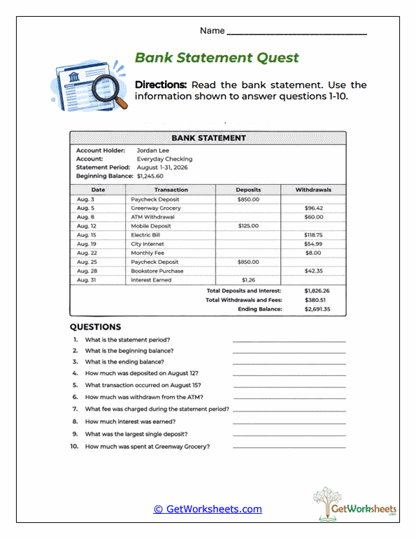
The Bank Statement Quest Worksheet helps students learn how to read a real-looking bank statement and make sense of what is happening to an account over time. Students examine the statement period, beginning balance, deposits, withdrawals, interest, and ending balance, then answer questions using the transaction history instead of guessing. This is a strong fit for grades 6-8 because students are beginning to connect addition and subtraction with practical money situations they may eventually see in their own lives. For parents, the value is pretty simple: this worksheet teaches kids how to look at a financial document and actually understand where the money came from, where it went, and what was left at the end.
Learning Goals
- Read a Bank Statement: Students identify important parts of a statement, including dates, balances, deposits, withdrawals, and transaction descriptions.
- Track Account Activity: Learners follow money moving into and out of an account across several transactions.
- Answer Financial Questions: Students use the statement as evidence to find specific amounts, dates, and account changes.
- Strengthen Money Math: The activity reinforces addition, subtraction, comparison, and careful reading in a practical setting.
Teaching Advantages
- Builds Real-Life Financial Literacy: Students practice with a document that closely resembles something adults actually use.
- Easy for Parents to Talk Through: Families can ask, “Was money added here or taken away?” while moving down the statement.
- Supports Reading and Math Together: Students must understand both the transaction description and the amount.
- Low-Prep Practical Practice: The worksheet works well for business math, financial literacy, homeschool lessons, or independent review.
Students strengthen bank statement reading, deposits, withdrawals, balances, interest, and transaction analysis while answering the questions. This matters because knowing how to read financial records is a basic life skill, not just a school exercise. In the classroom, teachers can have students point to the exact row that supports each answer. At home, parents can explain that every transaction changes the account in some way, and the statement is the record of those changes. That kind of discussion helps money math feel real and useful. With practice, students become more confident reading account activity, checking balances, and making sense of everyday banking information.
Bookmark Us Now!
New, high-quality worksheets are added every week! Do not miss out!