Back to School Shopping
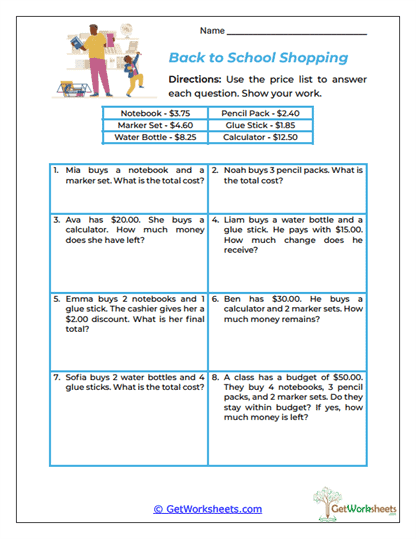
Back to School Shopping helps students apply decimal operations to realistic purchases, budgets, discounts, and change. Students use a school-supply price list to add several costs, multiply when buying multiples of the same item, subtract purchases from available money, and decide whether a shopper stays within a budget. The worksheet strengthens decimal addition, subtraction, multiplication, money math, budgeting, multi-step problem solving, and financial reasoning. It is especially useful for students in grades 5-6 who know how to calculate with decimals but need practice deciding how those operations work together in everyday situations.
Learning Goals
- Add several prices: Students combine the costs of different school supplies to find a total purchase.
- Multiply repeated costs: Learners find totals when two or more of the same item are purchased.
- Calculate change: Students subtract a purchase amount from the money given.
- Work within a budget: Children decide whether a list of purchases can be afforded and determine how much money remains.
How This Helps
- Makes decimal math practical: Students can immediately understand why accurate decimal calculations matter when dealing with money.
- Supports parent guidance: Adults can ask, “What do we need to total first, and what do we subtract afterward?”
- Builds multi-step thinking: Some questions require more than one operation before the final answer can be found.
- Encourages financial awareness: Learners practice spending, budgeting, and comparing costs.
- No-prep format: The price list and questions are ready for classroom, tutoring, homework, or homeschool use.
Shopping problems are a helpful way to show students that mixed decimal operations are not just school exercises. If someone buys several items, the costs may first need to be added or multiplied, and then that total may need to be subtracted from a budget. The worksheet also gives children a natural reason to pay attention to decimal places because an error can change dollars into cents or make a budget decision incorrect. As learners work, they strengthen decimal fluency, operation choice, money sense, multi-step reasoning, and confidence. In classroom and homeschool settings, this activity reinforces practical skills students can use when shopping, saving, and managing money.
Bookmark Us Now!
New, high-quality worksheets are added every week! Do not miss out!