Rounding Decisions
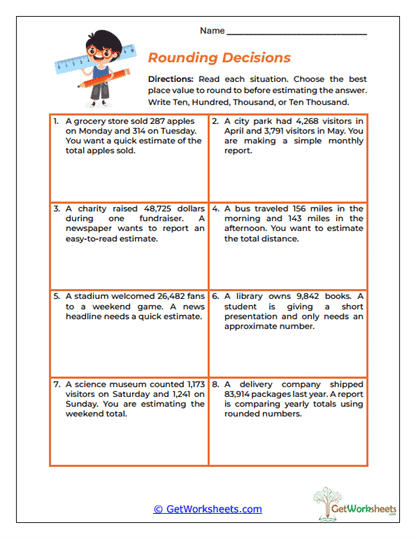
This worksheet asks students to do something more advanced than simply follow a rounding direction: they must decide which place value is most useful for the situation. Students read real-world scenarios involving grocery sales, city reports, charity totals, bus travel, stadium attendance, library books, museum visitors, and shipping counts, then choose whether rounding to the nearest ten, hundred, thousand, or ten thousand makes the most sense. That decision-making process develops rounding, place value, estimation, number sense, magnitude, real-world reasoning, and mathematical judgment while showing students that the “best” rounded number depends on what the information will be used for. It is especially appropriate for grades 4-5 students who already know how to round and are ready to think about why one level of precision may be better than another.
Targeted Skills
- Choose the Rounding Place: Students decide whether tens, hundreds, thousands, or ten-thousands best match the purpose of each estimate.
- Think About Precision: Learners consider whether a situation needs a close estimate or only a broad, easy-to-read number.
- Use Place Value Strategically: Students connect the size of the original number with the level of rounding that makes sense.
- Apply Math to Communication: The worksheet shows why people may round differently when reporting travel, attendance, money, inventory, or city data.
Instructional Benefits
- Builds Independent Thinking: Students are not told exactly where to round, so they must make a meaningful mathematical decision.
- Great for Parent Conversation: Ask, “Do we need a very close estimate here, or just a simple big-picture number?”
- Connects Math to Real Reporting: Newspaper totals, city reports, shipping summaries, and event attendance give rounding a clear purpose.
- Supports Higher-Level Reasoning: Students move beyond procedures and begin thinking about accuracy, usefulness, and audience.
- Excellent for Review or Enrichment: The worksheet works well for classwork, small groups, homework, assessment, or homeschool practice.
The biggest lesson in this worksheet is that rounding is not always about blindly looking at the digit next door. Place value, estimation, rounding, precision, number magnitude, number sense, and real-world reasoning all work together as students decide how much detail a situation really needs. For parents, a helpful comparison is that reporting 26,482 stadium fans might call for a broad rounded number, while estimating a short bus trip may need much less rounding. Students begin to understand that good estimation means balancing simplicity with usefulness. In classroom and homeschool settings, this activity builds stronger mathematical judgment and helps children become more confident deciding not just how to round, but why a particular rounding choice makes sense.
Bookmark Us Now!
New, high-quality worksheets are added every week! Do not miss out!