Reasonable Numbers
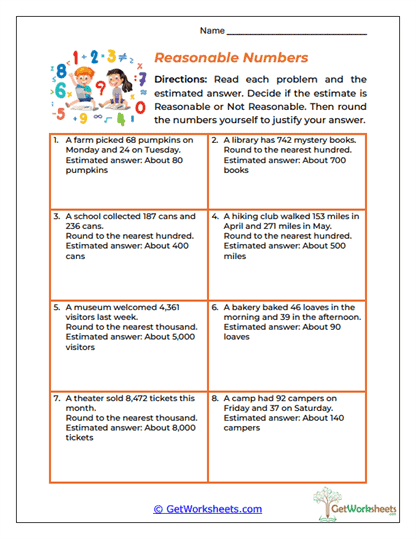
This worksheet asks students to become the judge of each estimate by deciding whether a proposed answer is reasonable and then using rounding to justify that decision. Students read short situations about pumpkins, library books, school collections, hiking distances, museum visitors, bakery production, theater tickets, and camp attendance, with estimates ranging from tens to thousands. To decide whether each answer makes sense, learners must use rounding, place value, number magnitude, estimation, comparison, mental math, and written reasoning rather than simply trusting the number provided. It is a strong grades 3-5 worksheet for students who have learned how to round and are ready to explain why an estimate is believable-or why it needs to be corrected.
Key Learning Objectives
- Judge Estimate Reasonableness: Students determine whether the proposed answer is close enough to the original values to make mathematical sense.
- Use Rounding as Evidence: Learners round the numbers themselves to support their Yes or No decision.
- Explain Mathematical Thinking: Students justify their answer rather than stopping after labeling an estimate reasonable or unreasonable.
- Strengthen Magnitude Sense: Comparing quantities in the tens, hundreds, and thousands helps students recognize when an estimate is far outside the expected range.
Instructional Benefits
- Great for Parent Conversations: Adults can ask, “What would these numbers round to, and does the proposed estimate land nearby?”
- Builds More Than Procedure: Students have to defend an answer instead of simply repeating a rounding rule.
- Encourages Error Detection: Unreasonable estimates become useful examples that students can analyze and repair.
- Supports Mathematical Language: Explaining why an estimate works helps children communicate place-value and rounding ideas clearly.
- Useful for Review or Assessment: Teachers can see whether students truly understand estimation rather than only knowing how to follow steps.
The important lesson here is that an estimate should not be accepted just because someone wrote “about” in front of it. Rounding, place value, reasonableness, estimation, number magnitude, comparison, mental math, and mathematical explanation all work together as students test each proposed answer. For parents, this is a helpful chance to move beyond asking, “What did you get?” and instead ask, “Why does that answer make sense?” A child who can explain that 4,361 visitors is about 4,000 has demonstrated a deeper understanding than a child who simply circles a choice. In classroom and homeschool settings, this activity strengthens estimation judgment, self-checking habits, and the confidence to question a number that does not fit.
Bookmark Us Now!
New, high-quality worksheets are added every week! Do not miss out!