Reciprocal Reasoning
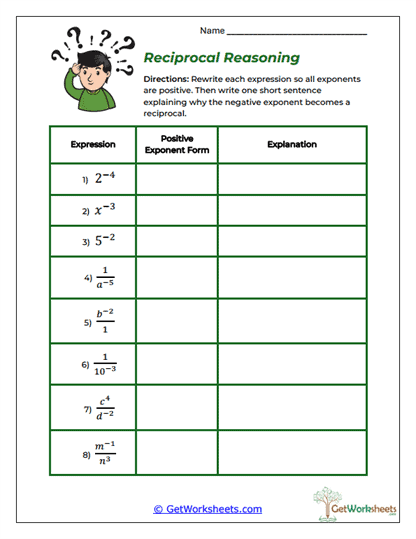
The Reciprocal Reasoning Worksheet asks students to rewrite expressions so that all powers are positive and then explain why the negative power turns into a reciprocal. Students work with fractions, variables, numerators, denominators, reciprocal forms, and positive powers, then add a short written explanation for each result. This is especially useful for grades 6-7 because it combines procedural skill with mathematical reasoning instead of letting students copy a rule without understanding it. For parents, the worksheet gives children a chance to explain the idea in their own words, which makes it much easier to tell whether they really understand what is happening.
Key Learning Objectives
- Rewrite with Positive Powers: Students move factors to the correct side of the fraction bar so no negative powers remain.
- Explain Reciprocal Changes: Learners describe why a factor changes location when the power changes sign.
- Use Mathematical Vocabulary: Students practice terms such as reciprocal, numerator, denominator, base, and positive power.
- Connect Procedure and Meaning: The activity reinforces both how to rewrite the expression and why the rule works.
Instructional Support
- Builds Deeper Understanding: Written explanations make students think beyond a memorized shortcut.
- Supports Math Communication: Students practice putting a symbolic process into clear words.
- Helpful for Assessment: Teachers can see whether a correct answer is backed by real understanding.
- Parent-Friendly Discussion: Families can ask students to explain why the factor moved before they write the sentence.
Students strengthen their understanding of reciprocals, positive powers, negative powers, fraction structure, variables, and mathematical reasoning by explaining each transformation. This is valuable because students who can explain a rule are more likely to remember it and use it correctly in unfamiliar expressions. In the classroom, teachers can use the written reasoning to uncover confusion that a correct final answer might hide. At home, parents can ask children to explain what changed and why the value stayed the same. That conversation builds comprehension, communication, and confidence. Over time, students become more independent and much better prepared for advanced algebraic fractions.
Bookmark Us Now!
New, high-quality worksheets are added every week! Do not miss out!