Reciprocal Pairs
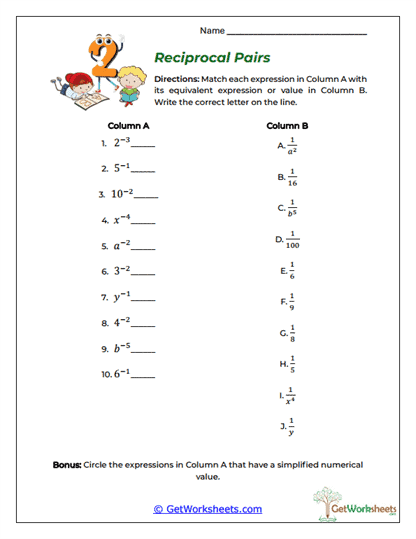
The Reciprocal Pairs Worksheet helps students connect negative powers to their equivalent positive-power or fractional forms through a matching activity. Students examine each expression, identify the base, read the negative power, and match it with the correct reciprocal, fraction, or positive-power form. This is a strong fit for grades 6-7 because it gives students practice recognizing equivalence without always having to compute the numerical value. For parents, the matching format makes the rule easier to reinforce because the child can look for the same base and then decide where the factor belongs.
Targeted Skills
- Match Equivalent Expressions: Students connect negative-power forms with mathematically equal reciprocal expressions.
- Recognize Positive-Power Forms: Learners rewrite or identify the matching fraction that uses a positive power.
- Compare Numerical and Variable Bases: Students work with both numbers and letters so the rule is not tied to only one kind of example.
- Build Fast Recognition: The matching activity helps students identify reciprocal relationships more quickly.
Learning Benefits
- Adds Variety to Practice: Matching gives students a break from a full page of standard computation.
- Encourages Careful Comparison: Learners must look closely at the base and power before choosing a partner expression.
- Useful for Partner Work: The activity works well for centers, tutoring, review, or small-group practice.
- Easy for Parents to Support: Families can ask, “What would this look like if the power were positive?”
Students strengthen their understanding of reciprocal relationships, negative powers, positive powers, fractions, equivalent expressions, and bases by pairing expressions that mean the same thing. This is valuable because students need to recognize these relationships quickly before they can handle more complicated algebraic fractions. In the classroom, teachers can use the worksheet as review, partner practice, or a quick check for understanding. At home, parents can help by having children say the rule aloud before making each match. That verbal step reinforces the connection between the sign of the power and the location of the factor. With repeated practice, students build fluency, confidence, and a clearer understanding of how reciprocal forms work.
Bookmark Us Now!
New, high-quality worksheets are added every week! Do not miss out!