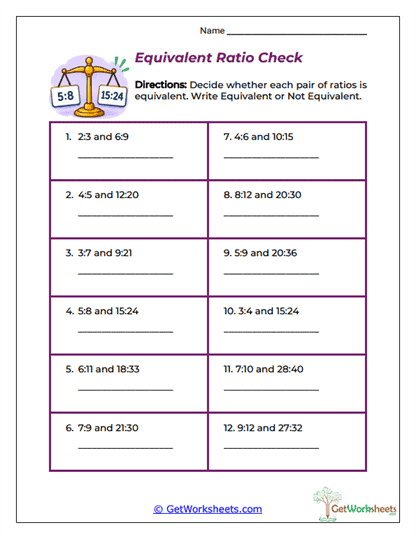
Equivalent Ratio Check
This worksheet asks students to look at pairs of ratios and decide whether they are Equivalent or Not Equivalent. The ratios are written in colon form, such as 2:3 and 6:9 or 4:5 and 12:20, so students must compare the relationship between the two numbers rather than just look at whether the values are larger or smaller. The activity strengthens equivalent-ratio reasoning, multiplication and division, scale-factor thinking, and mathematical checking. It is especially useful because it teaches students that two ratios can look very different on the surface and still represent the same relationship-or look similar and still fail to match.
For a parent, the easiest way to explain this is to ask whether both parts of the ratio were changed by the same factor. For example, 2:3 becomes 6:9 by multiplying both numbers by 3, so those ratios are equivalent. But 4:5 and 12:20 are not equivalent because 4 was multiplied by 3 while 5 was multiplied by 4. The relationship changed.
Learning Goals
- Check Ratio Equivalence: Students decide whether two ratios represent the same relationship.
- Use Scale Factors: Learners look for a common multiplier or divisor.
- Strengthen Simplification: Students can reduce larger ratios to compare them with smaller ones.
- Build Mathematical Judgment: Learners make a clear Equivalent or Not Equivalent decision.
- Prepare for Proportions: Understanding equivalence is the foundation for proportion equations.
Parent-Friendly Teaching Tips
Use this routine:
- Look at the first number in each ratio.
- Ask what factor changes one into the other.
- Try that same factor on the second number.
- If it works for both, the ratios are equivalent.
- If it does not, they are not equivalent.
For example:
2:3 and 6:9
2 × 3 = 6
3 × 3 = 9
So they are Equivalent.
But:
4:5 and 12:20
4 × 3 = 12
5 × 3 = 15, not 20
So they are Not Equivalent.
Why This Worksheet Helps
- Builds Reasoning Instead of Guessing: Students must justify why ratios match or do not match.
- Strengthens Scale-Factor Thinking: Learners become more comfortable with multiplicative relationships.
- Supports Fraction and Proportion Work: Equivalent ratios behave much like equivalent fractions.
- Encourages Careful Checking: Students learn that both parts must change in the same way.
- Prepares for More Advanced Ratio Problems: This skill is essential for solving proportions and rate problems.
The real value of this worksheet is that it helps students understand that equivalent ratios are about a consistent relationship, not just similar-looking numbers. Multiplication, division, scale factors, simplification, and ratio comparison all work together. For parents, the best reminder is: “Did both numbers change by the same factor?” In classroom and homeschool settings, this worksheet gives students a strong way to test and explain ratio equivalence.
Bookmark Us Now!
New, high-quality worksheets are added every week! Do not miss out!