Ratio Partners
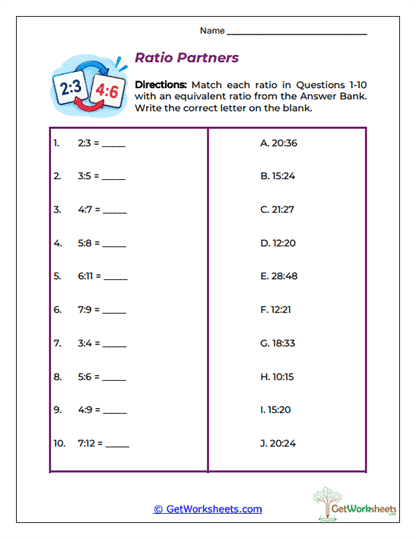
This worksheet gives students straightforward practice recognizing equivalent ratios by matching each ratio on the left with a ratio from the answer bank that represents the same relationship. Students work with pairs such as 2:3, 3:5, 4:7, and 5:8, then look for scaled versions like 12:18, 15:25, or 20:32. The activity strengthens ratio sense, multiplication, simplification, and pattern recognition while helping students understand that equivalent ratios may look different but still describe the same comparison.
For a parent who may not remember ratio rules very well, the easiest way to explain this is: both parts of the ratio must be multiplied or divided by the same number. For example, 2:3 can become 12:18 because both 2 and 3 were multiplied by 6. If only one side changes, then the ratio is no longer equivalent.
Learning Goals
- Recognize Equivalent Ratios: Students identify ratios that represent the same relationship.
- Use Multiplication Patterns: Learners look for a common scale factor between both parts of the ratio.
- Simplify When Needed: Students can reduce larger ratios to see whether they match a simpler one.
- Build Ratio Fluency: Learners become faster at spotting proportional relationships.
- Strengthen Matching Skills: Students connect each original ratio with one correct partner.
Parent-Friendly Teaching Tips
A good question is:
“What did the first number get multiplied by, and did the second number get multiplied by the same amount?”
For example:
2:3 → 12:18
2 × 6 = 12
3 × 6 = 18
So the ratios are equivalent.
You can also work backward by simplifying 12:18. Divide both numbers by 6 and you get 2:3.
Why This Worksheet Helps
- Makes Equivalent Ratios Concrete: Students see many different forms of the same relationship.
- Builds Scale-Factor Thinking: Learners begin noticing the multiplier that connects two ratios.
- Prepares for Proportions: Equivalent ratios are the foundation of proportion equations.
- Supports Mental Math: Students practice multiplication and division in a meaningful context.
- Encourages Self-Checking: If both parts do not change by the same factor, the match is probably wrong.
The main value of this worksheet is that it helps students understand that a ratio can grow or shrink without changing its underlying relationship. Multiplication, division, scaling, simplification, and proportional reasoning all work together. For parents, the best reminder is: “Whatever you do to one part of the ratio, do the same thing to the other.” In classroom and homeschool settings, this worksheet gives students a strong foundation for equivalent ratios and later proportion work.
Bookmark Us Now!
New, high-quality worksheets are added every week! Do not miss out!