Ratio Fill-In
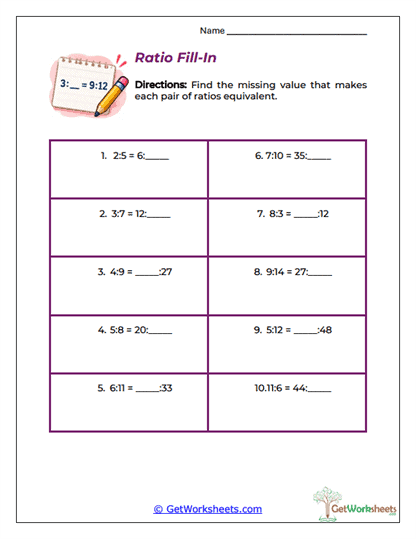
This worksheet asks students to find the missing number that makes two ratios equivalent. Problems include forms such as 2:5 = 6:, 3:7 = 12:, 4:9 = :27, and 7:10 = 35:. The activity helps students see that if one part of a ratio is scaled up or down, the matching part must be changed by the same factor. This strengthens ratio fluency, multiplication, division, scale factors, and proportional reasoning while giving students direct practice with the kind of missing-value questions they will see later in proportions.
For a parent, the easiest way to explain this worksheet is to ask: “What happened to the number we know?” If 2 becomes 6, that means it was multiplied by 3. So 5 must also be multiplied by 3, giving 15. The same thinking works whether the blank is in the first or second part of the ratio.
Key Learning Objectives
- Find Missing Ratio Values: Students determine the number needed to keep two ratios equivalent.
- Use Scale Factors: Learners identify how one known term changed.
- Apply the Same Change to Both Parts: Students preserve the ratio relationship.
- Work Forward and Backward: Learners use multiplication when scaling up and division when scaling down.
- Prepare for Proportion Solving: Missing-value ratios are a direct bridge to equations with variables.
Parent-Friendly Explanation
Use this simple routine:
- Find the pair of matching known numbers.
- Ask what multiplication or division connects them.
- Apply that same operation to the other part.
- Fill in the missing number.
For example:
2:5 = 6:___
2 × 3 = 6
So:
5 × 3 = 15
The missing number is 15.
Another example:
4:9 = ___:27
9 × 3 = 27
So:
4 × 3 = 12
The missing number is 12.
Why This Worksheet Helps
- Builds Direct Proportion Sense: Students see how one missing value can be found from the other three.
- Strengthens Multiplication and Division: The skill is practiced in a meaningful context.
- Prepares for Algebra: The blank acts like an unknown variable.
- Encourages Pattern Recognition: Students learn to look for scaling relationships quickly.
- Supports Confidence: The problems are structured and predictable once the scale factor is found.
Classroom & Home Use
- Great for Guided Practice: Parents or teachers can model the scale factor on the first few problems.
- Helpful for Struggling Students: The colon notation keeps the focus on ratios rather than fractions.
- Useful for Homework: The process is easy to explain and check.
- Good for Homeschooling: Families can create extra examples by multiplying both parts of a ratio by the same number.
- Strong for Review: The worksheet reinforces the core equivalent-ratio rule in a very direct way.
The real value of this worksheet is that it teaches students that every equivalent ratio is built by changing both parts together. Scale factors, multiplication, division, missing values, and ratio relationships all work together. For parents, the best question is: “What happened to one side, and did you do the same thing to the other?” In classroom and homeschool settings, this worksheet gives students a strong bridge from equivalent ratios to full proportion solving.
Bookmark Us Now!
New, high-quality worksheets are added every week! Do not miss out!