Whole Hunt
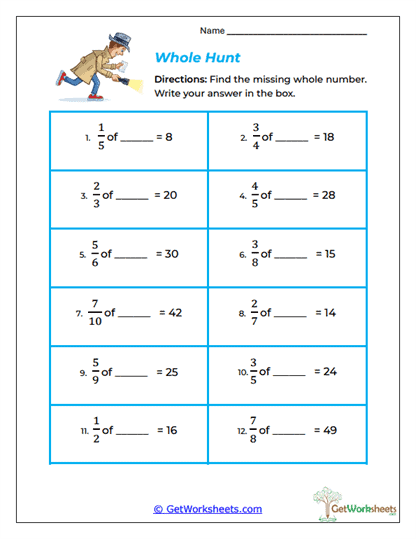
Students solve twelve fraction equations in which the whole number is missing. Each problem provides a fraction of an unknown number and its value, so learners must work backward to determine the original whole. This upper-elementary worksheet strengthens inverse operations, fraction reasoning, multiplication, division, missing-number equations, and mathematical problem solving. It is especially appropriate for grades 4-5 because students must reverse the usual fraction-of-a-number process instead of simply finding a part.
Learning Goals
- Identify the Known Part: Students recognize the fraction and the value already provided in each equation.
- Find One Fractional Unit: Learners divide the known value by the numerator to determine the value of one equal part.
- Rebuild the Whole: Children multiply the unit value by the denominator to find the missing number.
- Check the Result: Students substitute the whole back into the original equation to confirm that it works.
How This Helps
- Builds Reverse Thinking: Students learn that mathematical operations can be undone in a logical order.
- Supports Algebra Readiness: Missing-number equations prepare learners for later work with variables and inverse operations.
- Easy for Parents to Explain: Adults can say, “Find one part first, then put all the equal parts back together.”
- Encourages Organized Work: The repeated format helps students practice one dependable method.
- Ready for Immediate Use: The worksheet fits guided math, independent practice, tutoring, intervention, homework, or homeschool lessons.
Many students know how to find three-fourths of twenty-four but become unsure when three-fourths of a mystery number equals eighteen. This worksheet helps them see that the original whole can be rebuilt from the known fractional part. Students strengthen fraction sense, inverse operations, division, multiplication, equation reasoning, accuracy, and self-checking through twelve structured problems. Parents can encourage children to draw equal boxes when the numbers feel confusing and place the known value across the number of parts named by the numerator. In classroom and homeschool settings, this activity builds confidence and helps learners understand fraction relationships from both directions.
Bookmark Us Now!
New, high-quality worksheets are added every week! Do not miss out!