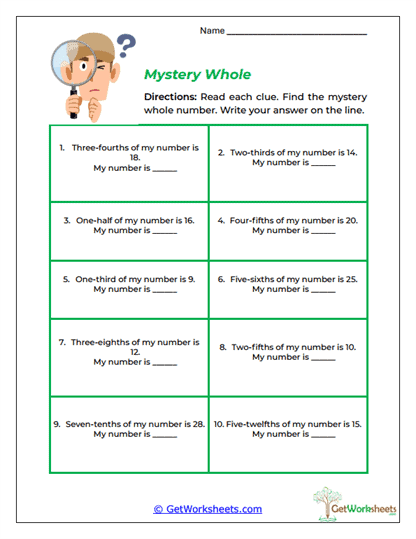
Mystery Whole
Students read ten clues in which a fraction of an unknown number is given, then work backward to find the complete whole. Problems include statements such as three-fourths of a number equals eighteen or five-sixths of a number equals twenty-five. This upper-elementary worksheet strengthens inverse operations, fraction-of-a-number reasoning, multiplication, division, equation sense, and problem solving. It is especially appropriate for grades 4-5 because students must reverse the usual process and determine the starting number rather than the fractional result.
Learning Goals
- Identify the Known Information: Students locate the fraction and the partial value provided in each clue.
- Find One Equal Part: Learners divide the known value by the numerator to determine the size of one fractional part.
- Rebuild the Whole: Children multiply the value of one part by the denominator to find the mystery number.
- Check the Solution: Students substitute the whole number back into the original clue to confirm that the fraction produces the stated value.
How This Helps
- Builds Reverse Reasoning: Students learn to undo a fraction calculation instead of always following the same forward procedure.
- Supports Equation Thinking: Each clue can be represented as a missing-number equation.
- Easy for Parents to Explain: Adults can say, “First find one part, then use the denominator to rebuild all the parts.”
- Prepares Students for Algebra: Working backward from a result supports later study of variables and inverse operations.
- Ready for Immediate Use: The worksheet fits guided practice, review, intervention, tutoring, homework, or homeschool instruction.
Many children know how to find three-fourths of twenty-four but become unsure when told that three-fourths of an unknown number is eighteen. This worksheet teaches them to reverse the steps in a logical and organized way. Students strengthen fraction sense, inverse operations, multiplication, division, equation reasoning, accuracy, and self-checking through ten varied clues. Parents can encourage children to draw equal boxes when the numbers feel confusing, placing the known amount across the numerator’s number of boxes first. In classroom and homeschool settings, this activity builds confidence and helps students understand that mathematical operations can be used both forward and backward.
Bookmark Us Now!
New, high-quality worksheets are added every week! Do not miss out!