Scientific to Standard
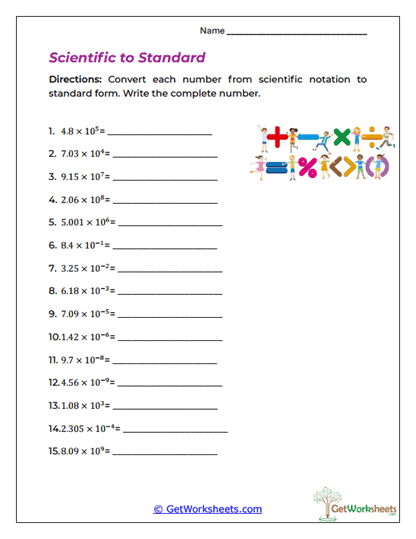
The Scientific to Standard Worksheet reverses the conversion process by asking students to turn compact scientific notation into the full number it represents. Students read the coefficient, examine the power of ten, use the sign and size of the power to determine decimal movement, and then write the complete number in standard form. This is especially useful for grades 6-8 because students need to be able to move freely in both directions rather than learning scientific notation as a one-way trick. For parents, a helpful way to explain the skill is that the power tells students how far the digits need to shift so the shortened number can be expanded back into its ordinary form.
Key Learning Objectives
- Convert to Standard Form: Students expand scientific notation into complete whole numbers or decimals.
- Interpret Positive Powers: Learners recognize that positive powers represent values scaled to larger place-value positions.
- Interpret Negative Powers: Students understand that negative powers represent values smaller than one.
- Place Zeros Correctly: Learners use place value to fill empty positions accurately during the conversion.
Instructional Benefits
- Reinforces Both Directions: This worksheet balances earlier practice converting standard numbers into scientific form.
- Targets Decimal Placement: Students get focused practice deciding exactly where the decimal belongs.
- Supports Self-Checking: Learners can ask whether a positive power should create a larger value and a negative power a smaller one.
- Works at School or Home: The page is useful for direct practice, homework, review, tutoring, or homeschool lessons.
Students reinforce standard form, scientific notation, powers of ten, positive powers, negative powers, and decimal place value through repeated conversion practice. This matters because students who can only convert in one direction often struggle when scientific notation appears in science or algebra problems. In the classroom, teachers can use the worksheet to see whether learners understand the meaning of the power rather than simply memorizing a direction for moving the decimal. At home, parents can ask whether the final number should be much larger than 1 or much smaller than 1 before the child writes the answer. That prediction helps catch common mistakes. With practice, students develop stronger fluency, better accuracy, and greater confidence moving between compact and expanded number forms.
Bookmark Us Now!
New, high-quality worksheets are added every week! Do not miss out!