Rounding Pairs
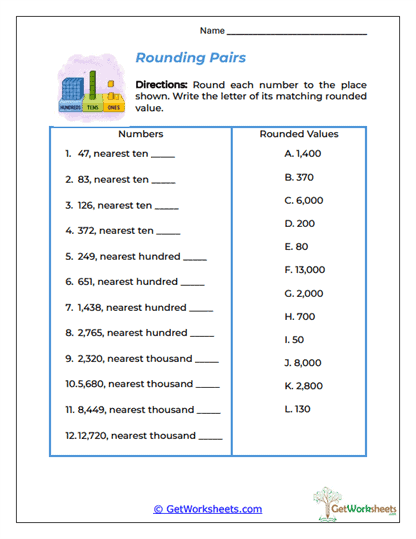
This worksheet turns rounding practice into a matching challenge where students must connect each original number with the correct rounded value from an answer bank. Students work with values rounded to the nearest ten, hundred, and thousand, using numbers that range from simple two-digit examples to five-digit values such as 12,720. The matching format strengthens rounding, place value, benchmark values, number magnitude, estimation, comparison, mental math, and self-checking while making the practice feel more like solving a set of clues than completing a plain list of exercises. It is especially useful for grades 3-5 students who already know the basic rounding process and are ready to switch between place values while working more independently.
Targeted Skills
- Round Across Several Places: Students move between nearest-ten, nearest-hundred, and nearest-thousand problems throughout the page.
- Match to the Correct Estimate: Learners find the rounded result in a separate answer bank and record the corresponding letter.
- Use Number Magnitude: Students think about whether an answer should land in the tens, hundreds, thousands, or ten-thousands.
- Check Through Elimination: As matches are used, the remaining choices give students another way to notice and correct mistakes.
Instructional Benefits
- Adds a Puzzle-Like Feel: The matching design gives students a goal beyond simply writing one rounded number after another.
- Parent-Friendly Routine: Families can ask, “What does this number round to, and which letter in the answer bank matches?”
- Encourages Careful Reading: Since the target place changes from problem to problem, students cannot rely on autopilot.
- Provides Built-In Feedback: If the rounded answer is not available in the list, students have a reason to go back and check their work.
- Flexible for Practice: The worksheet works well for centers, homework, partner activities, intervention, review, or homeschool lessons.
This worksheet helps students become more flexible and accurate with rounding while keeping the practice lively. Tens, hundreds, thousands, place value, estimation, benchmark numbers, matching, and number sense all work together as students connect each problem to its answer. For parents, the answer bank provides a natural opportunity to encourage self-checking instead of immediately telling the child whether an answer is right or wrong. Students also learn to pay attention to the requested place value because the same original number could round very differently depending on whether the target is tens, hundreds, or thousands. In classroom and homeschool settings, this activity strengthens rounding fluency, independent thinking, and confidence with whole-number estimation.
Bookmark Us Now!
New, high-quality worksheets are added every week! Do not miss out!