Probability Word Problems Worksheets
About This Worksheet Collection
Probability word problems ask students to translate written situations into mathematical statements about chance. Instead of being handed a fraction to calculate, learners must first determine what can happen, which outcomes satisfy the condition, and how those favorable results compare with the complete set of possibilities. This collection develops that reasoning through spinners, number cubes, cards, counters, carnival games, experimental trials, and other familiar situations where probability has a clear context.
The worksheets progress from single-event probability into more demanding applications involving complementary events, experimental results, expected frequencies, probability comparisons, compound events, and missing quantities. Students calculate theoretical probabilities, compare games, interpret trial data, distinguish predicted outcomes from observed ones, work with "not" events, and determine unknown numbers of objects or outcomes from a given probability. Several activities also require fraction simplification, number-property reasoning, proportional thinking, or multistep calculations.
Across the collection, learners become more deliberate about identifying the correct sample space before calculating anything. They learn that winning outcomes must be considered in relation to all possible outcomes, that experimental results may differ from theoretical expectations, and that two independent probabilities can be combined to describe a compound event. These skills strengthen fraction fluency, reading comprehension, logical reasoning, proportional thinking, and algebra readiness while preparing students for simulations, probability distributions, dependent events, and more advanced statistical applications.
Detailed Descriptions Of These Worksheets
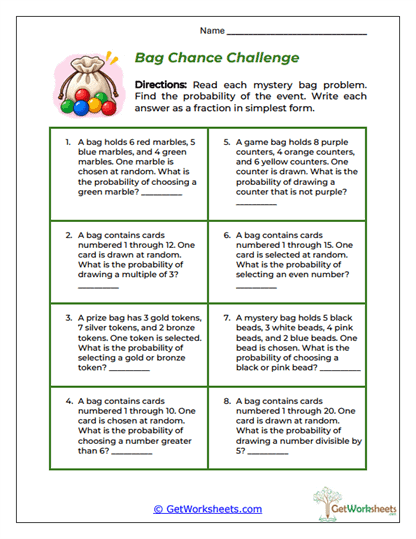
Bag Chance Challenge
Random-selection problems use mystery bags, marbles, numbered cards, counters, and prize tokens to make probability concrete. Students determine which objects satisfy a condition and compare that count with the total number available. Some questions involve multiples, divisibility, combined categories, or outcomes defined by what is not selected. The varied conditions encourage careful reading before the probability fraction is constructed and simplified.
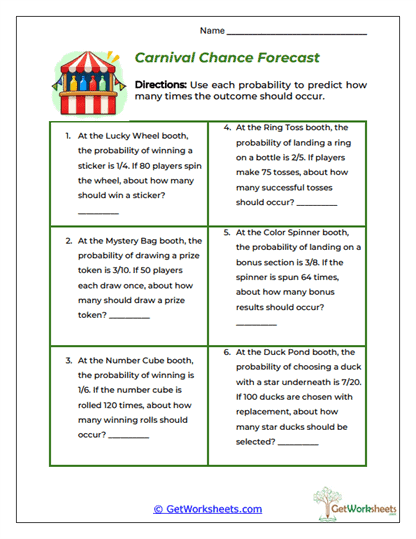
Carnival Chance Forecast
Carnival games provide the probabilities and trial counts students need to predict expected frequencies. Learners multiply an event's probability by the number of plays, spins, or selections to estimate how often the outcome should occur. Fraction multiplication and proportional reasoning are embedded naturally within the prediction process. The activity also emphasizes that an expected frequency describes a mathematical forecast rather than a guaranteed result.
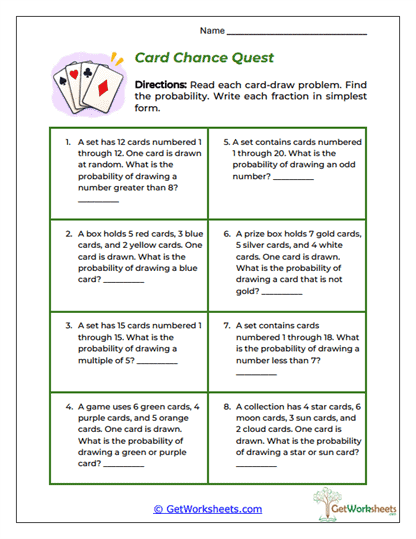
Card Chance Quest
Card-drawing situations require students to calculate probabilities from collections containing numbers, colors, symbols, or prize categories. Depending on the problem, favorable cards may be identified by odd numbers, multiples, inequalities, combined groups, or complementary conditions. Careful classification matters because an incorrect count changes the entire probability. This worksheet blends chance reasoning with number properties and fraction simplification.
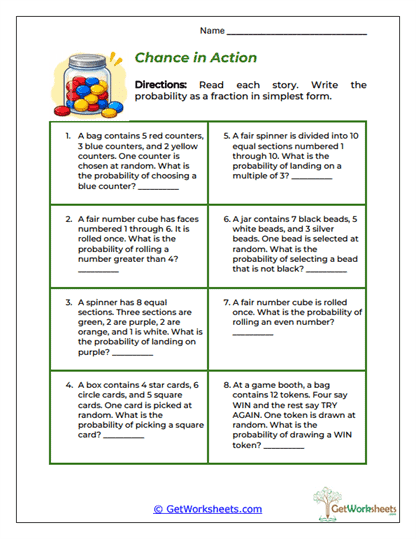
Chance in Action
Eight real-world probability stories introduce students to the full process of solving contextual probability problems. Counters, number cubes, spinners, shape cards, and prize tokens require learners to identify favorable outcomes and the total number of equally likely possibilities. Several scenarios include numerical conditions or more than one acceptable outcome, so students must interpret the wording before calculating. The activity establishes a dependable routine for translating probability stories into simplified fractions.
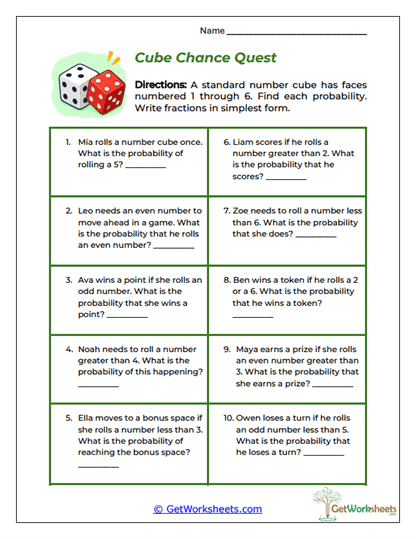
Cube Chance Quest
A standard six-sided number cube serves as the common sample space for ten probability problems. Students analyze specific rolls, even and odd results, numbers above or below a given value, and events with multiple qualifying outcomes. Because the possible results remain fixed from question to question, learners can concentrate on how changing the event changes the probability. The worksheet also reinforces inequalities, number classification, and fraction reduction.
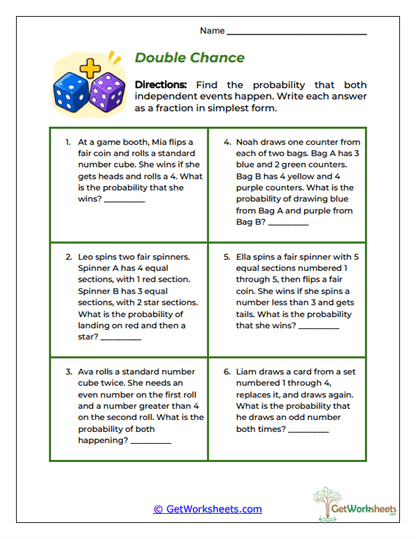
Double Chance
Two independent events are combined within each multistep word problem. Students first calculate the probability of each individual event and then multiply those values to find the chance that both occur. Coins, number cubes, spinners, counters, and card selections provide several settings for examining independence. This activity extends single-event probability into compound reasoning while providing meaningful fraction multiplication practice.
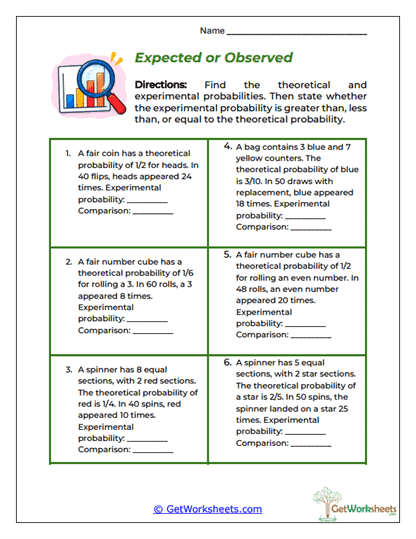
Expected or Observed
Each scenario contrasts a theoretical probability with actual results from an experiment. Students calculate the experimental probability from recorded frequencies and determine whether it is greater than, less than, or equal to the theoretical value. The comparison helps learners see that mathematical expectations and short-run observations do not have to match exactly. It also introduces random variation through familiar coin, spinner, cube, and counter experiments.
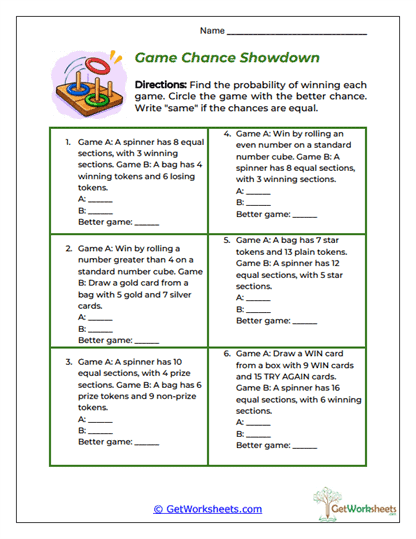
Game Chance Showdown
Pairs of games are evaluated to determine which offers the better chance of winning. Students calculate the winning probability for both options, simplify or compare the resulting fractions, and choose the mathematically stronger game or identify equal chances. The task makes clear that simply having more winning outcomes does not guarantee a better probability if the total number of possibilities also changes. This format turns probability into an evidence-based decision-making tool.
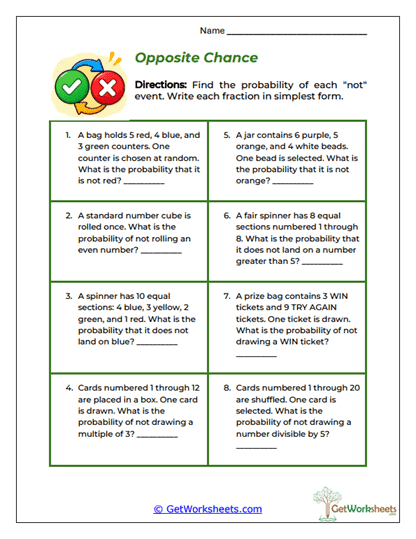
Opposite Chance
Every problem focuses on the complement of an event, asking for outcomes such as not red, not even, or not divisible by a particular number. Students may count the opposite outcomes directly or use the relationship between an event and its complement. Comparing the two approaches reinforces the idea that complementary probabilities account for the entire sample space. The worksheet gives students a more flexible way to reason about "not" conditions.
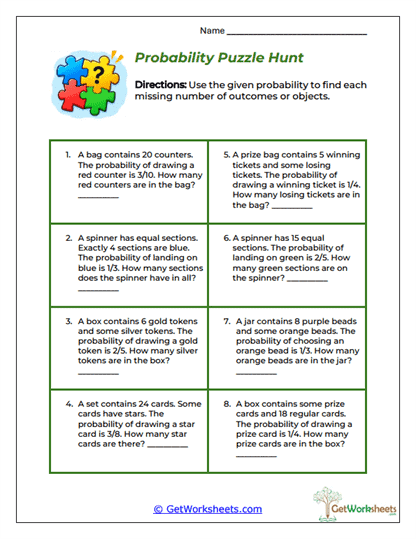
Probability Puzzle Hunt
Given probabilities and partial information are used to recover missing numbers of objects, sections, or outcomes. Students work backward with equivalent fractions, multiplication, division, subtraction, and part-to-whole relationships to determine the unknown quantity. Some questions ask for favorable outcomes, while others require the total sample space or the number of remaining objects. The puzzle structure creates a natural connection between probability, proportions, and introductory algebra.
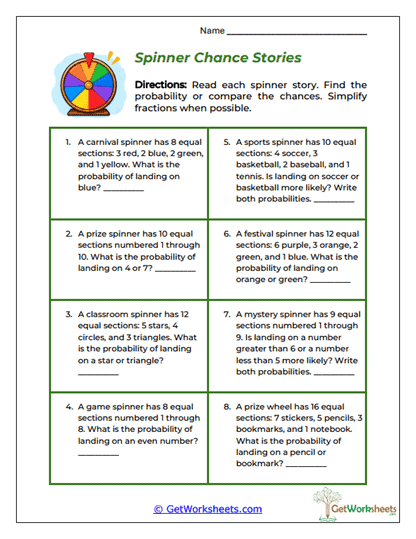
Spinner Chance Stories
Equally divided spinners provide the setting for probability calculations and comparisons. Students examine colors, numbers, combined categories, and numerical conditions while deciding which sections count as favorable outcomes. Several problems require comparing two chances rather than calculating only one. The spinner format makes it easy to see why probability depends on the proportion of favorable sections within the entire wheel.
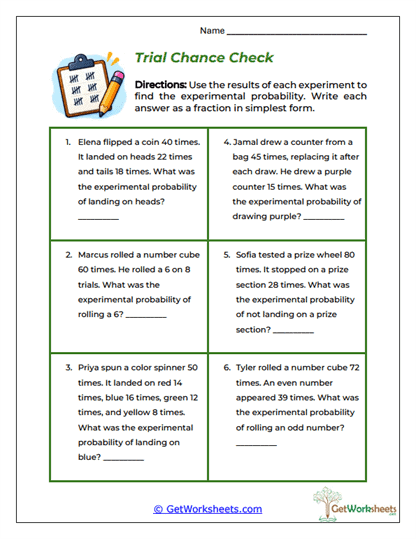
Trial Chance Check
Repeated experiments are described through word problems involving coins, number cubes, spinners, replacement draws, and prize wheels. Students use recorded frequencies to calculate experimental probability rather than relying on the theoretical structure of the experiment. Complementary outcomes may also be determined from the trial results when a problem asks about what did not occur. The activity develops the important distinction between probability based on observation and probability based on equally likely possibilities.
Bookmark Us Now!
New, high-quality worksheets are added every week! Do not miss out!