Trial Chance Check
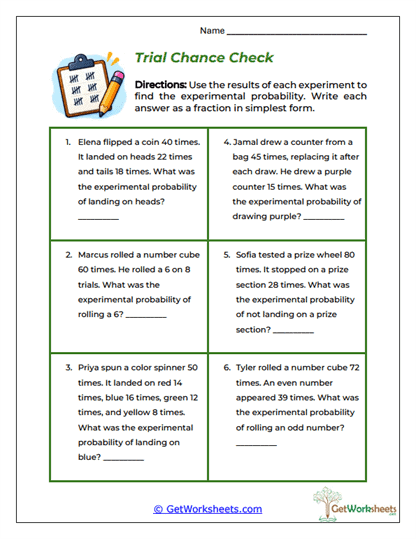
Understanding experimental probability helps students recognize how the results of repeated trials can be used to describe the likelihood of real-world events. This engaging statistics printable for Grades 5-7 presents six word problems involving coin flips, number cube rolls, colored spinners, replacement draws, and prize wheels. Students examine the number of times an experiment was performed, identify how often a particular outcome occurred, and calculate the corresponding experimental probability as a fraction in simplest form. Through these exercises, learners strengthen frequency interpretation, fraction simplification, numerical comparisons, complementary probability, and statistical reasoning while developing a practical understanding of how observed results differ from theoretical expectations.
Learning Goals
-
Calculating Experimental Probability: Divide the number of times an event occurred by the total number of trials to determine its observed probability.
-
Interpreting Trial Results: Extract relevant numerical information from written descriptions of repeated random experiments.
-
Analyzing Complementary Outcomes: Determine probabilities for events that did not occur, such as not winning a prize or rolling an odd number when even results are recorded.
-
Simplifying Probability Fractions: Reduce experimental probability fractions using common factors while preserving their mathematical meaning.
Teaching Advantages
-
Six Realistic Experiments: Includes familiar chance situations involving coins, spinners, number cubes, and colored objects.
-
Reading Comprehension Integration: Requires students to identify essential numerical details before performing probability calculations.
-
Multiple Reasoning Strategies: Encourages learners to calculate probabilities directly or use complementary frequencies when appropriate.
-
Hands-On Extension Opportunities: Teachers can recreate selected experiments and compare classroom results with the recorded observations.
-
Flexible Classroom Use: Suitable for guided instruction, independent practice, formative assessment, homework, and homeschool statistics lessons.
Analyzing experimental results helps students understand that probability can describe what actually happened during repeated random events. Through frequency counting, numerical comparisons, fraction calculations, and complementary reasoning, learners develop stronger statistical literacy and computational confidence. Teachers can extend the activity by asking students to predict how experimental probabilities might change if additional trials were conducted or to explain why observed frequencies may not perfectly match theoretical expectations. This print-and-go resource reinforces mathematical accuracy, data interpretation, logical reasoning, and independent problem-solving while preparing students for more advanced investigations involving experimental distributions and probability comparisons.
Bookmark Us Now!
New, high-quality worksheets are added every week! Do not miss out!