Mean Worksheets
About This Worksheet Collection
The arithmetic mean gives students a way to summarize a group of numbers with a single representative value. Although the familiar rule is to add the values and divide by how many there are, a deeper understanding comes from recognizing the mean as an equal share of the total. This collection develops both sides of the concept, helping students calculate averages accurately while also understanding what those averages reveal about a data set.
Practice ranges from introductory equal-sharing models to more advanced investigations involving missing values, changing data, target averages, outliers, and comparisons between groups. Students calculate sums and counts, match data sets with their means, analyze incorrect solutions, work backward from a known average, and explore what happens when individual observations are replaced or extreme values are introduced. Sports, reading, arcade scores, gardening, schoolwork, and other familiar settings give the calculations practical meaning.
Beyond mastering a formula, learners begin to see the mathematical relationship connecting the total, number of observations, and mean. They discover why changing one value can shift an average, why extreme observations can have a noticeable effect, and how a desired mean can be used to determine an unknown value. These ideas prepare students for broader work with measures of center, data distributions, algebraic reasoning, statistical comparisons, variability, and evidence-based interpretation.
Detailed Descriptions Of These Worksheets
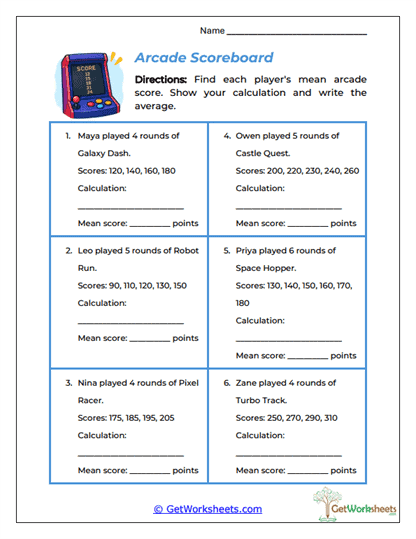
Arcade Scoreboard
Arcade scores place average calculations inside short performance-based word problems. Students total each player's scores, determine the number of rounds played, and divide to find the mean score. Because the number of observations varies from player to player, careful counting is just as important as accurate addition. The game setting shows how averages can summarize repeated performances in a meaningful way.
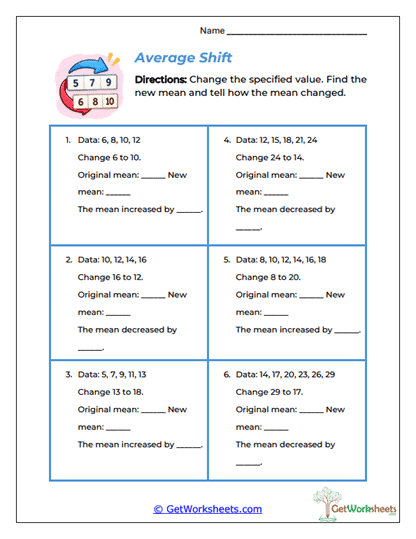
Average Shift
Students investigate how replacing one value changes the arithmetic mean of a data set. Each problem requires an original average, a revised calculation after the substitution, and the amount by which the mean increased or decreased. Comparing the before-and-after results highlights the connection between changes in the total and changes in the average. This activity moves students from routine computation into reasoning about how data behaves.
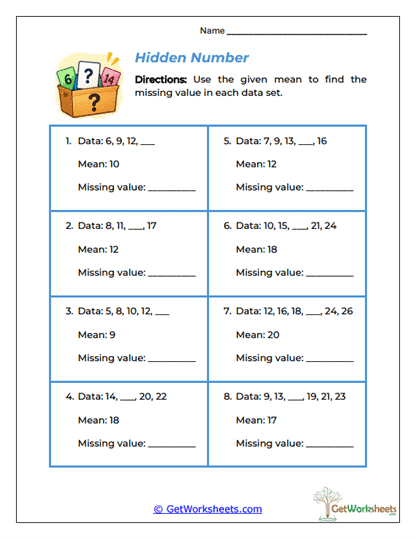
Hidden Number
A missing observation must be recovered from a known mean and the remaining values in the data set. Learners first multiply the mean by the number of observations to determine the required total, then subtract the sum of the known values. Working backward in this way turns an average problem into an introduction to inverse operations and algebraic thinking. Recalculating the completed mean also gives students a natural method for checking their answer.
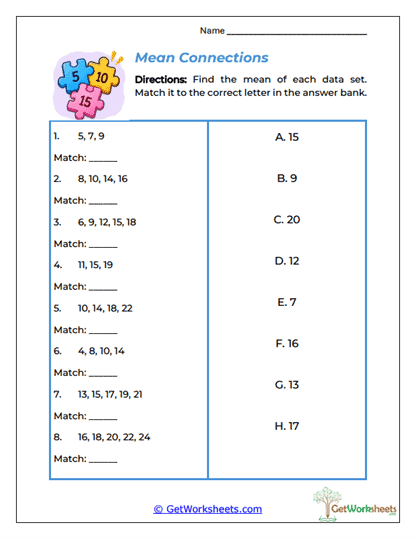
Mean Connections
Data sets are paired with their correct averages through a lettered answer bank. Students calculate each mean and then locate the matching result, creating a self-checking element within the activity. The format combines addition and division practice with numerical comparison and answer verification. It offers a more interactive alternative to a standard list of average calculations.
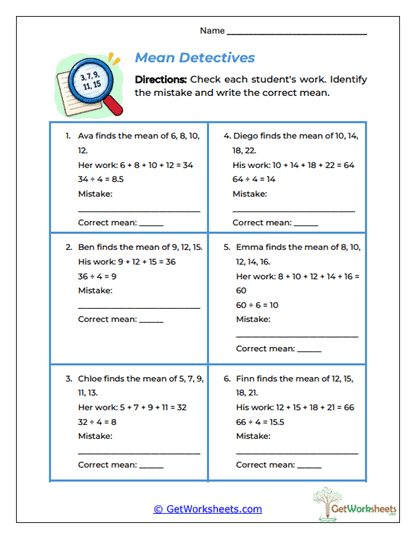
Mean Detectives
Incorrect average calculations become evidence for students to investigate. Learners inspect each solution, determine whether the error occurred in addition, counting the observations, or division, and then calculate the correct mean. Explaining the mistake requires a stronger understanding of the process than simply producing an answer. The detective-style format promotes careful checking and mathematical communication.
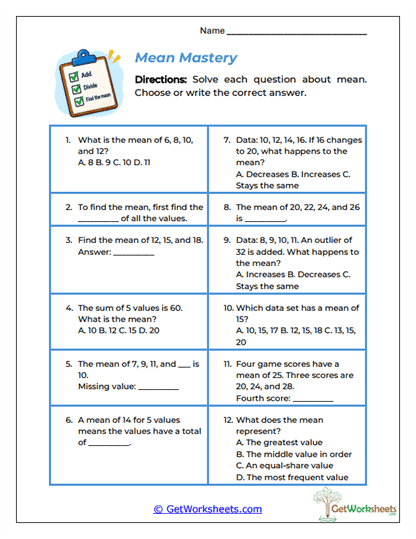
Mean Mastery
A comprehensive review brings together the major concepts developed throughout the mean collection. Questions address direct calculations, missing values, totals, changing averages, outliers, and the meaning of the arithmetic mean itself. Multiple-choice, numerical, and short-response formats require students to demonstrate both procedural fluency and conceptual understanding. This worksheet is well suited for end-of-topic review or assessment.
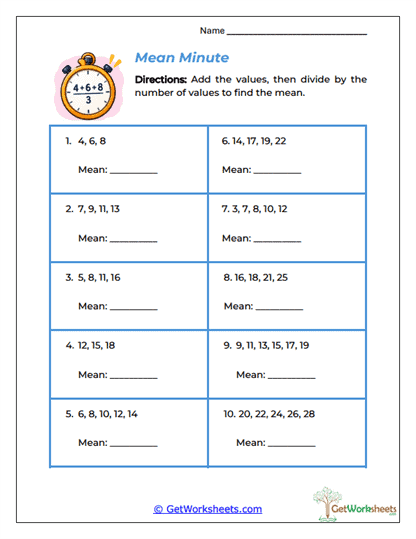
Mean Minute
Ten focused data sets provide concentrated practice with calculating arithmetic means. Students add each collection of values, count the observations correctly, and divide the total by that count. Varying the length of the data sets prevents the calculation from becoming overly mechanical. The streamlined format is useful for building speed, accuracy, and confidence with the standard mean procedure.
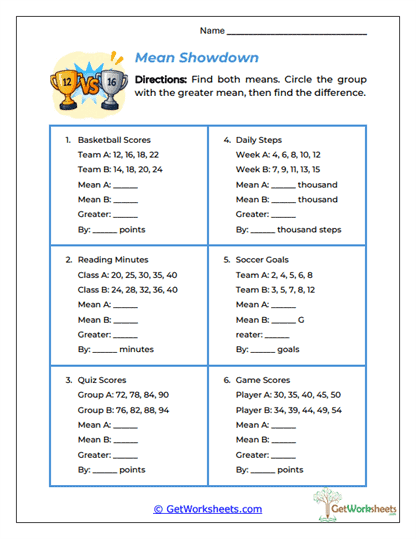
Mean Showdown
Pairs of data sets are compared by calculating the mean of each one. Students identify which group has the higher average and then determine the numerical difference between the two results. Contexts such as sports scores, reading time, quizzes, steps, and games make the comparisons easier to interpret. The activity reinforces that averages can be used to summarize and compare performances without describing every individual value.
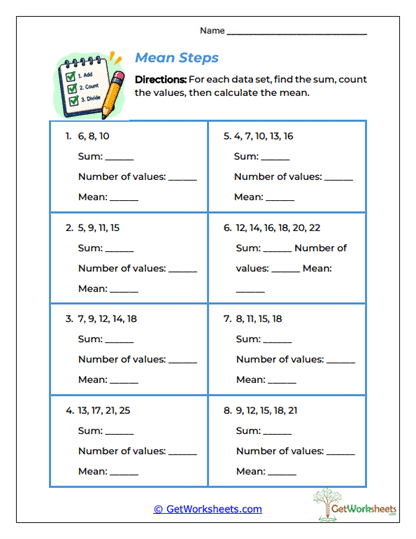
Mean Steps
Each problem separates the average calculation into three visible stages: sum, number of values, and mean. Students record each component before arriving at the final answer, making the mathematical structure easy to follow. This scaffolding is especially useful for revealing whether mistakes come from addition, counting, or division. The organized approach helps establish a dependable routine for future mean problems.
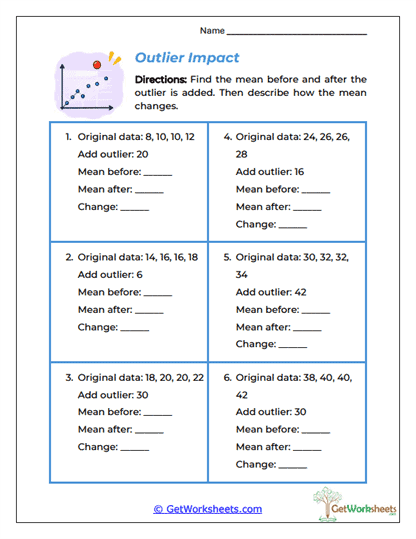
Outlier Impact
Extreme values are added to existing data sets so students can observe their influence on the arithmetic mean. Learners calculate the original average, include the unusually high or low observation, and then find the revised mean. Comparing the results demonstrates that the mean can be sensitive to values far from the rest of the data. This investigation provides an important foundation for later discussions of outliers, median, and representative measures of center.
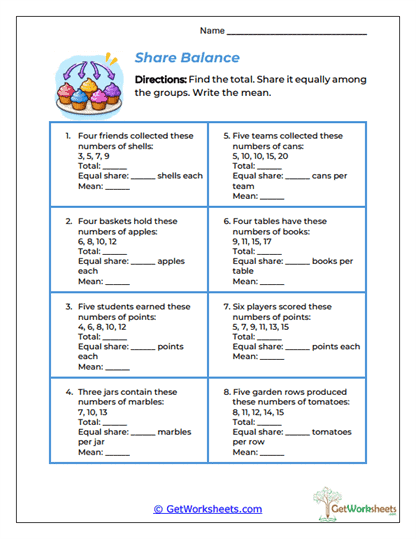
Share Balance
Equal sharing provides a concrete introduction to what the arithmetic mean represents. Students combine quantities from real-world situations and determine how much each group would receive if the total were redistributed evenly. That equal amount is then connected directly to the average. The activity helps students understand why addition and division produce the mean instead of treating the formula as an arbitrary rule.
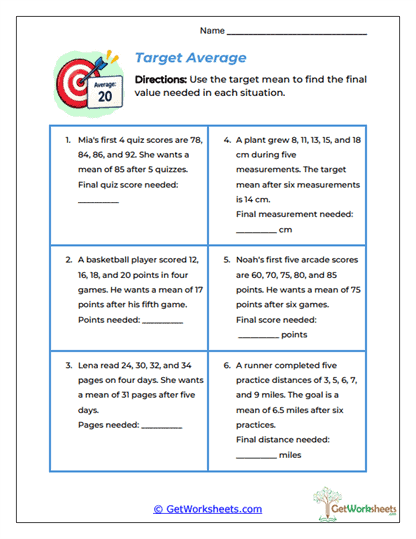
Target Average
Goal-based problems ask students to determine the final value needed to reach a specified mean. Quiz scores, basketball points, reading progress, plant growth, arcade games, and running distances provide realistic situations for working backward. Learners calculate the total required by the target average and subtract the values already known. The worksheet blends statistical reasoning with inverse operations and introductory equation solving.
Bookmark Us Now!
New, high-quality worksheets are added every week! Do not miss out!