Integer Number Lines Worksheets
-
Comparing Integers
-
Distance and Absolutes
-
Distance From Zero
-
-
Integer Arrangement
-
Integer Elevator
-
Integer In-Between
-
Integer Jumps
-
Integer Lineup
-
Integer Plotter
-
Integer Plotter
-
Integer Points
-
Integer Steps
-
Label Logic
-
Mirror Points
-
Number Line Hunt
-
Number Line Neighbors
-
Opposite Integers
-
Point Comparisons
-
Scale Search
-
Sum Jumps
-
Thermometer Check
-
Thermometer Check
-
Tick Mark Mystery
-
Upward Integers
About This Worksheet Collection
Integer number lines give students a visual structure for understanding how positive numbers, negative numbers, and zero relate to one another. Rather than treating integers as isolated symbols, number lines place each value in a meaningful position and make ideas such as order, distance, direction, opposites, and scale easier to see. This collection uses that visual foundation to support a wide range of integer skills, from simply reading a point to modeling addition and interpreting real-world measurements.
The worksheets cover reading and plotting integers, identifying missing values, finding neighboring numbers, locating opposites, connecting distance with absolute value, comparing and ordering values, listing integers within ranges, interpreting vertical number lines, reading thermometers, moving left and right, and adding integers through number-line jumps. Several activities also introduce scaled number lines where tick marks represent intervals larger than one, requiring students to inspect the spacing before deciding what a point means. The variety helps learners move from basic location skills toward more flexible use of number lines in computation, comparison, and measurement.
As students work across the collection, they build a stronger sense of integers as part of one continuous ordered system. They learn that values increase to the right or upward, decrease to the left or downward, and can be compared by position rather than digit size alone. They also see how opposites mirror one another around zero, how absolute value measures distance, and how movement along a line can model addition and subtraction. These ideas prepare students for inequalities, coordinate planes, graphing, algebraic expressions, scaled axes, and other middle-school topics that depend on confident visual number sense.
Detailed Descriptions Of These Worksheets
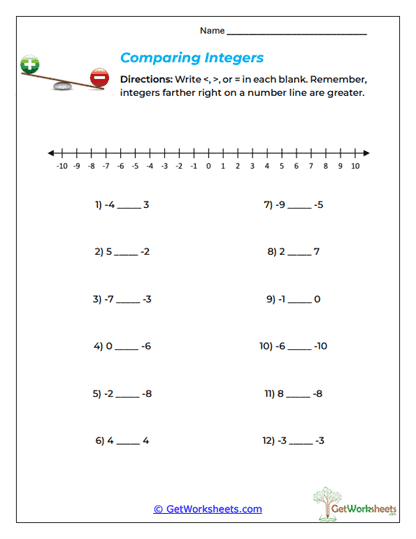
Comparing Integers
A horizontal number line supports comparisons using <, >, and =. Students locate both integers, identify which lies farther to the right, and use that position to determine the correct relationship. Negative-number pairs are especially important because they challenge the tendency to compare only digit size. The worksheet builds a dependable visual strategy for later inequality work.
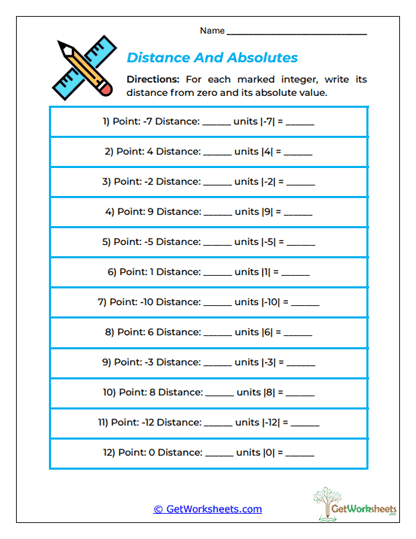
Distance and Absolutes
Marked integers are used to connect number-line position with absolute-value notation. Students identify how many units each point lies from zero and then write the corresponding absolute value. Positive and negative numbers with equal magnitude reinforce that distance does not depend on direction. This makes absolute value a visual concept rather than a sign-changing shortcut.
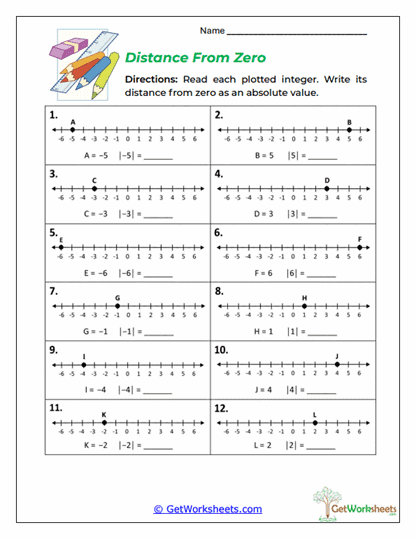
Distance From Zero
Students compare plotted positive and negative opposites by recording each point's distance from zero and absolute value. Repeated pairs such as -5 and 5 make the relationship between sign, direction, and magnitude especially clear. Learners see that opposite integers occupy different locations while sharing the same distance from the origin. The activity strengthens the conceptual meaning of absolute value.
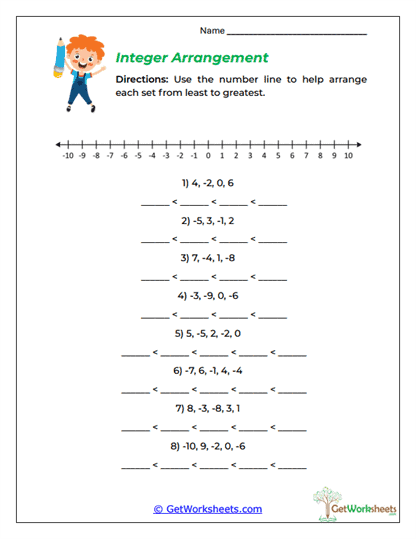
Integer Arrangement
Sets containing negative values, zero, and positive values are ordered from least to greatest. Students use the number line as a guide and write the completed sequence with comparison symbols between neighboring values. Multiple negatives require careful left-to-right reasoning. This activity develops multi-number organization and provides useful preparation for ordered data and compound inequalities.
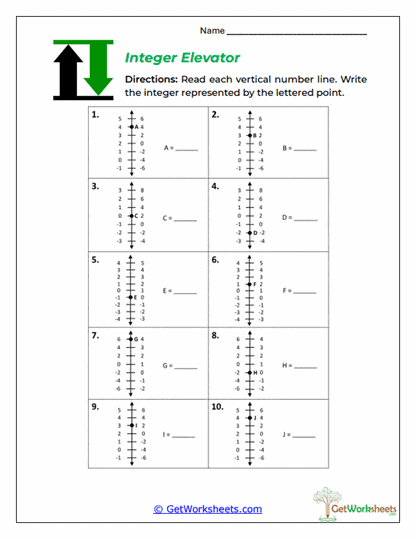
Integer Elevator
An elevator-style model helps students interpret integers on vertical scales. Ground level functions as zero, positions above are positive, and positions below are negative. Students identify marked values while applying the idea that moving upward increases a number. This real-world analogy provides a useful bridge to coordinate-plane vertical axes.
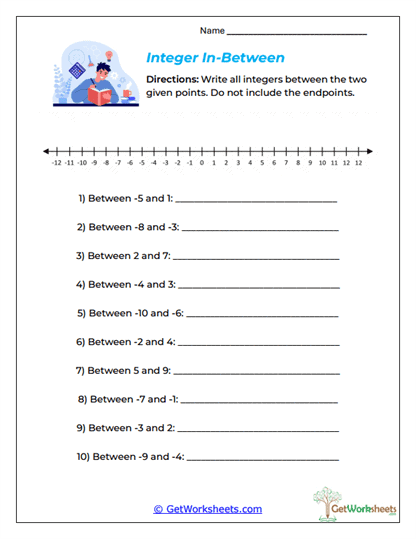
Integer In-Between
Students list every integer that falls strictly between two given endpoints. The boundary values themselves are excluded, so learners must begin one step after the smaller endpoint and stop one step before the larger one. Several ranges cross zero, giving practice with continuous integer sequence. The worksheet introduces an intuitive foundation for strict inequalities and solution intervals.
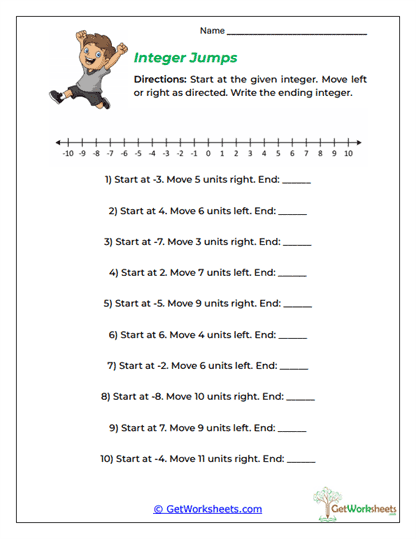
Integer Jumps
Movement directions replace traditional operation notation in this visual number-line activity. Students begin at a stated integer, move a specified number of units left or right, and record the value where they land. Crossing zero occurs frequently, helping learners become comfortable moving between negative and positive values. The task builds the spatial reasoning that later supports integer addition and subtraction.
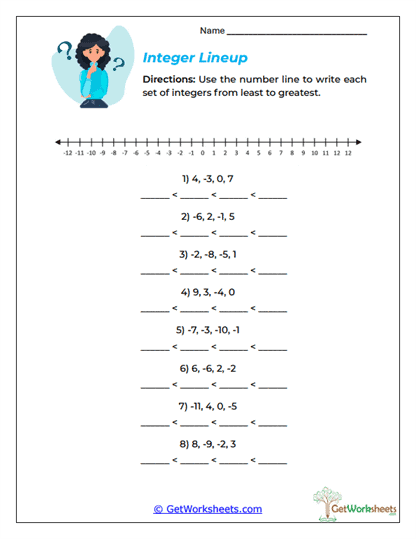
Integer Lineup
Groups of integers are arranged from least to greatest using number-line position. Learners identify the value farthest to the left first and continue moving right until every integer has been placed. The use of < symbols connects ordering with inequality notation. This activity moves students beyond pairwise comparison toward organizing several signed numbers at once.
Integer Plotter
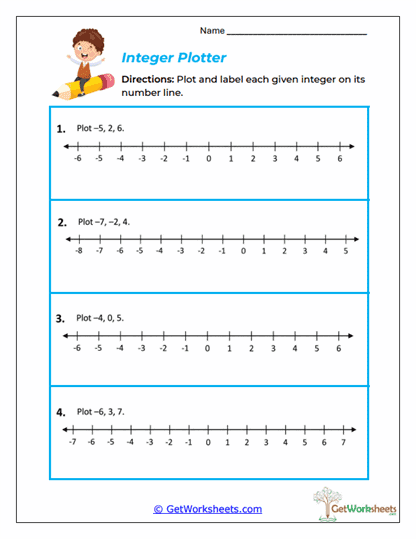
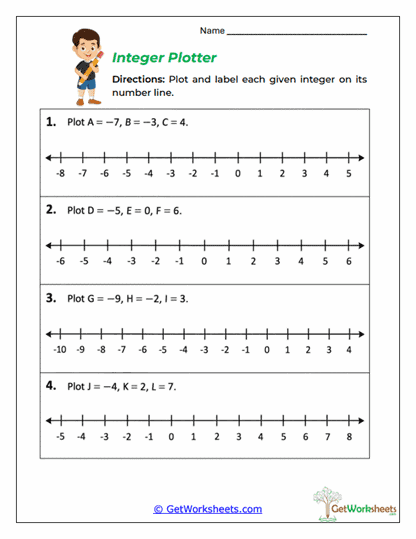
Given integers must be placed and labeled in their correct positions on a number line. Students start from zero, determine direction from the sign, and count the appropriate distance to each location. Plotting several values on one line naturally reinforces their order and relative spacing. This makes the worksheet useful preparation for coordinate graphing and comparison.
Integer Points
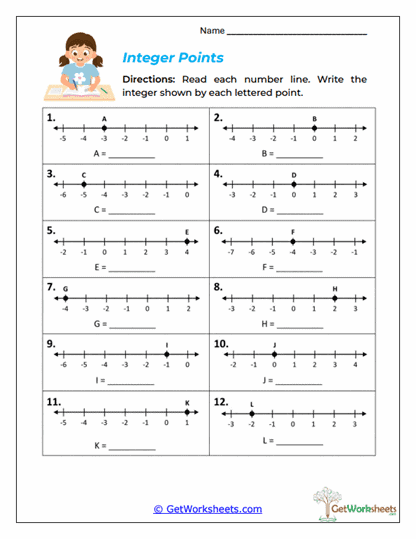
Students read individual labeled points from horizontal number lines and name the corresponding integers. Locating zero, checking which side the point occupies, and counting intervals carefully are central to the task. The focused format strengthens accuracy with negative signs and tick marks. It provides one of the most fundamental skills in the collection.
Integer Steps
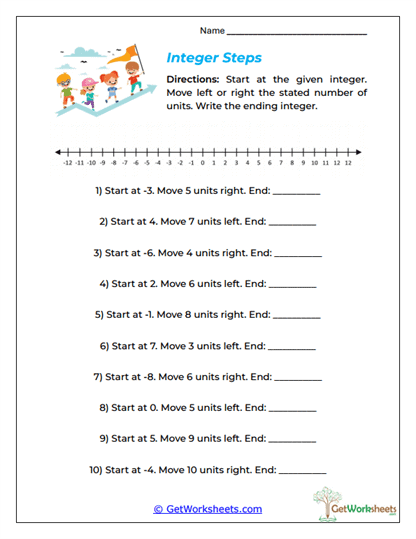
Starting points and left-or-right instructions guide students to ending integers. The activity emphasizes direction, counting units accurately, and crossing zero without losing track of signs. Learners begin to see increasing and decreasing values as physical movement along the line. This visual reasoning supports later computation with signed numbers.
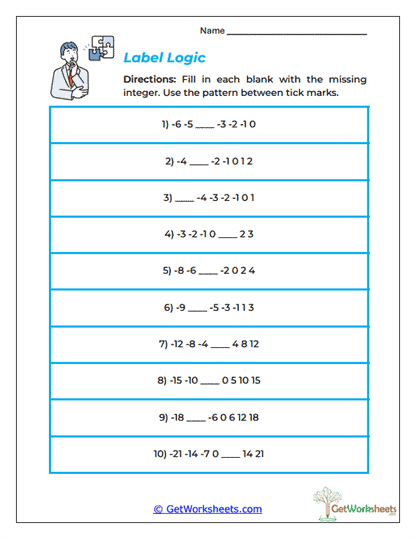
Label Logic
Integer sequences are examined to determine missing values and the pattern connecting neighboring positions. Some sequences advance by one, while others use larger consistent intervals. Students must identify the step size rather than assume every move represents a single unit. The activity strengthens scale awareness and pattern recognition across negative and positive values.
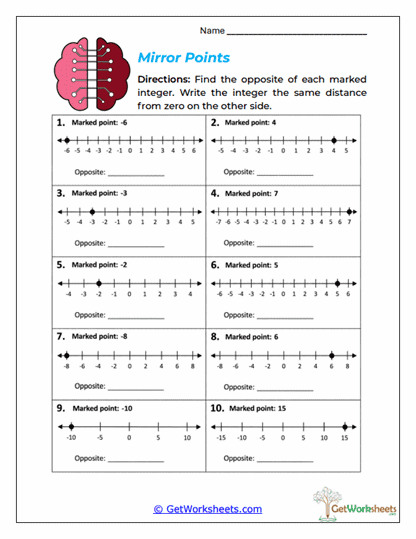
Mirror Points
A marked integer is paired with the point the same distance from zero on the opposite side. Students use number-line symmetry to identify positive and negative opposites. Seeing the two values as mirror locations makes the relationship more meaningful than merely changing a sign. This visual model supports later work with additive inverses and absolute value.
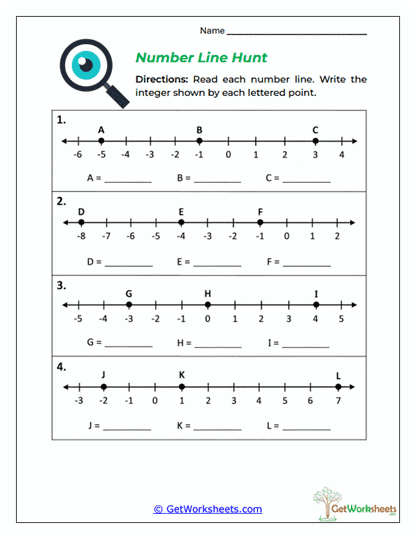
Number Line Hunt
Several labeled points appear on the same number line, requiring students to identify multiple integer values from one visual. Keeping track of letters, signs, and tick positions adds a layer of organization beyond single-point reading. Once the values are identified, their relative order is also easy to observe. The worksheet builds efficient number-line interpretation and attention to detail.
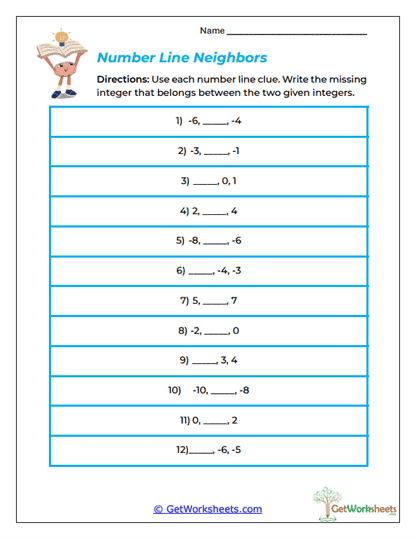
Number Line Neighbors
Each problem contains two nearby integers with a missing value between them. Students determine which consecutive integer completes the sequence, including examples involving negative values and crossings near zero. The short format reinforces ordinary counting order within the full integer system. This is especially helpful for learners who still reverse the sequence of negative numbers.
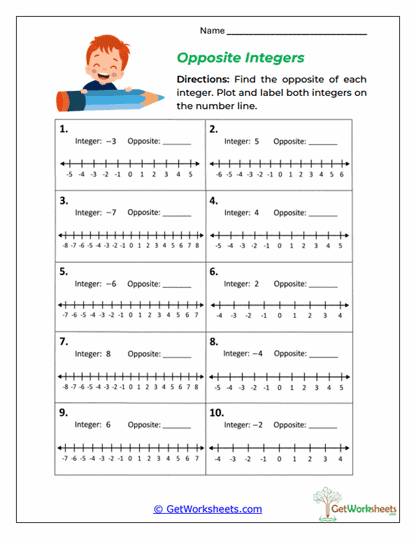
Opposite Integers
Students first find the opposite of a given integer and then plot both values on the same line. The finished pair demonstrates that opposite integers have equal distance from zero while occupying different sides. Plotting makes the symmetry immediately visible. The activity combines symbolic understanding with spatial reasoning and additive-inverse concepts.
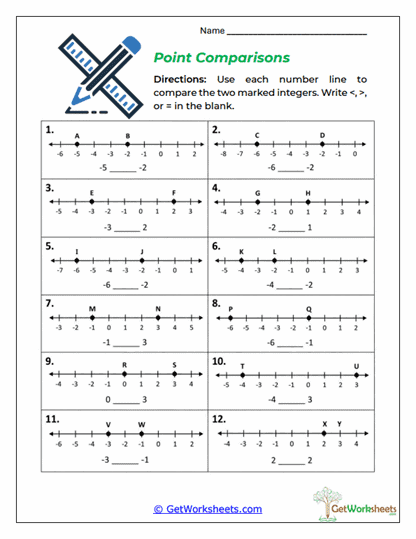
Point Comparisons
Two labeled points are read and then compared using <, >, or =. Because both values are presented visually, students can rely directly on the principle that farther right means greater. Negative-number comparisons become easier to justify when the positions are visible. The worksheet blends number-line reading with inequality-symbol practice.
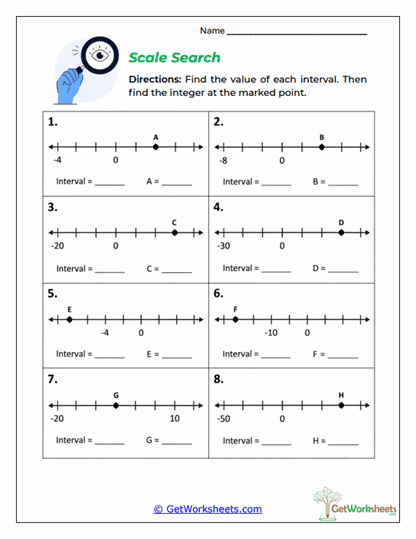
Scale Search
Partially labeled number lines require students to determine the interval before identifying a marked point. Tick marks may represent jumps of 2, 5, 10, or other values, so careful scale reading is essential. Students first determine what each step is worth and only then name the point. This activity develops habits that transfer directly to graphs, coordinate axes, and measurement scales.
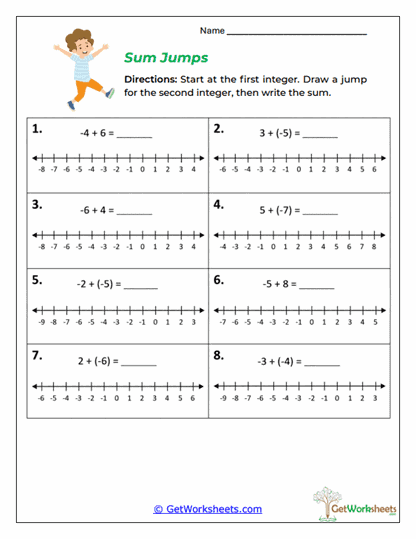
Sum Jumps
Integer addition is modeled as movement from a starting point. The first addend determines where students begin, while the second tells them how far and in which direction to move. Positive addends create rightward jumps and negative addends create leftward jumps, often crossing zero. This gives students a concrete explanation for integer addition before they rely entirely on abstract sign rules.
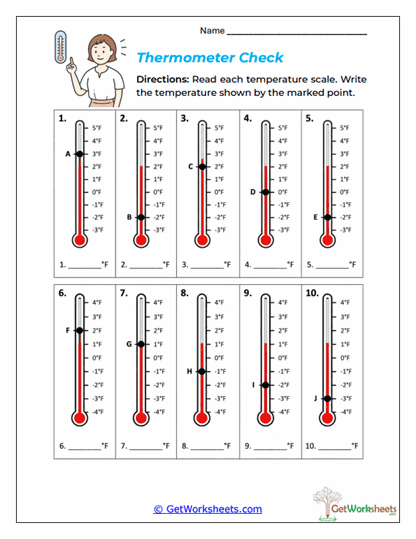
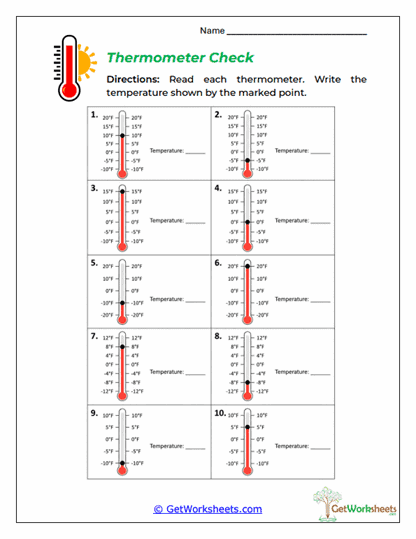
Thermometer Check
Temperature scales give vertical number lines a familiar real-world context. Students read marked temperatures above, below, and at zero while paying attention to the size of each interval. Some scales use larger jumps, so learners must inspect the labels rather than assume one-degree increments. The worksheet connects integer reading with measurement and weather data.
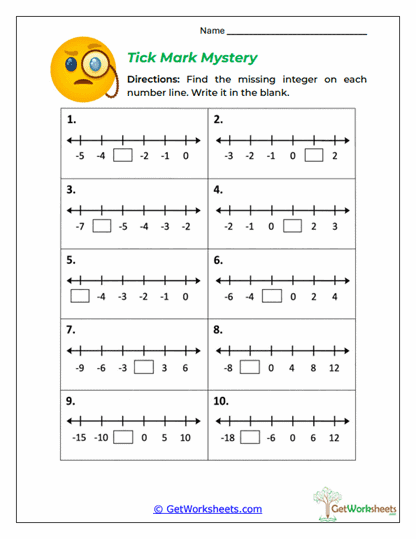
Tick Mark Mystery
Scaled number lines contain missing values that students recover by analyzing the interval between labeled ticks. Skip-counting through negative numbers, zero, and positive numbers is often required. The missing point can only be found after the scale has been identified correctly. This builds careful observation and prepares students for more advanced axis reading.
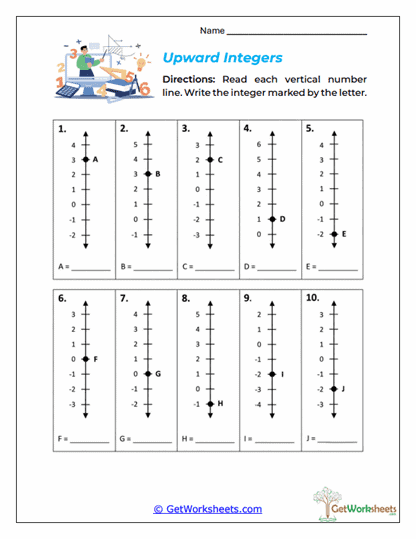
Upward Integers
Vertical number lines replace the usual horizontal layout. Students read marked points by recognizing that values increase upward and decrease downward. Zero remains the central reference point, making the structure easy to connect with elevators, thermometers, and the y-axis. The activity helps learners generalize number-line concepts across orientations.
Bookmark Us Now!
New, high-quality worksheets are added every week! Do not miss out!