Absolute Value Worksheets
About This Worksheet Collection
Absolute value gives students a way to separate a number's direction from its magnitude. A negative integer may lie to the left of zero and a positive integer to the right, but absolute value asks a different question: how far is the number from zero? That distinction becomes central to integer reasoning because it connects signs, opposites, number lines, comparison, equations, and real-world quantities such as temperature and elevation.
The worksheets in this collection approach absolute value through direct evaluation, number lines, matching, sorting, reverse reasoning, comparison, ordering, true-or-false statements, riddles, and applied situations. Students identify opposite integers, group equal magnitudes, solve simple absolute-value equations, compare distances from zero, order integers by absolute value, and interpret temperatures and elevations relative to a reference point. The variety helps grades 6-7 students develop a flexible understanding rather than relying on the oversimplified idea that absolute value merely "makes a number positive."
As learners progress, they become better at distinguishing position from distance and sign from size. They see why opposite integers have equal absolute values, why an equation such as |x| = 8 usually has two solutions, and why magnitude-based ordering can differ from ordinary integer ordering. These ideas create a strong foundation for later work with coordinate planes, distance, inequalities, equations, transformations, and more advanced algebraic reasoning.
Detailed Descriptions Of These Worksheets
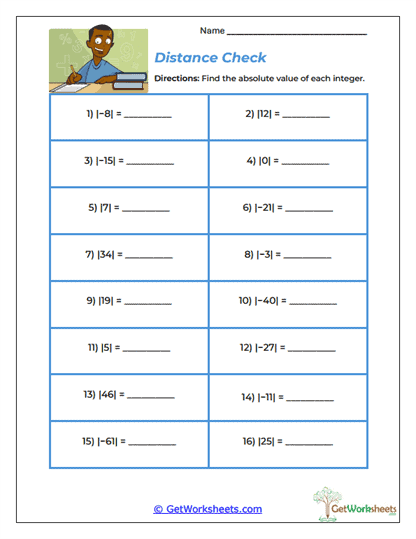
Distance Check
Students evaluate absolute-value expressions containing positive integers, negative integers, and zero. The focused format keeps attention on the central idea that the bars represent distance from zero rather than a command to copy or remove a sign mechanically. Repeated examples help learners recognize that opposite numbers such as 8 and -8 share the same absolute value. This activity provides a clear starting point before absolute value is combined with comparison or equations.
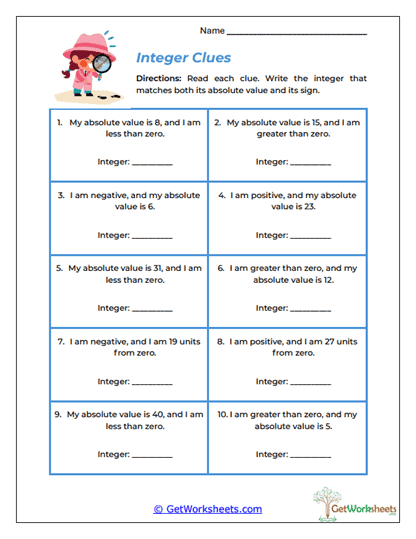
Integer Clues
Short mathematical clues require students to reconstruct an integer from information about its absolute value and sign. Knowing the magnitude narrows the possibilities to a pair of opposites, while phrases such as "less than zero" or "positive" identify the correct member of that pair. This makes the task a form of reverse reasoning rather than simple evaluation. The riddle-style structure also strengthens careful reading of mathematical vocabulary.
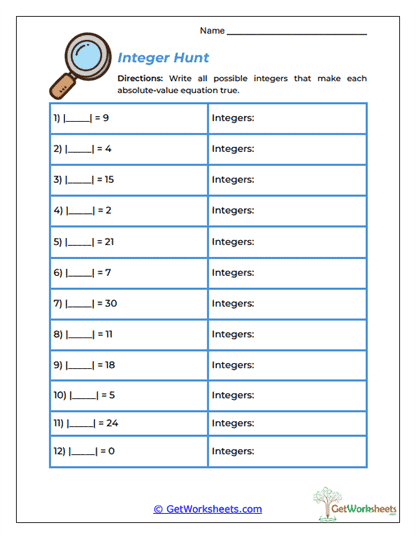
Integer Hunt
Students begin with a stated absolute value and determine every integer that satisfies the condition. Problems such as |x| = 9 encourage learners to think in both directions from zero and recognize the two possible solutions, while |x| = 0 introduces an important exception. The activity turns distance into a basic equation-solving idea. It provides a natural bridge from integer concepts into algebraic reasoning.
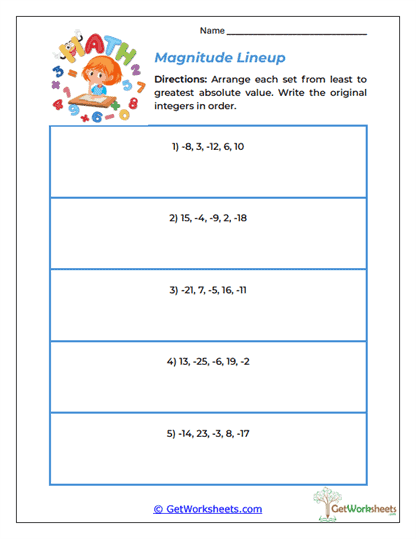
Magnitude Lineup
Sets of positive and negative integers must be arranged according to absolute value rather than their ordinary positions on the number line. Students first determine each magnitude, then order the distances while preserving the original signs in their final response. This forces them to distinguish "least integer" from "least absolute value." The multi-step format develops more flexible thinking about how numbers can be compared in different ways.
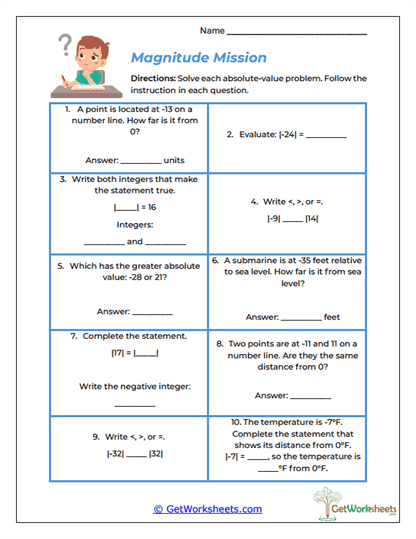
Magnitude Mission
Several absolute-value ideas are combined into one cumulative challenge. Students evaluate expressions, compare magnitudes, find integers from given absolute values, and interpret contexts involving temperature and sea level. Because the problem type changes throughout the page, learners must decide which aspect of absolute value is relevant each time. This makes the worksheet especially useful for review or assessment after the individual skills have been introduced.
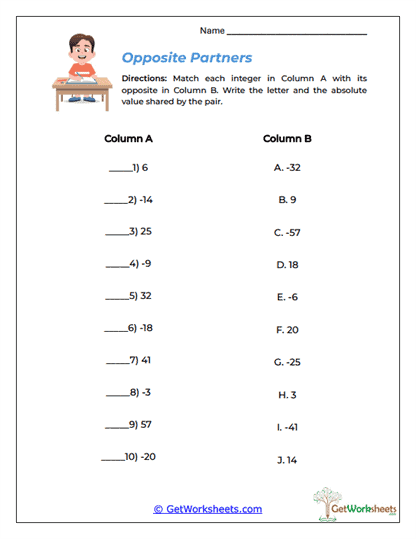
Opposite Partners
Positive and negative opposites are matched according to their shared distance from zero. After finding each pair, students record the absolute value both numbers have in common. The matching process makes it visually clear that direction changes while magnitude stays the same. This activity reinforces one of the central relationships students need for later integer comparison and coordinate-plane work.
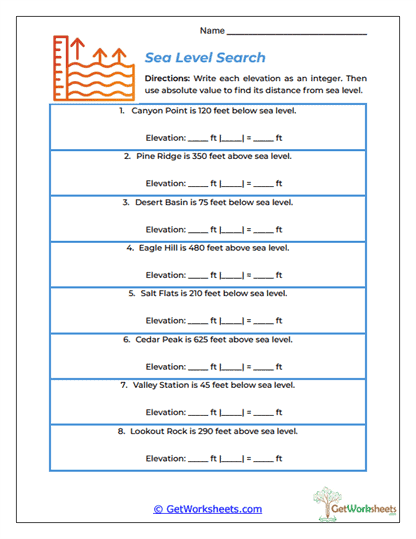
Sea Level Search
Elevation provides a natural setting for distinguishing signed position from absolute distance. Students represent locations above sea level with positive integers and locations below sea level with negative integers, then use absolute value to determine how far each place is from zero elevation. This makes the role of the negative sign meaningful instead of purely symbolic. The geography context also reinforces number-line thinking through a vertical reference point.
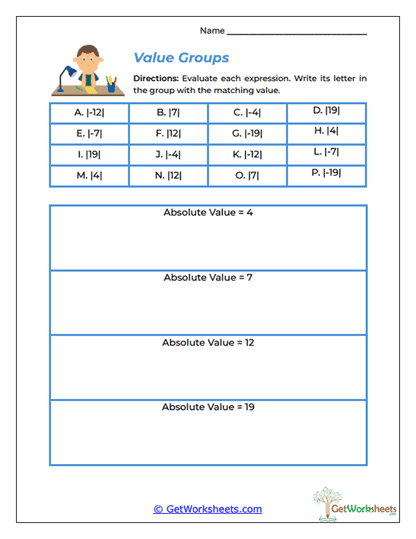
Value Groups
Absolute-value expressions are evaluated and then sorted into groups according to their resulting magnitudes. Expressions involving positive and negative opposites naturally land in the same category, which helps students notice structural patterns across the set. Classification requires learners to focus on mathematical properties rather than signs alone. The sorting format gives routine evaluation practice a stronger conceptual purpose.
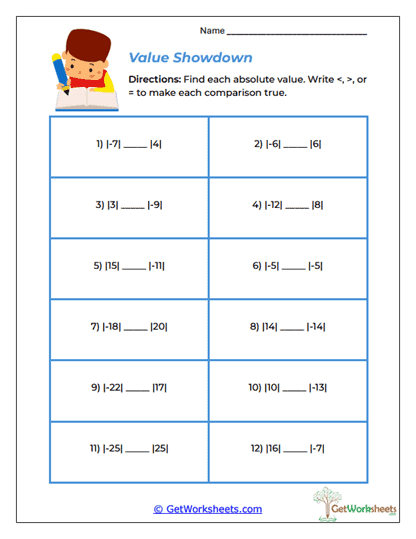
Value Showdown
Pairs of absolute-value expressions are compared using <, >, or =. Students must evaluate both sides before deciding which distance from zero is greater, preventing them from comparing the original signed integers too quickly. Equal-magnitude opposites provide important examples where different integers produce the same result. The activity combines absolute value with comparison-symbol fluency and careful magnitude reasoning.
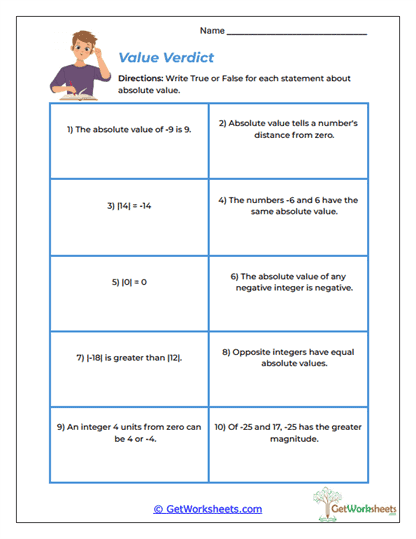
Value Verdict
True-or-false statements test students' understanding of what absolute value actually means. Claims address distance from zero, opposite integers, sign misconceptions, and the possibility of negative absolute values. Instead of simply calculating, learners must decide whether the mathematical idea expressed in each statement is valid. This makes the worksheet particularly useful for uncovering misconceptions that procedural practice may not reveal.
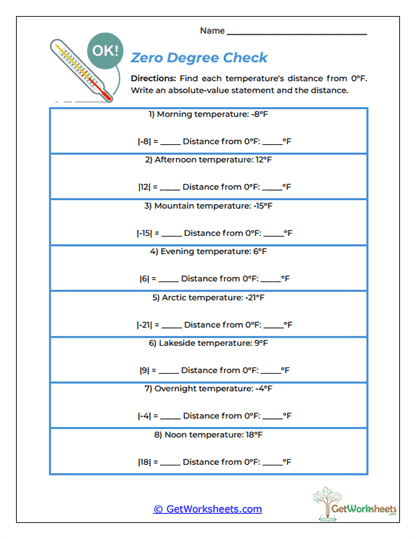
Zero Degree Check
Temperature readings above and below 0°F turn absolute value into a practical distance problem. Students write each temperature as an integer, express it using absolute-value notation, and determine how many degrees it lies from zero. Negative readings remain negative as positions even though their distances are positive. The thermometer context provides an intuitive real-world model for understanding signed numbers and magnitude.
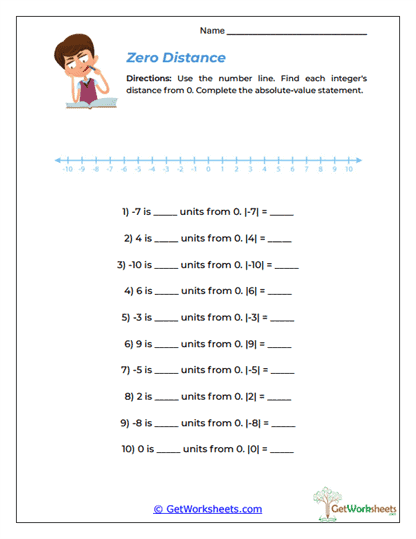
Zero Distance
A number line is used to make the meaning of absolute value visible. Students locate integers on either side of zero and determine the number of units separating each value from the origin. Recording the matching absolute-value statement then links the visual distance with symbolic notation. This activity is especially valuable for learners who need to see why opposite integers produce equal absolute values rather than simply memorize the rule.
Bookmark Us Now!
New, high-quality worksheets are added every week! Do not miss out!