Adding and Subtracting Integers Worksheets
About This Worksheet Collection
Adding and subtracting integers asks students to coordinate several ideas at once: direction, magnitude, opposites, signs, and the relationship between addition and subtraction. Positive and negative numbers can feel unfamiliar at first because the same operation may behave differently depending on the signs involved. These worksheets help students make sense of those patterns through number lines, visual movement, classification, reverse reasoning, and real-world situations rather than treating integer operations as a collection of disconnected rules.
The collection develops the topic in stages. Students begin by modeling addition on number lines, then work separately with same-sign and opposite-sign sums before connecting subtraction to addition of the opposite. From there, they solve mixed expressions, classify results, match problems with answers, find missing integers, complete fact families, and apply integer operations to temperatures and elevations. This progression gives grades 6-7 learners repeated practice while also showing how the operations are connected.
As students move through the collection, they become more comfortable predicting whether an answer should be positive, negative, or zero before finishing the arithmetic. They learn to use absolute value when signs differ, recognize how opposite numbers can cancel, rewrite subtraction consistently, and reason backward through equations. These habits strengthen integer fluency while preparing students for algebraic expressions, equations, coordinate planes, inequalities, and other situations where signed numbers describe direction and change.
Detailed Descriptions Of These Worksheets
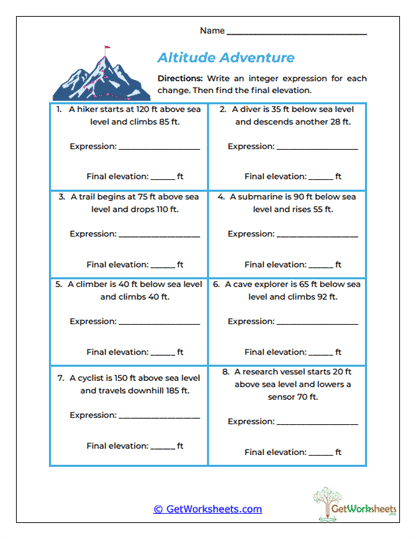
Altitude Adventure
Elevation problems turn integer operations into changes in physical position. Students interpret sea level as zero, represent locations above it with positive values and those below it with negative values, and then translate climbing or descending into signed changes. Each situation requires them to write an expression before finding the final elevation. The context makes addition and subtraction easier to understand as movement rather than as abstract sign manipulation.
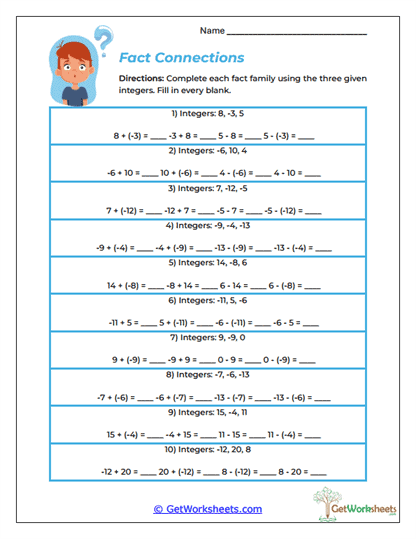
Fact Connections
Students build related addition and subtraction equations from the same three integers. The fact-family structure reveals that integer operations still follow familiar inverse relationships even when negative numbers are involved. Once one equation is known, learners use it to construct or verify the others. This activity strengthens equation sense and provides an early foundation for using inverse operations in algebra.
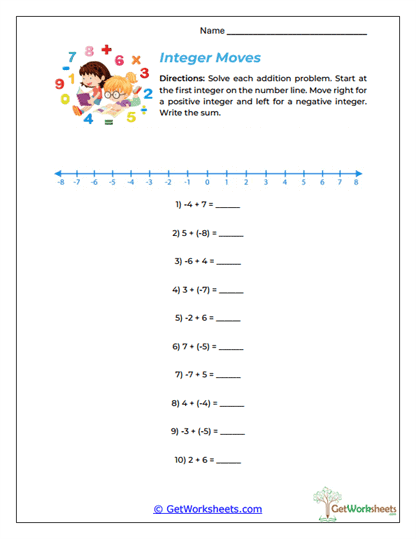
Integer Moves
A number line gives students a visual model for integer addition. They begin at the first integer and move right for a positive addend or left for a negative one, allowing the sum to emerge from the movement itself. Problems involving different sign combinations help learners see why addition can increase or decrease a value. This worksheet establishes meaning before students are expected to rely on abbreviated sign rules.
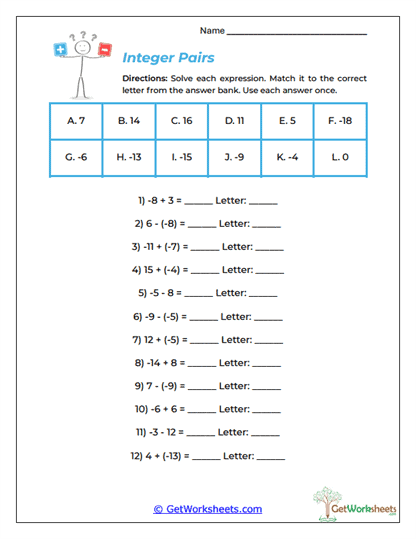
Integer Pairs
Mixed addition and subtraction expressions are solved and matched with answers from a separate bank. The matching format creates a built-in check because an unexpected result may not appear among the available choices. Students must manage both computation and sign accuracy before completing each connection. The puzzle-like structure provides broad review while encouraging independent correction.
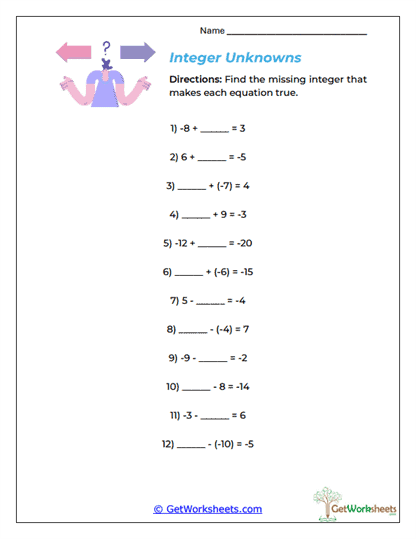
Integer Unknowns
Instead of finding the result of an operation, students determine which integer is missing from an equation. Problems may place the blank before or after an addition or subtraction sign, requiring learners to reason backward and use inverse relationships. A number line can serve as a useful model for connecting the known starting value with the required result. The activity provides a natural transition from integer computation to introductory equation solving.
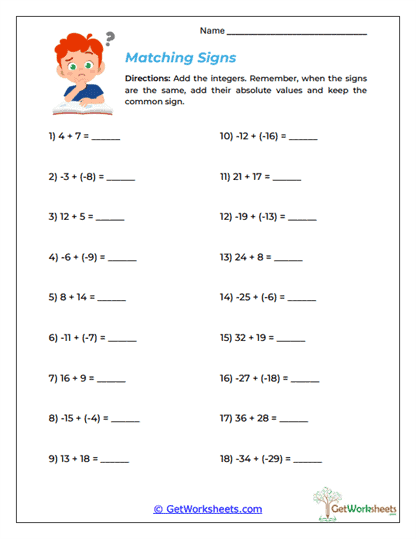
Matching Signs
This worksheet concentrates exclusively on addition problems in which both integers share the same sign. Students add the magnitudes and preserve the common positive or negative direction, building confidence with one predictable pattern before mixed-sign problems are introduced. Larger values gradually extend the practice beyond basic facts. Focused repetition helps the same-sign rule become dependable without competing with several other sign conventions at once.
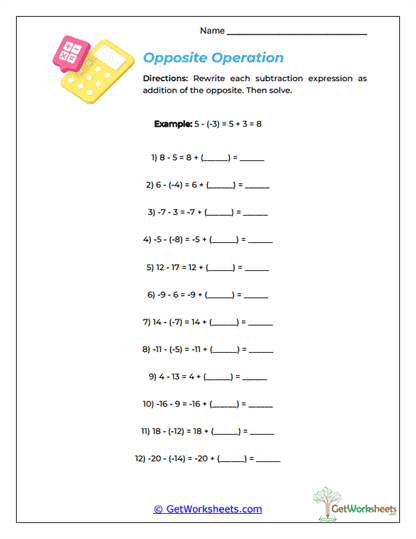
Opposite Operation
Students rewrite subtraction expressions as addition of the opposite before solving them. The repeated transformation makes relationships such as 6 - (-4) = 6 + 4 visible and gives learners one consistent approach to a wide variety of subtraction problems. Attention stays on preserving the first number while replacing the second number with its opposite. This strategy reduces confusion around double negatives and supports later algebraic manipulation.
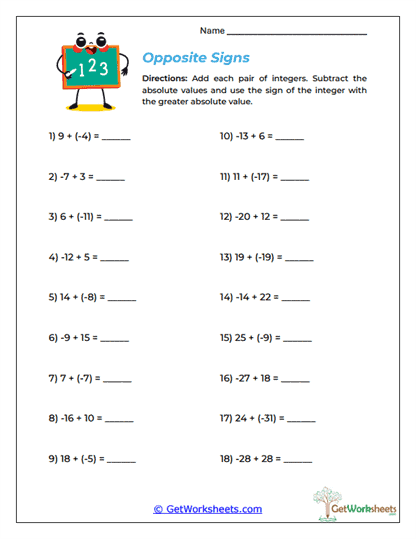
Opposite Signs
Mixed-sign addition becomes a comparison of magnitudes. Students determine which integer has the greater absolute value, subtract the smaller magnitude from the larger one, and use the sign of the stronger value for the final sum. This helps explain why 9 + (-4) and 6 + (-11) produce answers with different signs. The worksheet strengthens the link among absolute value, subtraction, and direction.
Result Check
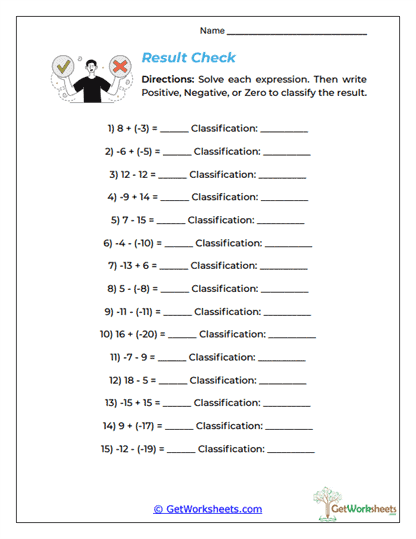
Students solve a mixture of integer additions and subtractions and then classify every result as positive, negative, or zero. That second task encourages them to interpret the answer instead of viewing computation as finished once a number is written. Cancellation examples and mixed-sign situations make prediction particularly useful. The worksheet develops the habit of checking whether the final sign agrees with the numerical relationship in the problem.
Sign Sort
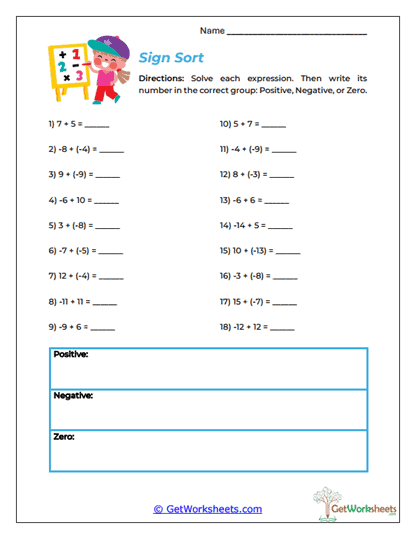
Integer sums are solved and then organized according to whether the result is positive, negative, or zero. Sorting makes recurring sign patterns easier to notice, including same-sign results and exact cancellation between opposites. Students can often predict the category before completing the arithmetic, creating a built-in reasonableness check. This combination of calculation and classification strengthens overall sign awareness.
Subtraction Sprint
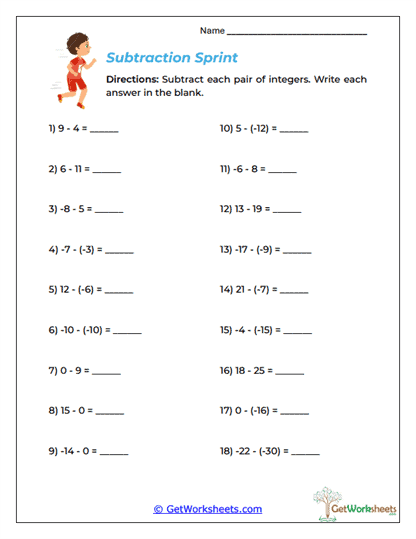
A broad mix of integer subtraction problems gives students practice using addition of the opposite with many sign combinations. Positive-minus-positive, positive-minus-negative, negative-minus-positive, negative-minus-negative, and zero cases all appear. Rewriting first provides a consistent method even when the original expression contains several signs. The repeated practice helps students become more fluent without abandoning the reasoning behind the procedure.
Weather Shifts
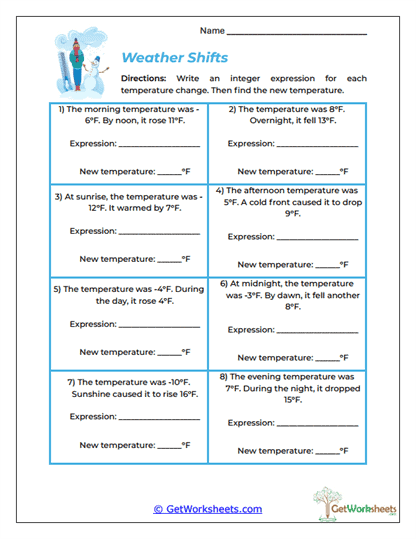
Temperature changes give signed operations a familiar real-world meaning. Students interpret rises as positive movement and drops as negative movement, write an integer expression from each situation, and calculate the new temperature. Problems often cross zero, making the number-line structure especially visible. The worksheet strengthens both integer computation and the ability to translate verbal changes into mathematical expressions.
Bookmark Us Now!
New, high-quality worksheets are added every week! Do not miss out!