Integer Mazes Worksheets
About This Worksheet Collection
Integer mazes turn familiar middle-school skills into decision-based challenges where every answer determines what happens next. Instead of solving isolated problems and moving on, students must calculate, classify, compare, or interpret a result before deciding whether a cell belongs to the correct route. That structure gives integer practice an immediate purpose and encourages learners to check their reasoning when a path unexpectedly stops.
The collection spans addition, subtraction, multiplication, division, absolute value, comparison, number-line movement, temperature changes, ranges, and mixed operations. Some mazes require positive or negative answers, while others depend on even numbers, multiples of 3, true comparisons, values below a benchmark, or results inside a given interval. Because the condition changes from worksheet to worksheet, students must understand both the mathematics in each cell and the rule controlling the path.
As learners work through these activities, they strengthen much more than computation. They practice sign prediction, absolute-value reasoning, divisibility, inequality thinking, operation recognition, number-line movement, and self-correction. A wrong turn becomes useful feedback, making these worksheets especially effective for review, centers, intervention, enrichment, and cumulative practice with integer concepts.
Detailed Descriptions Of These Worksheets
Difference Route
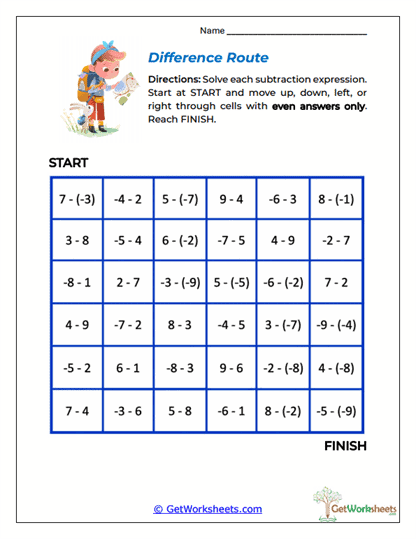
Integer subtraction is combined with an even-number condition. Students rewrite subtraction as addition of the opposite, solve each expression, and move only through cells whose results are even integers. Because negative values and zero can also be even, learners must think carefully about number properties rather than assume only positive results qualify. The maze reinforces both subtraction fluency and classification.
Frosty Route
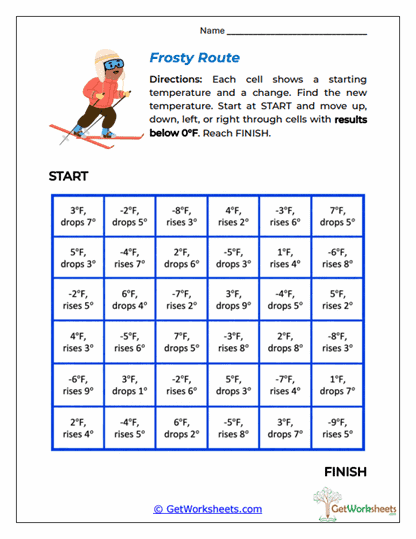
Temperature changes provide the setting for a maze built around results below 0°F. Students interpret rises and drops, calculate the new temperature, and decide whether that value is negative enough to remain on the route. Several problems cross zero, helping learners visualize integer movement in both directions. The weather context makes signed-number changes easier to understand and interpret.
Integer Journey
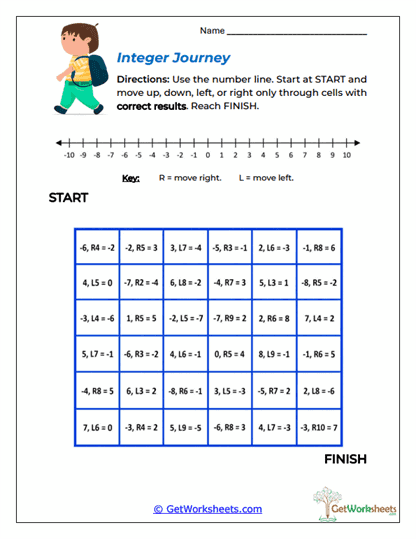
Rather than using operation symbols alone, this maze gives students a starting integer, a direction, and a number of spaces to move on a number line. Learners travel right toward greater values or left toward smaller ones and verify whether each stated result is correct. Crossing zero becomes a natural part of the activity. The worksheet provides a highly visual foundation for later addition, subtraction, and coordinate movement.
Negative Path
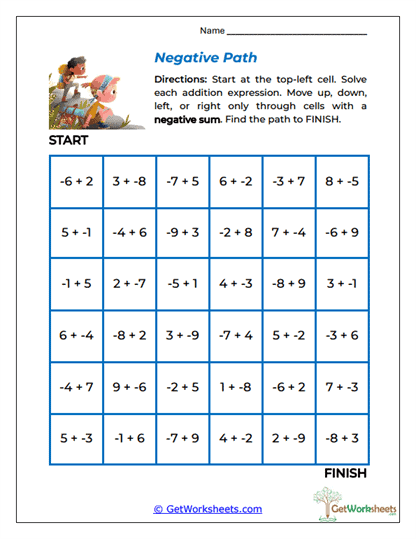
Students navigate through addition expressions whose sums are negative. Mixed-sign problems require them to compare absolute values and determine which sign controls the result, while same-sign cases reinforce familiar patterns. A wrong sign can lead directly to a dead end, so the maze naturally promotes rechecking. The activity is especially useful for strengthening recognition of negative sums.
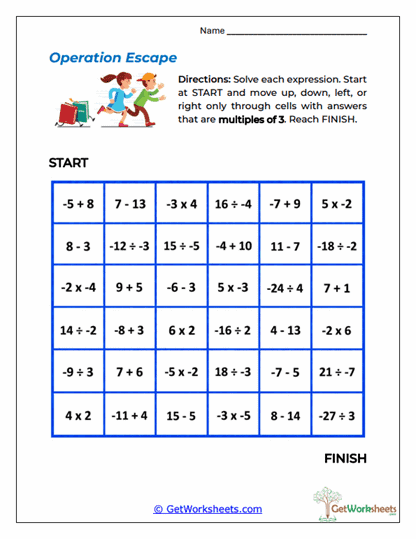
Operation Escape
All four integer operations appear in this cumulative maze, but only results that are multiples of 3 can form the route. Students must identify the operation, apply the correct sign rule, calculate accurately, and then test the answer for divisibility. Negative multiples and zero expand the challenge beyond familiar positive multiplication facts. This makes the worksheet a strong end-of-unit test of flexible integer reasoning.
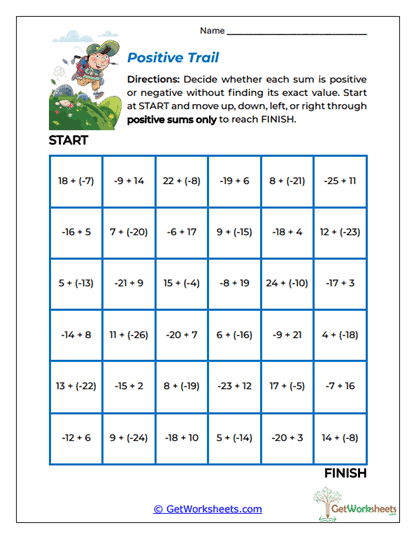
Positive Trail
The correct route passes only through addition expressions with positive sums. In many cells, students can predict the sign by comparing magnitudes before calculating the exact answer. This encourages efficient mental reasoning rather than unnecessary computation. The maze strengthens the idea that a positive result occurs when the positive side outweighs the negative side in a mixed-sign sum.
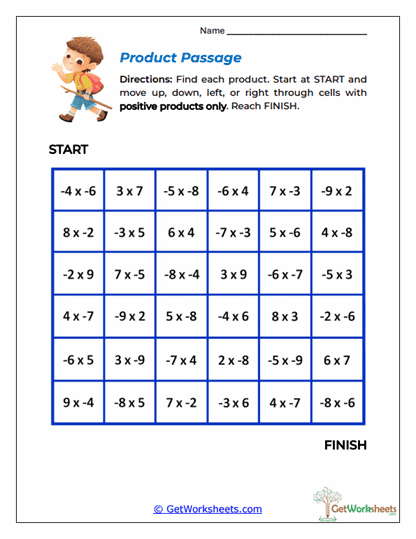
Product Passage
Integer multiplication determines the route, with only positive products allowed. Students repeatedly apply the principle that matching signs produce positive results while different signs produce negative ones. Because sign alone often determines whether a cell qualifies, learners can separate sign reasoning from the multiplication fact itself. This repeated pattern helps integer multiplication rules become more automatic.
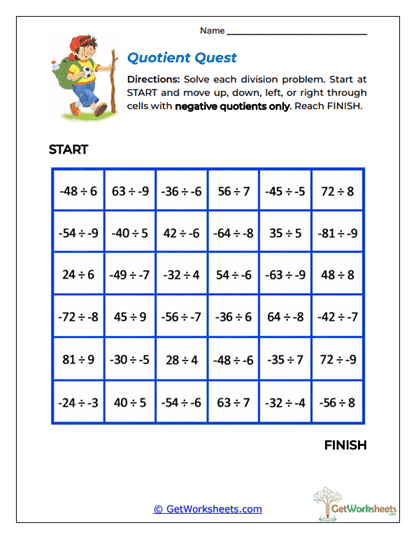
Quotient Quest
Students solve division expressions and follow only cells with negative quotients. The maze reinforces that integer division uses the same sign structure as multiplication: equal signs give positive results and different signs give negative results. Familiar division facts keep attention on sign decisions. The route also gives students immediate feedback when an error in either arithmetic or sign reasoning blocks progress.
Range Run
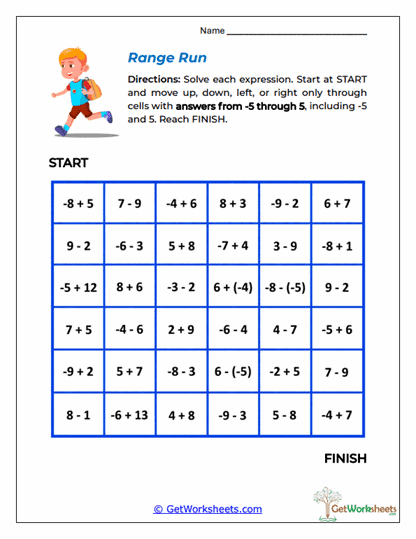
Addition and subtraction answers must fall within the inclusive interval from -5 through 5. Students first calculate the result and then determine whether it lies inside both boundaries. This adds range reasoning to ordinary integer computation and introduces the idea that a set of several values can satisfy the same condition. The activity provides useful preparation for compound inequalities and interval thinking.
Sign Passage
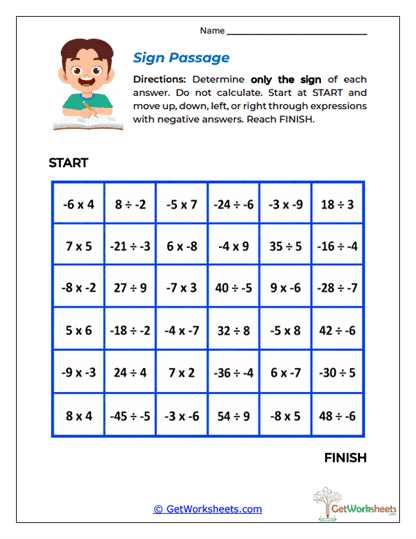
Exact products and quotients are often unnecessary in this maze because students only need to determine whether the result is positive or negative. The route includes only expressions with negative answers, so learners focus entirely on sign relationships. Multiplication and division share the same same-sign/different-sign rule, making the worksheet an efficient way to build rapid sign recognition. It also shows students when full computation is not needed.
Truth Trail
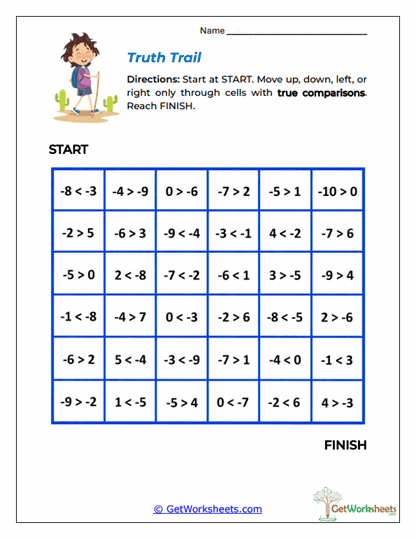
Complete integer comparisons are evaluated as true or false, and only true statements form the path. Students work with positive numbers, negative numbers, zero, and the symbols <, >, and = while relying on number-line order to judge each claim. The maze format makes reversed comparison symbols particularly noticeable because one incorrect judgment can disrupt the route. This activity strengthens both comparison fluency and mathematical logic.
Value Passage
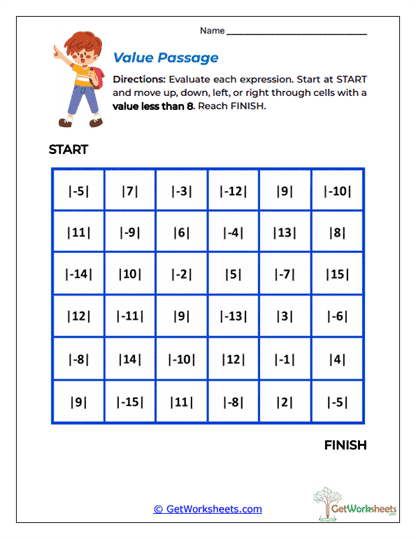
Absolute-value expressions are evaluated and compared with the benchmark of 8. Students move only through cells whose absolute values are less than 8, so they must first interpret each expression as a distance from zero and then apply a comparison condition. Positive and negative integers can produce the same magnitude, reinforcing the distinction between sign and size. The worksheet combines absolute value and inequality reasoning in a compact maze format.
Bookmark Us Now!
New, high-quality worksheets are added every week! Do not miss out!