Integer Arrangement
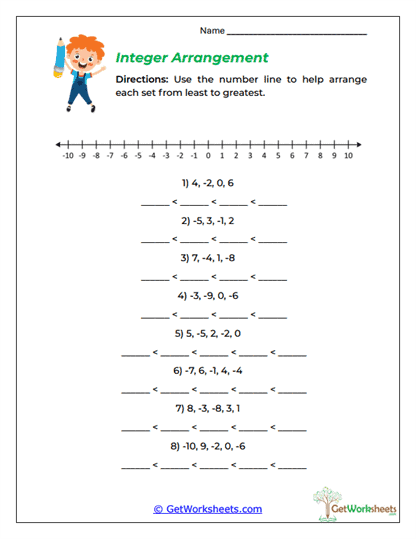
This worksheet asks students to use a number line to arrange sets of integers from least to greatest. Each problem includes several mixed integers, often combining negative numbers, positive numbers, and zero, and students must place them in the correct order with < symbols between them. Because some sets contain several negative values, students need to understand that the number farther left is smaller, even when its digits look larger. The activity strengthens integer ordering, comparison, number-line use, negative-number reasoning, and multi-number organization.
For a parent, the easiest way to explain “least to greatest” is to imagine reading the number line from left to right. The number farthest left comes first. Then keep moving right until all of the values have been used. So if a set contains 4, -2, 0, and 6, the correct order is -2 < 0 < 4 < 6. If a set contains -5, -3, -1, and 2, then -5 comes first because it sits farthest left.
Learning Goals
- Order Several Integers at Once: Students arrange each set from smallest to largest.
- Use the Number Line as a Guide: Learners rely on position rather than digit size.
- Compare Multiple Negative Values: Students practice determining which negative integer is smallest.
- Place Zero Correctly: Learners understand that zero belongs between negative and positive values.
- Write Ordered Chains: Students use < symbols correctly between each consecutive value.
Parent-Friendly Teaching Tips
Use this routine:
- Find the smallest value first.
- Look for the number farthest left on the number line.
- Write it first.
- Keep moving right until all numbers are used.
Example:
7, -4, 1, -8
Order:
-8 < -4 < 1 < 7
The confusing part for many children is the negative side. Remind them that -8 is less than -4 because -8 is farther left.
Why This Worksheet Helps
- Builds Multi-Step Comparison Skills: Students manage several values at the same time.
- Strengthens Number-Line Fluency: Learners repeatedly use left-to-right order.
- Reinforces Negative Integer Relationships: More negative means smaller.
- Prepares for Data Sorting: Ordering numbers is important in statistics, tables, and graphs.
- Supports Inequality Work: Ordered chains naturally connect to compound inequalities later.
Classroom & Home Use
- Great for Cumulative Practice: The worksheet combines comparison and ordering in one task.
- Helpful for Parents: “Start with the farthest-left number” gives families a simple routine.
- Useful for Intervention: Students who reverse negative numbers can refer directly to the printed number line.
- Good for Independent Work: Once the pattern is understood, students can complete each set on their own.
- Strong for Homeschooling: Families can extend the lesson by making paper number cards and physically sorting them.
The real value of this worksheet is that it helps students see integers as part of one continuous ordered system. Negative numbers, zero, positive numbers, comparison symbols, and left-to-right number-line order all work together. For parents, the best coaching phrase is: “Least to greatest means start on the left and move right.” In classroom and homeschool settings, this activity builds the ordering skills students need for inequalities, graphing, data, and later algebra.
Bookmark Us Now!
New, high-quality worksheets are added every week! Do not miss out!