Integer Points
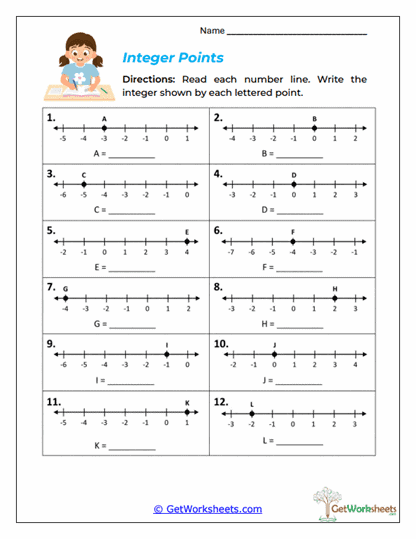
This worksheet gives students direct practice reading integer values from number lines. Each small number line has a marked point labeled with a letter, and students must determine the integer represented by that point. Some points fall on negative values, some on positive values, and others appear close to zero, so students get repeated practice recognizing how integer values are arranged from left to right. The activity strengthens number-line reading, positive and negative integer recognition, zero as a reference point, counting intervals, and basic number sense. It is especially useful for students who understand what positive and negative numbers are but still need practice locating them accurately on a visual model.
For a parent who may not remember integer number lines from school, the basic idea is very simple: numbers get larger as you move to the right and smaller as you move to the left. Zero sits in the middle. Numbers to the left of zero are negative, while numbers to the right are positive. If a point is placed over the tick labeled -3, then that point represents -3. The child is not doing arithmetic here; they are learning how to correctly read position and value.
Learning Goals
- Read Marked Integers: Students identify the value represented by each labeled point.
- Recognize Positive and Negative Positions: Learners distinguish between values on either side of zero.
- Use Zero as an Anchor: Students understand zero as the dividing point between negative and positive integers.
- Count Tick Marks Carefully: Learners practice moving one interval at a time rather than guessing.
- Strengthen Number-Line Fluency: Students become more comfortable interpreting number lines quickly and accurately.
Parent-Friendly Teaching Tips
A simple routine is:
- Find zero first.
- Look at which side of zero the point is on.
- Count the tick marks carefully.
- Write the number with the correct sign.
For example, if the point is three spaces to the left of zero, the value is -3. If it is four spaces to the right, the value is 4.
One common mistake is for students to count the number of spaces but forget the negative sign. Remind them that anything to the left of zero needs a minus sign.
Why This Worksheet Helps
- Builds a Visual Understanding of Integers: Students see where numbers actually belong instead of memorizing isolated facts.
- Prepares for Comparison and Ordering: Once students can locate integers, it becomes easier to decide which is greater or smaller.
- Supports Later Coordinate Work: Reading number lines is a foundation for coordinate planes and graphing.
- Helps Catch Sign Confusion: The visual layout makes it easier to see when a negative sign is required.
- Provides Focused Practice: Each problem targets the same core skill without unnecessary extra steps.
The real value of this worksheet is that it helps students connect an integer with a physical position. Negative numbers are not just numbers with little minus signs attached; they have a clear place to the left of zero. Positive numbers sit to the right, and zero acts as the central reference point. For parents, the best coaching question is: “Where is the point compared with zero?” In classroom and homeschool settings, this worksheet gives students a strong foundation for nearly every other integer skill that follows.
Bookmark Us Now!
New, high-quality worksheets are added every week! Do not miss out!