Comparing and Ordering Integers Worksheets
About This Worksheet Collection
Comparing and ordering integers requires students to understand numbers as positions rather than simply judging them by the size of their digits. Positive values, negative values, and zero all behave predictably on a number line, but negative numbers introduce an important reversal: among negatives, the value closer to zero is greater. This collection helps students build that spatial understanding so comparisons and ordering decisions come from number sense rather than memorized tricks.
The worksheets move from simple comparisons with <, >, and = into least-to-greatest and greatest-to-least ordering, sorting around zero, comparing only negative integers, reading inequalities in words, finding integers within ranges, and solving clue-based comparison problems. Real-world contexts involving temperature and elevation make abstract integer order easier to visualize, while true-or-false and mixed-direction sorting activities require students to check their reasoning carefully. The variety gives grades 6-7 learners repeated opportunities to use the same number-line structure in different ways.
As students work through the collection, they become more comfortable treating zero as a reference point, recognizing that farther right means greater, and distinguishing ordinary digit size from actual integer value. They also begin working with ranges and compound inequalities, where more than one number may satisfy the conditions. These skills create a strong foundation for later work with inequalities, coordinate planes, graphing, algebraic reasoning, data interpretation, and signed quantities in real-world settings.
Detailed Descriptions Of These Worksheets
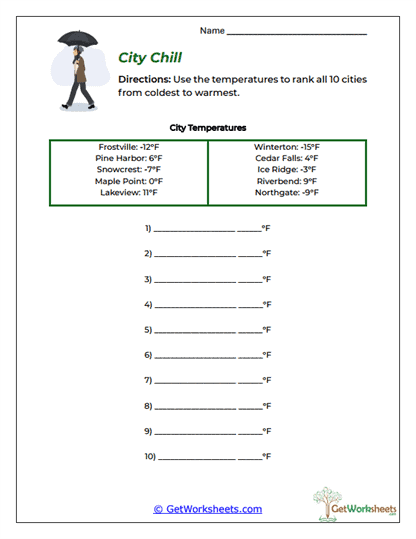
City Chill
Students rank city temperatures from coldest to warmest using both positive and negative values. The familiar thermometer context makes least-to-greatest ordering concrete because colder temperatures correspond to smaller integers. Larger sets require learners to organize several negative, zero, and positive values at once. This activity strengthens ordering while giving negative numbers an intuitive real-world meaning.
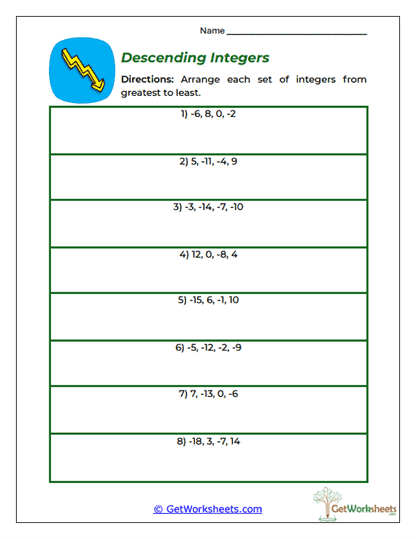
Descending Integers
Integer sets are arranged from greatest to least, requiring students to reverse the direction used in ordinary ascending practice. Positive values generally come first, followed by zero and then negative values, with the negative numbers closest to zero appearing before those farther away. The task reinforces that greatest-to-least ordering corresponds to moving right to left on a number line. Careful attention to directions is just as important as the comparison itself.
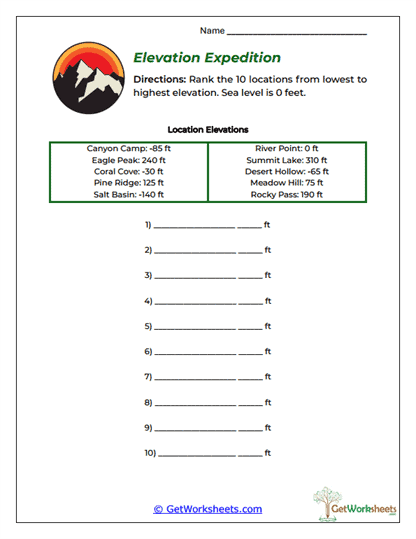
Elevation Expedition
Elevations above and below sea level provide a physical model for integer order. Students interpret negative elevations as positions below zero, positive elevations as positions above zero, and then arrange locations from lowest to highest. This context makes comparisons such as -140 versus -85 easier to visualize because the lower elevation is also the smaller integer. The activity combines geography, number-line thinking, and least-to-greatest ordering.
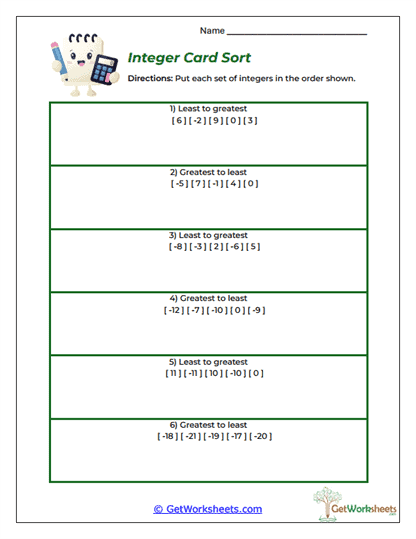
Integer Card Sort
Mixed sets of integers must be ordered in whichever direction each problem requests. Some sets call for least to greatest, while others switch to greatest to least, preventing students from following one routine automatically. Positive numbers, negative numbers, and zero all appear together. This flexible sorting practice makes the worksheet a strong cumulative review of integer order.
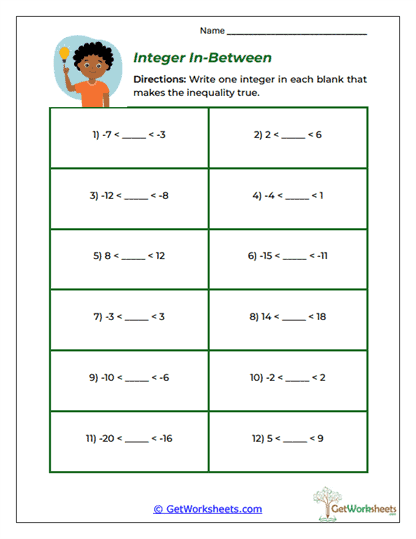
Integer In-Between
Students choose integers that make compound inequalities true. Rather than comparing only two values, they must identify a number that lies between two boundaries and satisfies both sides of the statement. Some problems allow several correct answers, which introduces students to the idea of solution ranges. The worksheet develops number-line reasoning and provides an early bridge to algebraic inequalities.
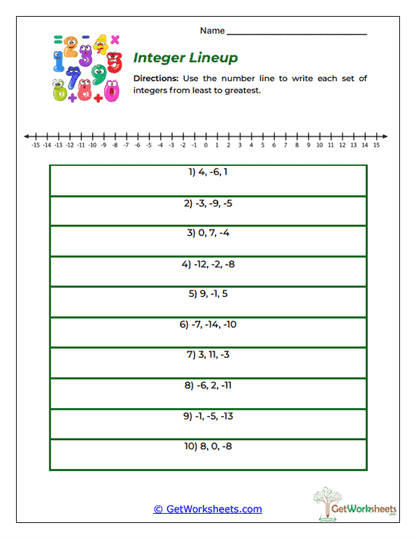
Integer Lineup
Sets of integers are ordered from least to greatest with support from a number line. Students identify the farthest-left value first and continue moving right until the full set is arranged. Negative-number groups provide especially useful practice because more negative values must appear earlier. The visual structure helps students develop a reliable ordering method before working without support.
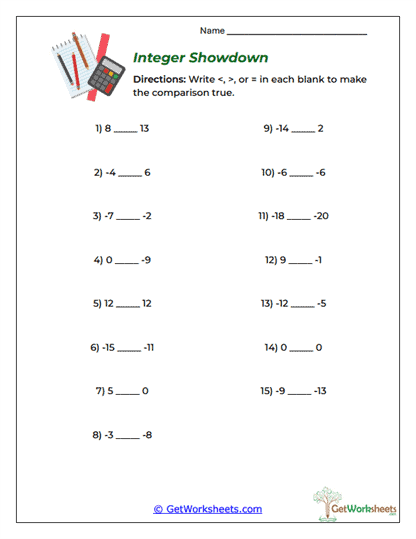
Integer Showdown
Pairs of positive integers, negative integers, and zero are compared using <, >, or =. Students learn that number-line position determines which value is greater, especially when both numbers are negative. Examples involving zero reinforce its role as the dividing point between negative and positive values. This focused comparison practice provides the groundwork needed before students begin ordering larger sets.
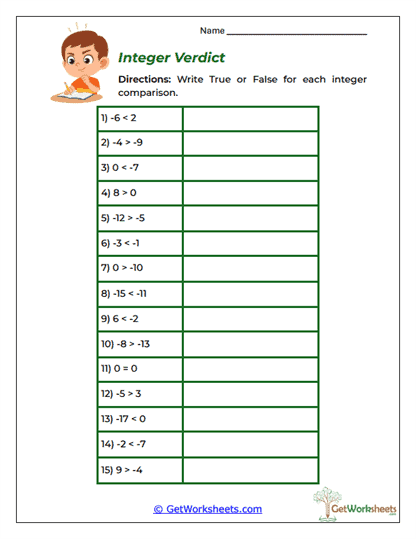
Integer Verdict
Completed integer comparisons are evaluated as true or false. Instead of supplying a missing symbol, students must decide whether an entire mathematical statement accurately reflects the order of the values. This makes number-line reasoning and symbol interpretation part of the checking process. The format is particularly useful for revealing misconceptions about negative-number order.
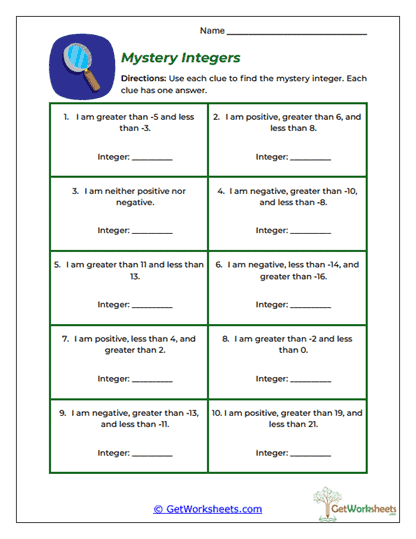
Mystery Integers
Short clues describe an unknown integer using phrases such as greater than, less than, positive, or negative. Students combine all of the information to identify the single integer that fits the conditions. The riddle-like structure turns comparison into logical reasoning within a numerical range. It also strengthens the language students will later encounter in symbolic inequalities.
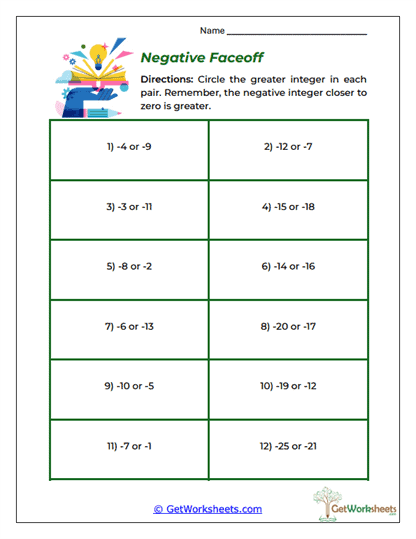
Negative Faceoff
Only negative integers are compared, allowing students to concentrate on one of the most common sources of confusion. The central idea is that the negative value closer to zero is greater, even when its digits appear smaller. Repeated pairs help students stop treating negatives like ordinary positive counting numbers. This focused practice supports more accurate ordering of larger mixed integer sets later.
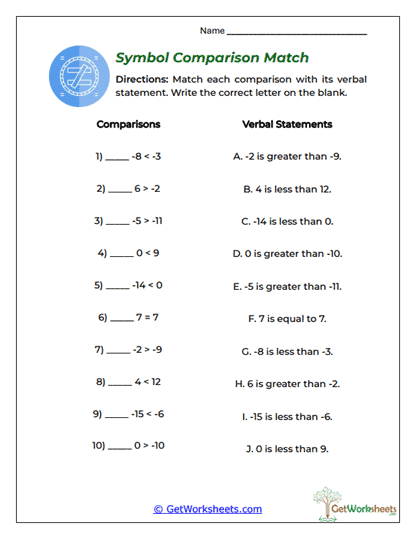
Symbol Comparison Match
Symbolic comparisons are matched with equivalent verbal statements. Students connect <, >, and = with phrases such as "is less than," "is greater than," and "is equal to," strengthening both math vocabulary and comprehension. Reading each comparison aloud helps learners interpret the statement from left to right rather than rely on visual tricks alone. This skill becomes especially useful when students begin reading and writing inequalities.
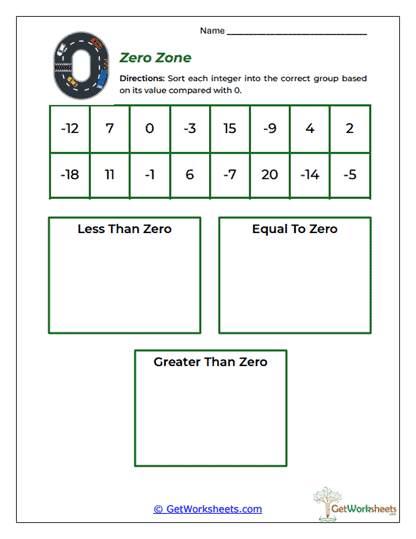
Zero Zone
Students sort integers into three categories: less than zero, equal to zero, and greater than zero. The task establishes zero as the central reference point separating negative and positive values. Because no arithmetic is required, learners can focus entirely on sign meaning and position. This worksheet offers a simple foundation for later comparison, ordering, and inequality work.
Bookmark Us Now!
New, high-quality worksheets are added every week! Do not miss out!