All Operations with Integers Worksheets
About This Worksheet Collection
Working with all four integer operations requires students to do more than remember a collection of sign rules. They must first recognize whether a problem involves addition, subtraction, multiplication, or division, then choose the strategy that fits that operation and carry it through accurately with positive and negative values. This collection is designed to build that flexibility so students can move confidently among operations instead of treating each one as a completely separate topic.
The worksheets include mixed computation, operation sorting, matching, sign classification, comparison, missing-value equations, decoding puzzles, order-of-operations practice, and real-world word problems. Students solve single-step expressions, compare different operations using the same integers, work backward to find unknown values, evaluate multi-step expressions, and translate situations involving scores, temperature, debt, elevation, and shared quantities into mathematical equations. The variety helps grades 6-7 learners apply integer rules in changing formats rather than rely on one repeated problem pattern.
Across the collection, students strengthen both procedural fluency and mathematical judgment. They learn to pause before calculating, identify the operation, predict the likely sign of a result, use inverse operations when working backward, and check whether an answer makes sense in context. These habits prepare learners for algebraic expressions, equations, inequalities, coordinate work, order of operations, and other middle-school mathematics where signed numbers and multiple operations appear together.
Detailed Descriptions Of These Worksheets
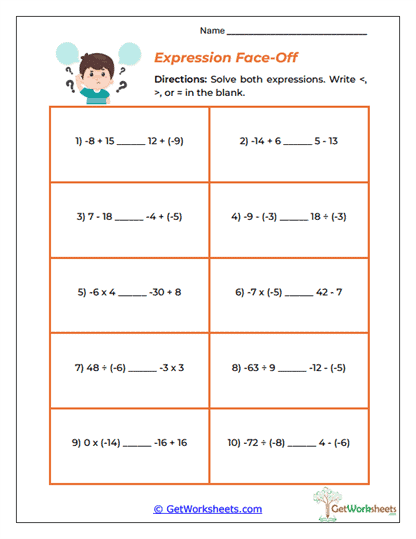
Expression Face-Off
Students solve two separate integer expressions and then compare the results using <, >, or =. Because addition, subtraction, multiplication, and division may appear on either side, learners must manage the arithmetic accurately before deciding which final value is greater. Negative results add an important layer of reasoning because the value closer to zero is the greater number. The activity combines computation with integer ordering and careful comparison.
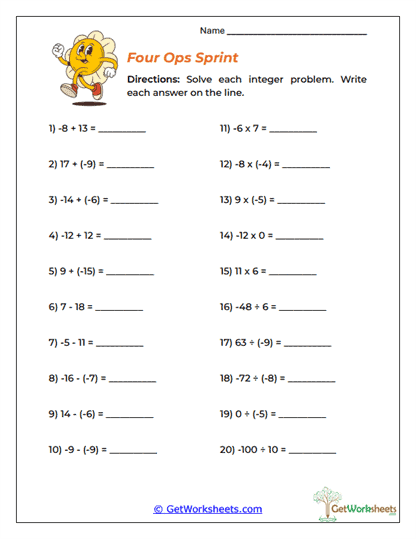
Four Ops Sprint
All four integer operations appear together in a broad mixed-practice set. Students must identify whether each expression requires addition, subtraction, multiplication, or division before choosing the appropriate sign rule. Constantly switching operations prevents them from applying one memorized rule automatically to every problem. This makes the worksheet especially useful for cumulative review and for identifying which operation still causes difficulty.
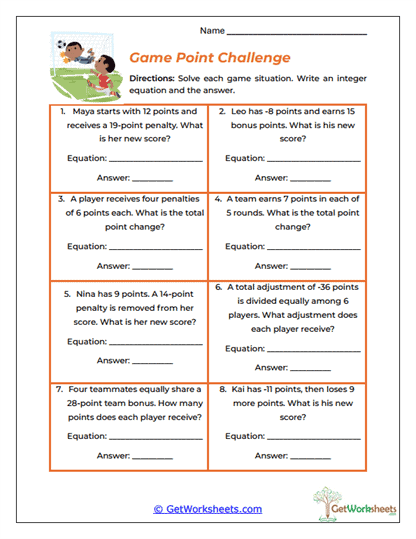
Game Point Challenge
Game scores and point adjustments provide the setting for choosing and applying integer operations. Students interpret bonuses, penalties, repeated point changes, and shared adjustments before writing and solving an equation. Because the operation is embedded in the story, learners must understand what happened rather than simply react to a visible symbol. The context also makes negative scores and directional changes easier to interpret.
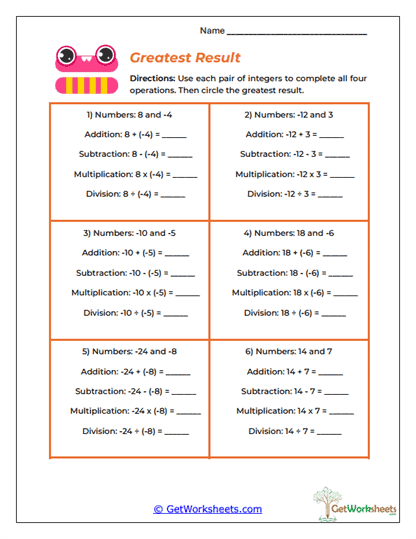
Greatest Result
The same pair of integers is used with addition, subtraction, multiplication, and division, allowing students to see how strongly the operation affects the outcome. After solving all four expressions, learners determine which result is greatest. This requires both accurate computation and sound integer comparison, particularly when several answers are negative. The format encourages deeper thinking about the relationship between operations, signs, and magnitude.
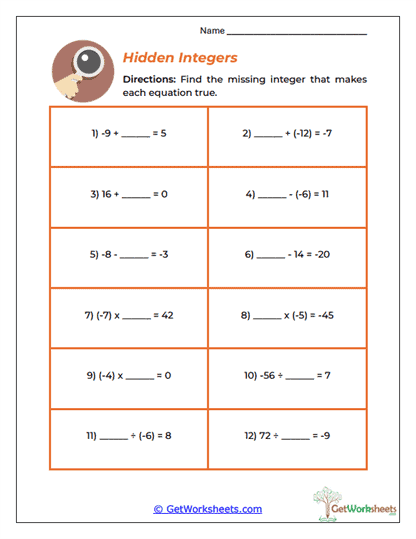
Hidden Integers
Missing-value equations require students to work backward across all four operations. Instead of calculating a result directly, learners determine which integer must fill the blank to make each equation true. Addition and subtraction problems call for inverse reasoning, while multiplication and division require students to undo the given operation carefully. This activity serves as a strong bridge from integer arithmetic into introductory algebra.
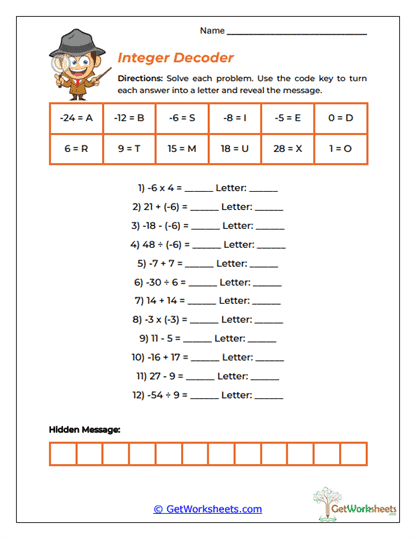
Integer Decoder
Mixed integer expressions become part of a decoding puzzle in which each numerical answer corresponds to a letter. Students solve addition, subtraction, multiplication, and division problems, then use a code key to reveal a hidden message. An answer that does not appear in the key signals that the calculation or sign should be checked. The puzzle format encourages persistence and gives students a natural reason to correct their own work.
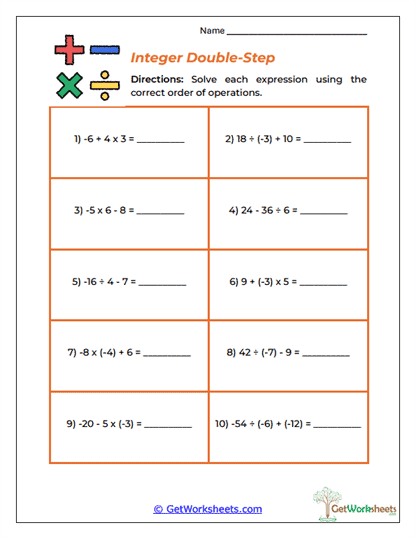
Integer Double-Step
Multi-step expressions require students to combine integer sign rules with the correct order of operations. Problems include several operations in the same expression, so learners must decide what to calculate first rather than working automatically from left to right. Writing intermediate steps helps keep signs and operations organized. The activity builds the disciplined, sequential reasoning students will need for algebraic expressions.
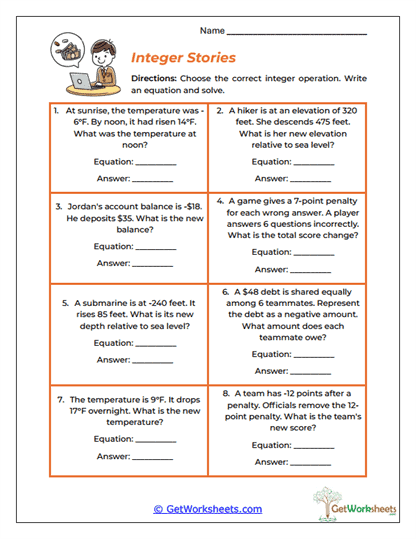
Integer Stories
Real-life situations involving temperature, elevation, debt, penalties, gains, losses, and shared amounts require students to choose the appropriate integer operation themselves. They translate each scenario into an equation, solve it, and interpret the result in context. Because no operation symbol is supplied in advance, the task tests whether students understand the mathematical action described by the story. This makes it a strong cumulative application of the entire topic.
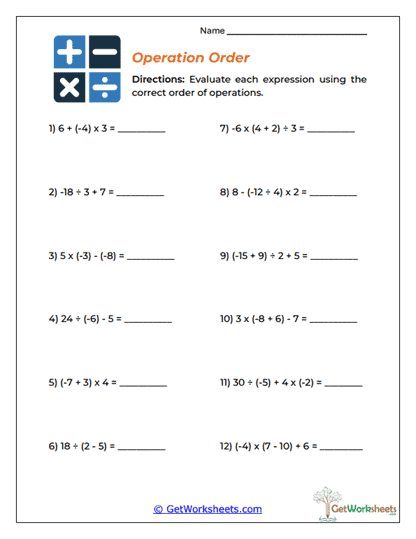
Operation Order
Students evaluate expressions that contain multiple integer operations and grouping symbols. Parentheses, multiplication, division, addition, and subtraction must be handled in the proper sequence while the correct sign rules are applied at each stage. The combination of order-of-operations reasoning and integer arithmetic makes careful written work especially important. This worksheet provides direct preparation for more advanced numerical and algebraic expressions.
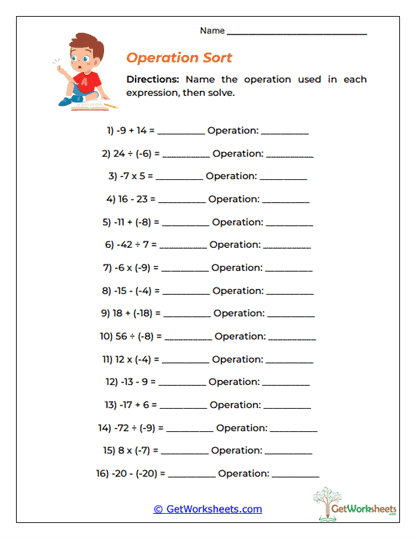
Operation Sort
Each problem begins with an extra identification step: students name the operation before solving the integer expression. This forces them to distinguish addition, subtraction, multiplication, and division before selecting a sign rule. The format is particularly useful for preventing mistakes caused by reacting to negative signs without noticing the actual operation symbol. It also strengthens mathematical vocabulary and careful reading.
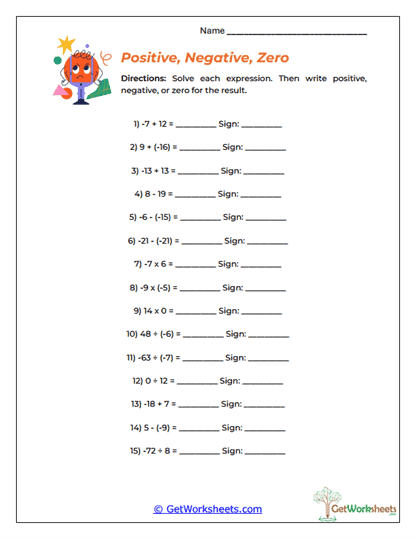
Positive, Negative, Zero
Students solve mixed-operation expressions and then classify every result as positive, negative, or zero. Predicting the sign gives learners an additional way to check whether their calculations are reasonable. Multiplication and division patterns, cancellation between opposites, and mixed-sign addition all appear naturally throughout the page. The classification step turns routine computation into a stronger exercise in number sense.
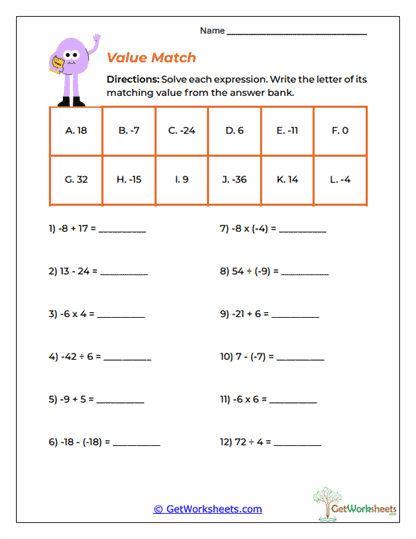
Value Match
Students solve mixed integer expressions and connect each result with a value in a lettered answer bank. Finding the correct match requires both the right magnitude and the right sign, so even a small sign mistake becomes immediately visible. The answer bank provides built-in feedback and encourages students to revisit questionable work independently. This format makes comprehensive integer review feel more like a puzzle than a standard drill.
Bookmark Us Now!
New, high-quality worksheets are added every week! Do not miss out!