Integer In-Between
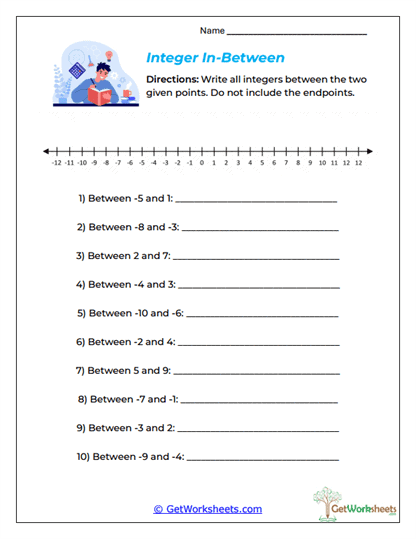
This worksheet gives students practice finding all the integers between two given values, while making sure they do not include the endpoints themselves. Problems include ranges such as between -5 and 1, between -8 and -3, between 2 and 7, and between -10 and -6. A number line is provided so students can visually locate the two endpoints and then list the values that fall strictly in between. This strengthens integer order, sequence, range thinking, number-line reading, and careful attention to directions.
For a parent, the key phrase is “between, but not including the endpoints.” If the problem says “between -5 and 1,” the child should list -4, -3, -2, -1, and 0. They should not include -5 or 1 because those are the boundary values. This is a useful skill because it begins to prepare students for later work with ranges and inequalities.
Learning Goals
- Identify Integers Inside a Range: Students list every whole-number integer between two endpoints.
- Exclude the Endpoints: Learners pay attention to the instruction not to include the boundary numbers.
- Count Across Negative and Positive Values: Students practice moving through zero when needed.
- Strengthen Integer Sequence: Learners reinforce the order of consecutive integers.
- Prepare for Inequalities: Students begin to think about values that satisfy a condition within a range.
Parent-Friendly Teaching Tips
Use this routine:
- Find the two endpoint numbers.
- Start one integer after the smaller endpoint.
- Count by ones.
- Stop one integer before the larger endpoint.
For example:
Between -3 and 2
The integers are:
-2, -1, 0, 1
Do not include -3 or 2.
Another example:
Between 5 and 9
The integers are:
6, 7, 8
Why This Worksheet Helps
- Builds Range Understanding: Students learn that a set of values can lie between two boundaries.
- Strengthens Counting Through Zero: Learners get practice moving smoothly from negatives to positives.
- Encourages Careful Reading: The phrase “do not include the endpoints” matters.
- Prepares for Algebra: This is an early step toward understanding strict inequalities such as -5 < x < 1.
- Supports Number-Line Fluency: Students use position and sequence together.
Classroom & Home Use
- Great for Small-Group Discussion: Students can explain why certain values belong and others do not.
- Useful for Parents: The “start after, stop before” rule is easy to remember.
- Good for Intervention: Number lines help students who lose track of negative-number order.
- Strong for Enrichment: Teachers can ask students to rewrite each range as an inequality.
- Helpful for Homeschooling: Parents can easily create additional examples with different endpoints.
The real value of this worksheet is that it teaches students to think of integers as a continuous ordered set rather than isolated numbers. Endpoints, ranges, sequence, negative values, zero, and positive values all work together. For parents, the best reminder is: “Start after the first number and stop before the second.” In classroom and homeschool settings, this worksheet builds number-line confidence and lays useful groundwork for future inequality work.
Bookmark Us Now!
New, high-quality worksheets are added every week! Do not miss out!