Crowd Quick Count
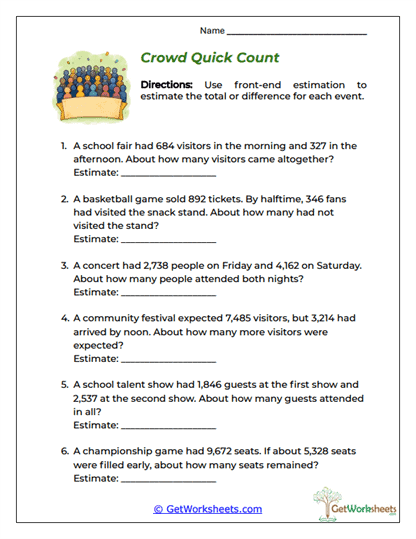
This worksheet uses crowds, ticket sales, festivals, concerts, and other large events to show students how front-end estimation can simplify real-world addition and subtraction. Students read short situations, pull out the leading place values from each quantity, and then estimate either the total number of people or the difference between two groups. Because the problems involve hundreds and thousands of people, students practice front-end estimation, addition, subtraction, place value, word-problem comprehension, number magnitude, and mental math in situations where exact counting would be slow and unnecessary. It is a strong grades 4-5 activity for students who are ready to connect estimation with real situations instead of working only with isolated number sentences.
Key Learning Objectives
- Estimate Large Crowds: Students simplify attendance numbers to their leading values before combining or comparing them.
- Choose Addition or Subtraction: Learners must understand whether the problem asks for a total crowd or how many people remain, differ, or have not arrived.
- Use Place Value in Context: Numbers in the hundreds and thousands become easier to understand when students focus on the biggest place first.
- Interpret Word Problems: Students must read carefully enough to know what the quantities represent before estimating.
Educational Value
- Makes Big Numbers Feel Manageable: A crowd of 7,485 becomes much less intimidating when students first think of it as about 7,000.
- Parent-Friendly Discussion: Families can ask, “Are we combining these groups or comparing them?”
- Builds Practical Number Sense: Students see why a rough attendance count can still be useful even when it is not exact.
- Supports Reading and Math Together: Understanding phrases such as “in all,” “had not visited,” and “seats remained” becomes part of the math.
- Flexible No-Prep Resource: The worksheet works well for homework, centers, intervention, review, enrichment, or homeschool lessons.
The strength of this worksheet is that front-end estimation suddenly feels like something people might actually use. Attendance, crowds, ticket counts, addition, subtraction, place value, approximate totals, and number sense all come together as students make quick judgments about large groups. For parents, this can be explained as getting a fast crowd count without needing to tally every person exactly. A student who sees about 2,000 people on one night and about 4,000 on another can quickly predict a total around 6,000 before doing any exact addition. In classroom and homeschool settings, this practice makes large numbers friendlier while strengthening estimation fluency and confidence with addition and subtraction word problems.
Bookmark Us Now!
New, high-quality worksheets are added every week! Do not miss out!