Estimate Upgrade
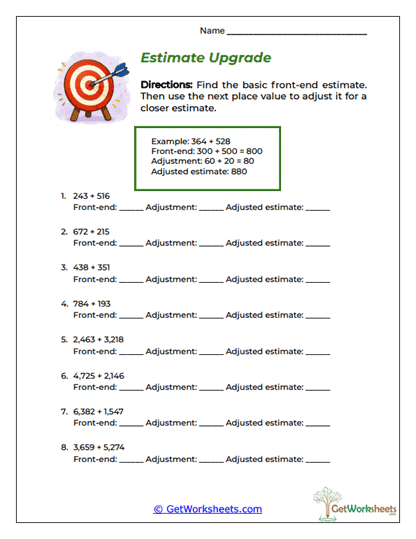
This worksheet takes front-end estimation to a more advanced level by teaching students how to improve a rough estimate with an adjustment. Students first find the basic front-end values, then look at the next place value they originally left out, use that information to make an adjustment, and combine the two parts for a closer estimated answer. That extra step strengthens front-end estimation, place value, addition, adjustment strategies, mental math, number sense, and estimation accuracy while helping students understand why a first estimate can sometimes be improved. It is especially appropriate for grades 4-5 students who already understand basic front-end estimation and are ready to refine their answers instead of stopping at the roughest possible approximation.
Targeted Skills
- Build a Basic Front-End Estimate: Students first keep the leading place value of each addend and combine those values.
- Use the Next Place Value: Learners return to the ignored digits and use the next-largest place to create an adjustment.
- Improve Estimate Accuracy: Students add the adjustment to the first estimate to produce a result that is usually closer to the exact sum.
- Think About Estimation Quality: The worksheet helps students see that estimation can be refined when greater accuracy is useful.
Instructional Benefits
- Shows Estimation as a Process: Students learn that an estimate does not have to be one-and-done; it can be improved.
- Parent-Friendly Explanation: Adults can say, “Start with the big pieces, then add back one smaller piece to make the estimate closer.”
- Strengthens Place-Value Layers: Students work with thousands, hundreds, tens, and other places as connected parts of the same number.
- Builds Flexible Mental Math: Learners combine a large rough estimate with a smaller adjustment instead of completing full exact addition.
- Good for Challenge and Enrichment: This worksheet works especially well after students have mastered basic front-end estimation.
This worksheet helps students understand that estimation can have levels of accuracy. Front-end values, place value, addition, adjustments, mental computation, approximation, accuracy, and number sense all work together as students upgrade a rough answer into a closer one. For parents, a helpful way to think about it is that the first estimate gives the broad picture, while the adjustment fills in one more layer of detail. Students begin seeing numbers as pieces-thousands, hundreds, tens-rather than as a single block that must always be calculated exactly. In classroom and homeschool settings, this activity develops more mature estimation thinking and helps students become comfortable choosing between a quick rough estimate and a more carefully adjusted one.
Bookmark Us Now!
New, high-quality worksheets are added every week! Do not miss out!