Estimate Investigators
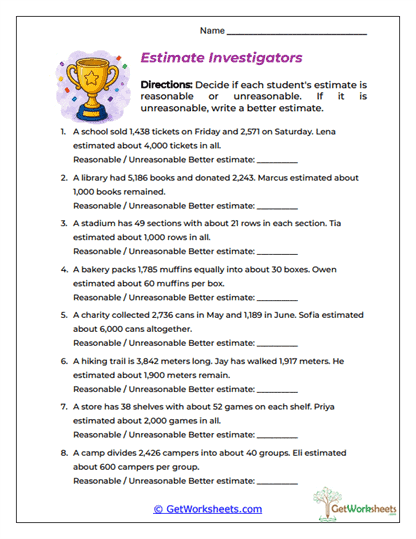
This worksheet asks students to investigate another student’s estimate and decide whether the mathematical thinking is reasonable or needs to be repaired. The problems mix addition, subtraction, multiplication, and division through situations involving ticket sales, library books, classrooms, bakery packing, charity collections, hiking distances, store shelves, and camp groups. Students must understand the story, identify the operation, examine the proposed estimate, and then create a better estimate when necessary, bringing together estimation, compatible numbers, rounding, mental math, number sense, error analysis, and mathematical reasoning. It is a strong grades 4-5 activity for students who already know basic estimation strategies and are ready to judge the quality of someone else’s approach.
Key Learning Objectives
- Evaluate Proposed Estimates: Students decide whether an approximate answer is sensible for the numbers and situation given.
- Work Across Four Operations: Addition, subtraction, multiplication, and division estimates appear together, so learners must stay alert to the structure of each problem.
- Correct Weak Reasoning: When an estimate is unreasonable, students create a better approximation rather than simply marking the original one wrong.
- Strengthen Operation Sense: Students must understand what the quantities are doing in the story before they can judge the estimate.
Instructional Benefits
- Turns Errors Into Learning Opportunities: Students study incorrect thinking and determine what would make the estimate more useful.
- Great for Parent Discussion: Families can ask, “Does that answer sound about right? What easier numbers would give us a better estimate?”
- Builds Self-Checking Habits: Evaluating someone else’s work helps students become more critical of their own answers.
- Rich Mixed Review: One worksheet revisits rounding, compatible numbers, all four operations, and reasonableness.
- Useful for Assessment: Teachers can see whether students understand estimation conceptually rather than only being able to follow a memorized procedure.
This worksheet helps students understand that an estimate can be mathematically easy to calculate and still be a poor estimate. Addition, subtraction, multiplication, division, rounding, compatible numbers, error analysis, reasonableness, and number sense all work together as students inspect each proposed answer. For parents, the goal is to help children ask a simple but powerful question: “Is this close to what the original problem should give us?” That question encourages students to think about the size and meaning of the answer instead of blindly trusting a completed calculation. In classroom and homeschool settings, this activity builds stronger mathematical judgment, more careful reasoning, and the confidence to challenge and correct an estimate that does not fit the situation.
Bookmark Us Now!
New, high-quality worksheets are added every week! Do not miss out!