Size It Up
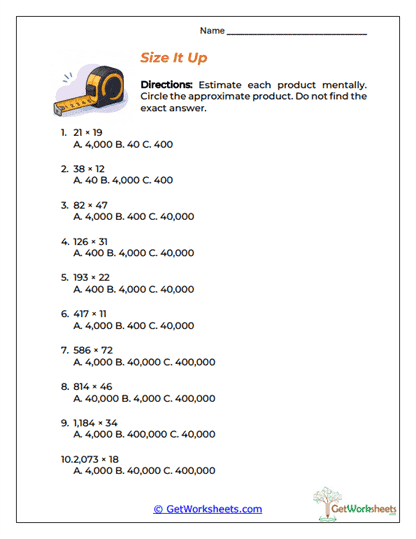
This worksheet focuses on helping students recognize the approximate size of a multiplication product without calculating the exact answer. Students look at each multiplication expression, estimate mentally, and choose the approximate product from several choices that may differ by a factor of ten or even one hundred. That means students must use rounding, multiplication, estimation, place value, number magnitude, mental math, and number sense to decide whether a product belongs in the hundreds, thousands, tens of thousands, or hundreds of thousands. This is especially helpful for grades 4-5 students who may know their multiplication procedures but still need practice understanding how large a product should actually be.
Academic Focus
- Recognize Product Size: Students determine the general magnitude of a multiplication answer rather than finding an exact product.
- Estimate Mentally: Learners round or simplify the factors in their heads to quickly determine which choice is reasonable.
- Strengthen Place Value: Answer choices such as 400, 4,000, and 40,000 force students to pay attention to the value and number of digits.
- Reject Unreasonable Answers: Students practice identifying choices that are much too small or much too large for the original expression.
Learning Benefits
- Excellent for Number Sense: Students learn that multiplication is not just a written procedure-they should also understand the approximate size of the result.
- Simple for Parents to Support: Families can ask, “Should the answer be hundreds, thousands, or tens of thousands?” before worrying about precise calculation.
- Encourages Efficient Thinking: Because students are told not to find the exact answer, they must rely on estimation and mental math.
- Helps Prevent Place-Value Mistakes: Comparing answers that differ by zeros can reveal whether students really understand the size of a product.
- Flexible Practice: The worksheet fits well into warm-ups, math centers, homework, intervention, test review, or homeschool lessons.
The real value of this activity is that it helps children develop a feeling for how multiplication changes the size of numbers. Estimation, multiplication, place value, magnitude, rounding, mental computation, comparison, and number sense all work together while students decide which approximate product is realistic. For example, a child who knows that about 200 times 40 is around 8,000 has a much better chance of noticing when an exact answer accidentally comes out as 800 or 80,000. Parents do not need to teach a complicated new algorithm to help with this skill; simply talking about whether an answer should be in the hundreds or thousands can be very useful. In both classroom and homeschool settings, this worksheet strengthens mathematical judgment and prepares students to check larger multiplication problems with much more confidence.
Bookmark Us Now!
New, high-quality worksheets are added every week! Do not miss out!