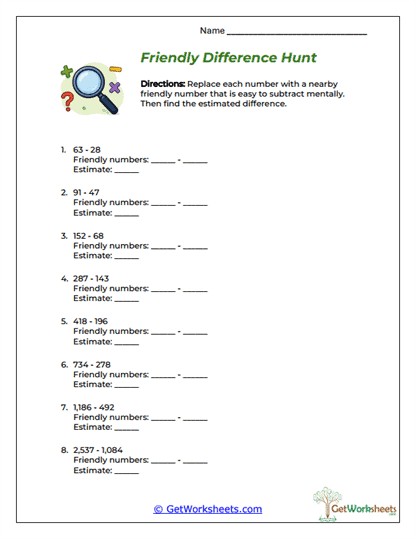
Friendly Difference Hunt
This worksheet helps students learn a very practical estimation strategy: changing awkward numbers into nearby “friendly numbers” that are easier to subtract mentally. For each problem, students look at the two original numbers, choose nearby values that work well together, and then subtract those easier numbers to find an estimated difference. This gives students practice with compatible numbers, subtraction, estimation, mental math, number sense, place value, and flexible thinking rather than requiring them to follow only one fixed rounding rule. It is especially useful for grades 4-5 students who understand basic subtraction but need more experience choosing numbers that make calculations easier and faster.
Learning Goals
- Choose Friendly Numbers: Students replace each original value with a nearby number that is easier to work with mentally.
- Estimate Differences: After selecting compatible numbers, students subtract to produce a reasonable approximate answer.
- Develop Flexible Number Sense: Students learn that there can be more than one useful way to simplify a subtraction problem.
- Strengthen Mental Math: Working with easier numbers helps students become less dependent on lengthy written computation.
Classroom & Home Use
- Easy to Explain at Home: Parents can simply ask, “What nearby number would make this easier to subtract?” instead of needing to teach a complicated rule.
- Encourages Student Choice: Unlike exercises that tell students exactly where to round, this activity gives them some responsibility for choosing useful numbers.
- Works Across Different Number Sizes: Students practice with two-digit, three-digit, and four-digit subtraction problems.
- Great for Math Discussions: Teachers can compare different friendly-number choices and show students that more than one estimate may be reasonable.
- Low-Prep Practice: The sheet works well for independent work, centers, homework, intervention, review, or homeschool lessons.
This worksheet is valuable because students begin to see numbers as quantities they can work with flexibly instead of as fixed digits that always require one exact procedure. Compatible numbers, estimation, subtraction, mental computation, place value, number sense, and approximation all come together as students decide which nearby values will make each problem easier. That kind of thinking can help a child handle everyday situations where a quick answer is more useful than an exact one. It also prepares students for more advanced problem solving because they are learning to choose an efficient strategy rather than waiting to be told exactly what to do. In both classroom and homeschool settings, this practice can build confidence with larger numbers and help students become more independent mathematical thinkers.
Bookmark Us Now!
New, high-quality worksheets are added every week! Do not miss out!