Rounding Decisions
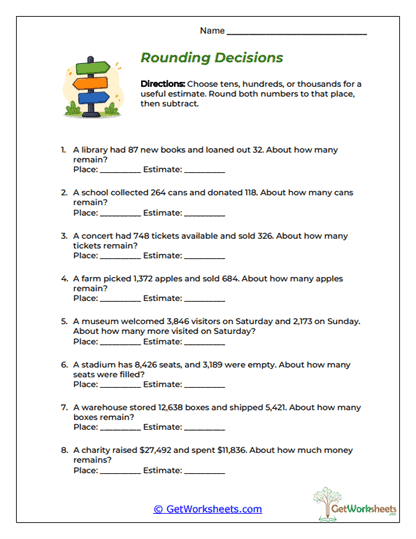
This worksheet takes estimation a step further by asking students to decide for themselves whether rounding to the nearest ten, hundred, or thousand makes the most sense for each subtraction situation. Instead of being told exactly how to round every problem, students read a short real-world situation, choose an appropriate place value, round both numbers, and then subtract to find an estimated difference. That decision-making process gives students meaningful practice with rounding, subtraction, estimation, place value, number sense, word problems, and mathematical reasoning while showing them that not every problem needs to be approached in exactly the same way. It is especially useful for grades 4-5 students who already know the mechanics of rounding and are ready to become more independent in choosing an estimation strategy.
Targeted Skills
- Choose a Rounding Place: Students decide whether tens, hundreds, or thousands will give a useful estimate for the numbers in each situation.
- Estimate Real-World Differences: Learners apply subtraction estimation to books, cans, tickets, apples, museum visitors, stadium seats, boxes, and money.
- Use Number Size as a Guide: Students begin recognizing that larger numbers often call for a broader estimate, while smaller numbers may be better rounded more closely.
- Explain Mathematical Decisions: Choosing the place value before solving encourages students to think about why a particular estimation method is appropriate.
How This Helps
- Builds Independence: Students are not simply following “round to the nearest hundred” directions; they have to make part of the mathematical decision themselves.
- Helpful for Parent Conversations: A parent can ask, “Do we need a very close estimate here, or would a bigger rounded number be enough?”
- Connects Skills Naturally: Reading comprehension, rounding, subtraction, and estimation are combined in one practical activity.
- Supports Different Skill Levels: Some students can focus on choosing the place value, while stronger students can explain why their choice produces a useful estimate.
- Easy to Use Anywhere: The worksheet works well for classwork, homework, small groups, intervention, assessment, or homeschool practice.
This kind of practice is important because students eventually need to know not only how to round, but also when and how much to round. Estimation, subtraction, place value, word-problem solving, number sense, approximation, and mathematical judgment all come together as students decide what level of precision each situation really needs. A child comparing two three-digit quantities may choose a different strategy than a child comparing numbers in the thousands, and learning to recognize that difference makes estimation much more useful. The activity also helps parents and teachers see whether a student understands the purpose behind rounding instead of simply memorizing a procedure. With classroom or homeschool practice, students can become more confident choosing efficient strategies and making sensible decisions with larger numbers.
Bookmark Us Now!
New, high-quality worksheets are added every week! Do not miss out!