Ratio Builders
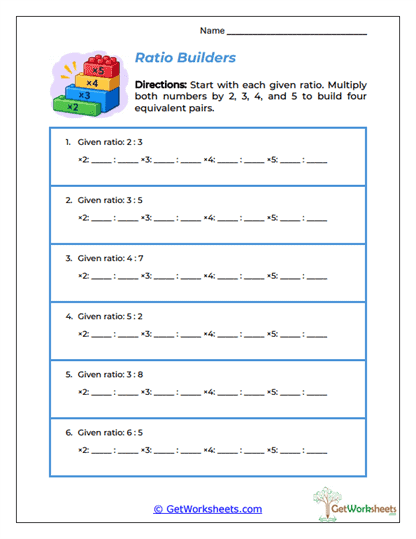
This worksheet teaches students to build equivalent ratios on purpose. Each problem begins with a given ratio, such as 2:3, 3:5, 4:7, or 5:2. Students then multiply both parts by 2, 3, 4, and 5 to create four new equivalent ratios. This is an excellent foundational activity because instead of only recognizing equivalent ratios after they are given, students actively create the ratio family themselves.
For a parent, this is much like making several larger versions of the same recipe. If the original ratio is 2:3, multiplying both parts by 2 gives 4:6. Multiplying both by 3 gives 6:9. Multiplying both by 4 gives 8:12. All of those ratios look different, but they describe the same relationship because both parts were multiplied by the same number.
Learning Goals
- Generate Equivalent Ratios: Students create new ratios from a starting pair.
- Multiply Both Terms Consistently: Learners apply the same factor to both quantities.
- Build Ratio Families: Students see several equivalent forms of one relationship.
- Strengthen Multiplication Fluency: Learners practice basic facts within proportional reasoning.
- Understand Why Ratios Stay Equivalent: Students see that changing both parts by the same factor preserves the relationship.
Parent-Friendly Explanation
Start with:
2 : 3
Multiply both parts by 2:
2 × 2 = 4
3 × 2 = 6
So:
4 : 6
Multiply both parts by 3:
2 × 3 = 6
3 × 3 = 9
So:
6 : 9
Continue the same way for ×4 and ×5.
The rule is simple:
“Whatever multiplier you use on the first number, use the exact same multiplier on the second.”
Why This Worksheet Helps
- Builds Equivalent Ratios from the Ground Up: Students see exactly where larger ratio pairs come from.
- Makes Scale Factors Concrete: Each new ratio is labeled by its multiplier.
- Strengthens Multiplication Facts: Basic facts are practiced in a meaningful setting.
- Prepares for Ratio Tables: The new equivalent ratios could easily become columns in a ratio table.
- Supports Proportion Understanding: Students see why ratios such as 2:3 and 8:12 can represent the same relationship.
Classroom & Home Use
- Excellent for Introductory Lessons: This is a strong way to teach equivalent ratios before missing-value problems.
- Helpful for Parents: The repeated “multiply both” rule is easy to explain.
- Useful for Struggling Learners: The worksheet removes guessing and gives students a clear procedure.
- Good for Fluency Practice: Students repeatedly use multiplication facts while reinforcing ratio concepts.
- Strong for Homeschooling: Families can extend each ratio beyond ×5 or work backward by dividing.
The real value of this worksheet is that it helps students understand that equivalent ratios are not random pairs of numbers. They are created by scaling both quantities together. Multiplication, scale factors, ratio families, and proportional reasoning all work together. For parents, the best coaching phrase is: “Multiply both parts by the same number, and the ratio stays equivalent.”
Bookmark Us Now!
New, high-quality worksheets are added every week! Do not miss out!