Integer Lineup
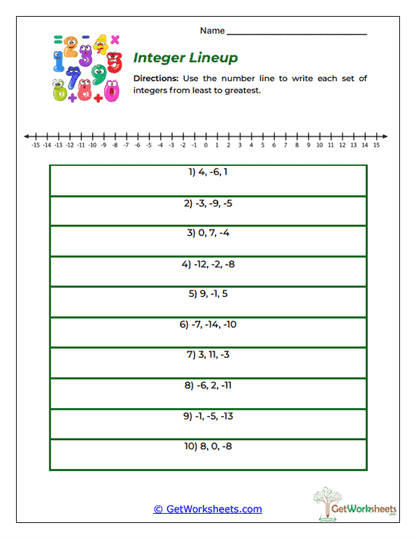
This worksheet moves students beyond comparing just two numbers and asks them to arrange entire sets of integers from least to greatest. A number line from -15 to 15 is provided at the top of the page, giving students a visual tool they can use to organize values such as 4, -6, and 1 or -7, -14, and -10. This is a very important next step because ordering several integers requires students to keep track of positive numbers, negative numbers, and zero all at once.
For a parent, the easiest way to understand “least to greatest” is to picture the child reading a number line from left to right. The smallest number is farthest to the left. The greatest number is farthest to the right. With positive numbers, this usually feels familiar. The challenge comes with negative numbers. For example, -14 comes before -10 because -14 is farther left on the number line. Even though 14 is a larger counting number than 10, the negative sign changes where the value sits.
Key Learning Objectives
- Order Integers from Least to Greatest: Students arrange each set from smallest to largest.
- Use a Number Line as a Tool: Learners locate numbers visually before deciding their order.
- Compare Several Negatives at Once: Students practice recognizing that more negative values lie farther left.
- Place Zero Correctly: Learners understand that zero belongs between negative and positive integers.
- Build Multi-Number Comparison Skills: Students move from comparing pairs to organizing complete sets.
Parent-Friendly Explanation
Tell the child to imagine that all the numbers are standing on the number line.
Then ask:
“Which number is farthest left?”
Write that one first.
Then move right until all the numbers are used.
For example, suppose the set is:
-6, 2, -11
On a number line:
- -11 is farthest left.
- -6 comes next.
- 2 is farthest right.
So the order is:
-11, -6, 2
Another useful reminder is that negative numbers are always less than positive numbers, no matter how large the digits look.
Why This Worksheet Helps
- Provides a Visual Safety Net: Students can use the printed number line instead of guessing.
- Strengthens Negative Number Sense: Learners repeatedly practice the idea that -12 is less than -4.
- Builds Ordering Fluency: Several short sets give enough repetition for the pattern to become familiar.
- Prepares Students for Graphing: Ordering integers supports later work with coordinate planes and inequalities.
- Helps Parents Explain the Skill: “Start on the left and move right” is much easier to teach than memorizing a long rule.
Classroom & Home Use
- Excellent for Guided Practice: Students can point to each number on the line before writing the answer.
- Useful for Struggling Learners: The number line lowers the memory burden and makes the ordering visible.
- Good for Independent Review: Once students understand the method, the sets can be completed quickly.
- Strong Bridge to Inequalities: Ordering several numbers prepares students to understand chains such as -8 < -3 < 4.
- Works Well for Homeschooling: Parents can recreate the same idea with a homemade number line if more support is needed.
The real value of this worksheet is that it teaches students to think of integers as positions, not just written symbols. Least to greatest means moving from left to right. Negative values, zero, positive values, number-line position, and ordering all work together in every set. For parents, the best phrase to repeat is: “Start with the number farthest left.” Once that habit is established, even sets with several negative integers become much easier.
Bookmark Us Now!
New, high-quality worksheets are added every week! Do not miss out!