Coordinate Planes Worksheets
About This Worksheet Collection
Coordinate planes help students describe exact locations using numbers, directions, axes, and ordered pairs. Learners begin by understanding the x-axis, y-axis, origin, quadrants, and positive and negative directions, then build toward reading, plotting, comparing, reflecting, and measuring points. These skills support graphing, spatial reasoning, geometry, number sense, and later algebraic thinking.
This collection gives upper elementary students several ways to practice working with four-quadrant coordinate planes. Activities include identifying graph parts, reading and plotting ordered pairs, classifying quadrants, recognizing points on axes, checking graphing errors, matching coordinates to plotted points, comparing horizontal and vertical relationships, reflecting points, finding distances, reviewing mixed coordinate skills, and solving mystery-coordinate clues. The worksheets are well suited for grade 5 graphing lessons, independent practice, homework, math centers, intervention, tutoring, or homeschool instruction.
As students work through the collection, they strengthen ordered-pair fluency, quadrant recognition, positive and negative number sense, spatial reasoning, graph interpretation, and coordinate accuracy. They also practice recognizing sign patterns, using zero coordinates correctly, comparing x- and y-values, finding distances, applying reflection rules, and reasoning from clues. These activities help learners move from basic coordinate vocabulary to more confident and flexible use of the coordinate plane.
Detailed Descriptions Of These Worksheets
Coordinate Hunting
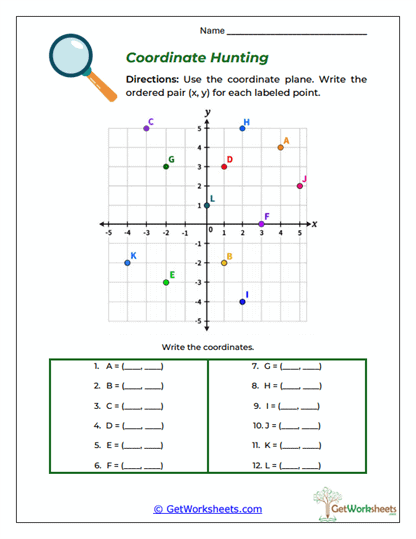
Students read points that are already plotted on a four-quadrant coordinate plane and write the matching ordered pairs. The activity reinforces the rule that the x-coordinate is read first and the y-coordinate second. Points on axes and in different quadrants provide practice with positive, negative, and zero values. This worksheet strengthens graph-reading fluency and coordinate notation.
Coordinate Map
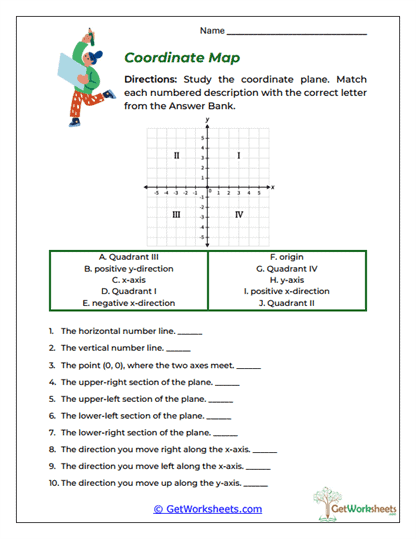
A labeled coordinate grid introduces the main parts of the coordinate plane. Students identify the x-axis, y-axis, origin, four quadrants, and positive and negative directions. Connecting vocabulary to visible graph features makes the coordinate system easier to understand before students begin plotting. This activity provides a strong foundation for later graphing work.
Grid Check
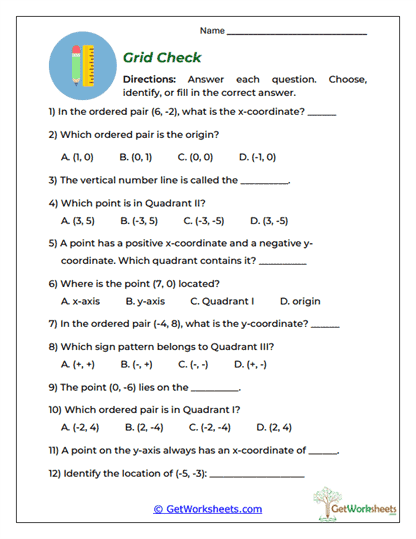
A mixed review asks students to use several coordinate-plane skills within the same worksheet. Questions cover ordered pairs, axes, origin, quadrants, coordinate signs, and point locations. Because the problems require different rules, students must decide which idea applies instead of repeating one procedure. The activity is useful for review, assessment, and identifying skills that need more practice.
Grid Gap
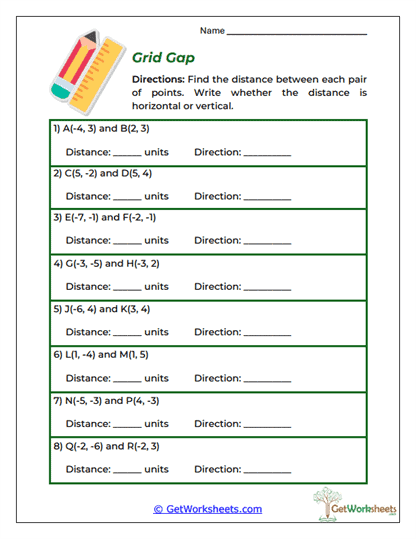
Students find the distance between coordinate points that line up horizontally or vertically. They determine which coordinate stays the same and compare the changing values to calculate the number of units between the points. Positive and negative coordinates make the numerical comparison more meaningful. This worksheet connects graphing with measurement and prepares students for later coordinate-geometry work.
Horizontal or Vertical
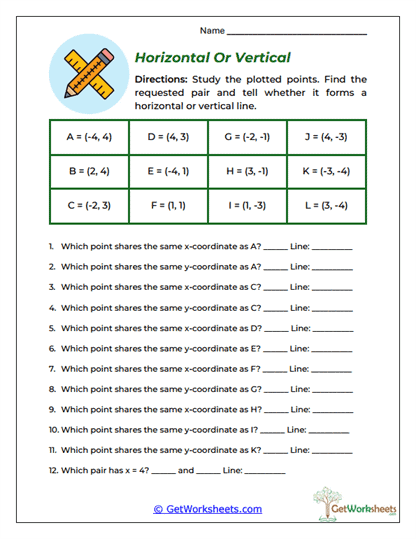
Pairs of ordered coordinates are compared to determine whether they form horizontal or vertical lines. Students learn that equal x-coordinates create vertical alignment, while equal y-coordinates create horizontal alignment. The activity helps learners notice patterns in coordinates without plotting every point. It strengthens coordinate comparison and geometric reasoning.
Mirror Points
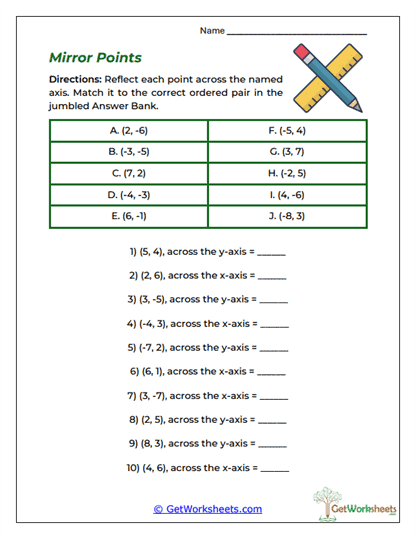
Students reflect coordinates across the x-axis or y-axis and determine the resulting ordered pair. They learn that reflecting across the x-axis changes the sign of the y-coordinate, while reflecting across the y-axis changes the sign of the x-coordinate. The activity connects coordinate rules with symmetry and transformations. It also strengthens spatial visualization and sign awareness.
Mystery Coordinates
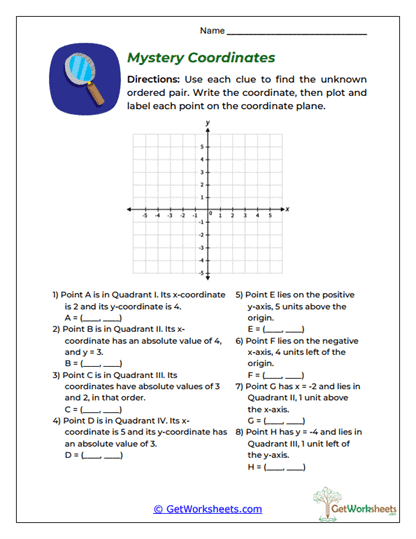
Written clues are used to determine unknown ordered pairs before students plot the solved points. Clues may involve quadrants, coordinate signs, absolute value, distance from an axis, or relationships to the origin. The multi-step format requires learners to combine several coordinate concepts rather than rely on one repeated rule. This worksheet provides strong problem-solving and enrichment practice.
Ordered Pair Spots
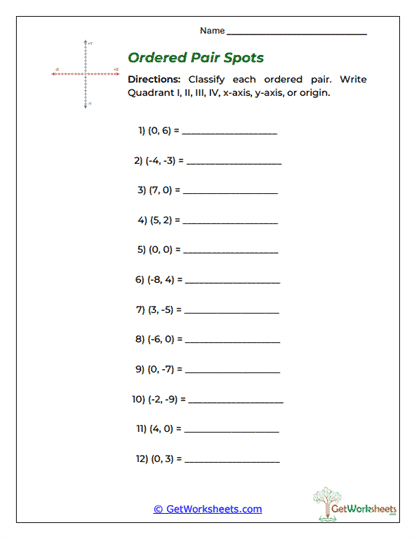
Students classify ordered pairs as belonging in one of the four quadrants, on the x-axis, on the y-axis, or at the origin. Coordinates containing zero help learners understand why not every point belongs inside a quadrant. The activity strengthens axis recognition and special-coordinate reasoning. It also reinforces the role of positive, negative, and zero values in determining location.
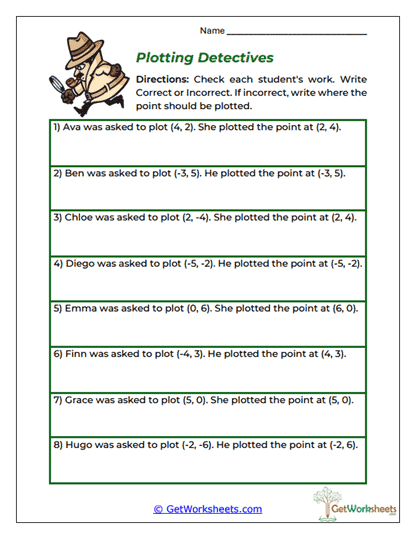
Plotting Detectives
Students review another person's coordinate work and decide whether each plotted answer is correct. Common mistakes such as reversed x- and y-values, incorrect signs, or wrong locations must be identified and corrected. Error analysis encourages learners to explain why an answer works instead of simply plotting another point. This activity builds accuracy and stronger self-checking habits.
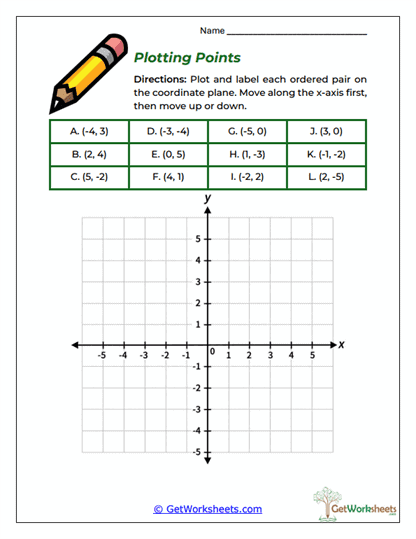
Plotting Points
Given ordered pairs are plotted and labeled on a four-quadrant coordinate plane. Students follow the x-first, y-second process while working with positive, negative, and zero coordinates. The activity requires careful attention to direction, quadrant, and coordinate signs. It provides important independent practice after students have learned how to read plotted points.
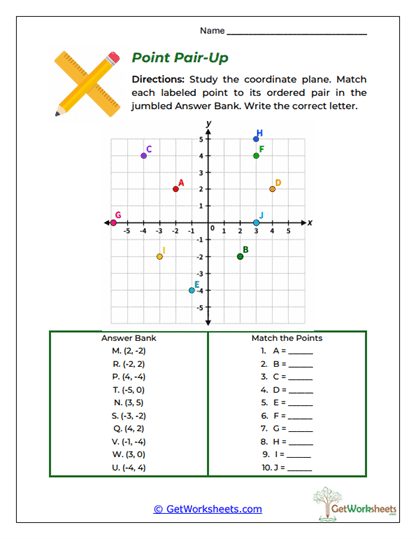
Point Pair-Up
Plotted points are matched with ordered pairs from a scrambled answer bank. Students first determine each point's x- and y-coordinates and then compare their result with the available choices. The matching format provides support while still requiring careful graph reading. This worksheet strengthens coordinate order, quadrant recognition, and attention to negative signs.
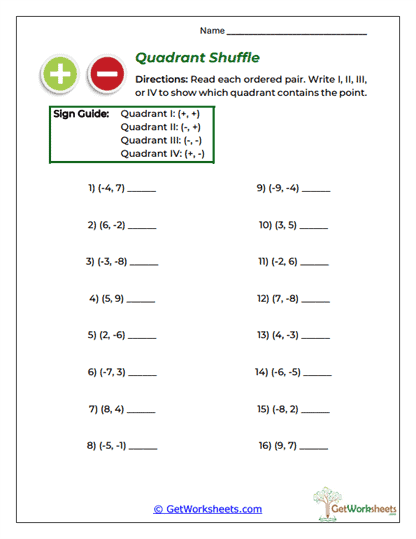
Quadrant Shuffle
Students identify which quadrant contains each ordered pair by examining the signs of the x- and y-coordinates. Repeated practice reinforces the sign patterns for Quadrants I, II, III, and IV. Because students do not need to plot every point, they begin developing mental graphing skills. The activity builds faster quadrant recognition and stronger number-sign reasoning.
Bookmark Us Now!
New, high-quality worksheets are added every week! Do not miss out!