Rainbow Circle Sequence
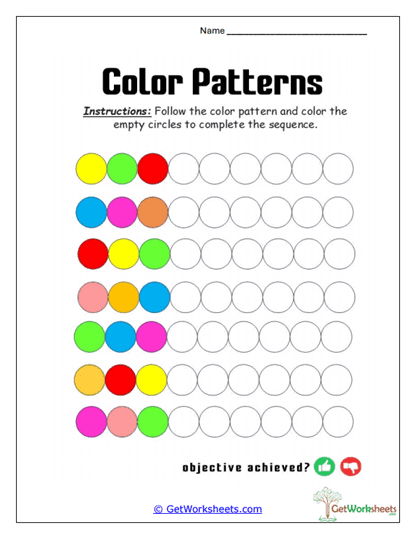
The Rainbow Circle Sequence Worksheet helps young learners understand that a pattern is simply a rule that repeats in the same order. Students look at the first three colored circles, identify the color sequence, notice the repeating unit, and then color the remaining circles so the same pattern continues correctly. This is a strong fit for preschool and kindergarten because children are practicing pattern recognition, sequencing, color identification, prediction, and visual attention without needing to read complicated directions or perform calculations. For a parent who may not remember much school math, the value is simple: your child is learning to look at information, figure out the rule, remember it, and use that rule to decide what comes next.
Learning Goals
- Recognize Three-Part Patterns: Students identify the three colors that make up each repeating sequence and notice when the pattern begins again.
- Predict What Comes Next: Learners use the starting colors as clues instead of guessing which color should fill each blank circle.
- Maintain Correct Order: Students practice keeping colors in the same first-second-third arrangement throughout an entire row.
- Strengthen Visual Memory: Children remember a short sequence while continuing it across several additional spaces.
Teaching Advantages
- Easy to Explain: Parents can simply point to the first three circles and ask, “What colors repeat?”
- Good Beginning Practice: Keeping every object a circle lets children concentrate on color order without also tracking changing shapes.
- Fine-Motor Support: Coloring the circles gives students useful crayon control and hand-eye coordination practice.
- No-Prep Learning: The page works well for preschool centers, kindergarten morning work, independent practice, or homeschool lessons.
Students strengthen color patterns, sequencing, prediction, repetition, working memory, and visual discrimination as they complete each row. Although the activity looks like simple coloring, children are actually practicing a basic kind of mathematical reasoning: finding a rule and applying it consistently. Teachers can encourage students to say the three colors aloud before coloring the blanks. Parents can do the same thing at home with crayons, blocks, cereal pieces, or toys. When children become comfortable recognizing these repeating relationships, they are better prepared for later work with number patterns, skip counting, operations, and early algebra. Just as importantly, repeated success helps them become more confident about looking for clues and solving a problem on their own.
Bookmark Us Now!
New, high-quality worksheets are added every week! Do not miss out!