Shooting Star Color Trail
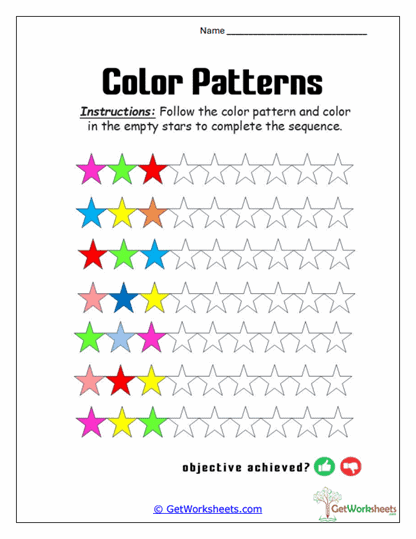
The Shooting Star Color Trail Worksheet gives children repeated practice following a three-color rule across rows of familiar star shapes. Students examine the first three colored stars, determine the repeating sequence, and then use color matching, position awareness, prediction, and pattern continuation to finish each row. This is especially appropriate for preschool through kindergarten because every row provides a new color combination while the basic task remains familiar, giving children many chances to practice the same reasoning skill successfully. For parents, think of the first three stars as a little recipe: once your child knows the recipe, the job is to repeat those same ingredients in exactly the same order.
Key Learning Objectives
- Find the Repeating Unit: Students recognize that the first three stars provide the rule for the rest of the row.
- Follow Positional Order: Learners distinguish which color belongs first, second, and third in each sequence.
- Make Logical Predictions: Children determine the next color by looking back at the established pattern rather than choosing randomly.
- Develop Pattern Fluency: Multiple rows help students become quicker and more independent at recognizing repetition.
Classroom & Home Use
- Provides Plenty of Practice: Seven separate sequences let children repeat the skill without every problem looking identical.
- Supports Verbal Learning: Saying the colors aloud can make the repeating order much easier for young learners to remember.
- Combines Thinking and Coloring: Students practice early math reasoning while also strengthening fine-motor control.
- Simple for Home Support: A parent does not need special math knowledge; asking “What comes next, and how do you know?” is enough.
Students build stronger pattern recognition, color sequencing, visual memory, prediction, order awareness, and attention to detail while completing the stars. These skills matter because mathematics depends heavily on noticing relationships and recognizing when the same rule appears again. In the classroom, teachers can have students point to one complete three-star unit and say it aloud before continuing. At home, parents can reproduce the same idea with three colored objects and ask the child to keep the arrangement going. That little conversation turns coloring into meaningful reasoning practice. As students become more comfortable with these patterns, they gain confidence, concentration, and a stronger foundation for more complicated visual and number sequences.
Bookmark Us Now!
New, high-quality worksheets are added every week! Do not miss out!