Active vs. Passive Voice Worksheets
About This Worksheet Collection
This comprehensive collection of active and passive voice worksheets helps students develop a stronger understanding of sentence mechanics through meaningful grammar practice and real-world writing applications. Rather than treating active and passive voice as simple grammar labels, these activities encourage learners to analyze sentence structure, revise writing, evaluate author choices, and understand how voice affects clarity, emphasis, and communication. Through sentence transformations, editing challenges, paragraph revisions, science writing analysis, and literary investigations, students gain hands-on experience using grammatical voice as a purposeful writing tool. Teachers, parents, and homeschool educators will appreciate the variety of activities that support both foundational grammar instruction and more advanced writing development.
As students work through these worksheets, they strengthen grammar knowledge, sentence analysis, editing skills, revision strategies, writing fluency, critical thinking, and reading comprehension. Learners practice identifying subjects, verbs, objects, and verb phrases while developing a deeper understanding of how sentence structure influences meaning and emphasis. Many activities also connect grammar instruction to authentic contexts such as science reports, mystery stories, and narrative writing, helping students see the practical value of these concepts beyond isolated exercises. Together, these resources help children become more confident writers, stronger editors, and more thoughtful readers of language.
Detailed Descriptions Of These Worksheets
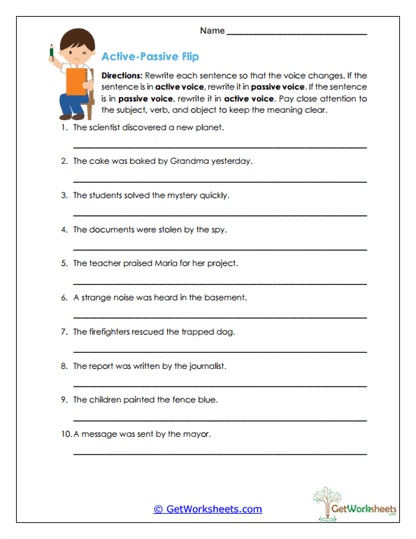
Active-Passive Flip
Students rewrite sentences from active voice to passive voice and from passive voice to active voice while preserving the original meaning. The activity strengthens understanding of subjects, objects, verbs, and sentence structure through direct sentence transformation practice. Learners develop greater flexibility with language while improving revision and editing skills. It also helps students recognize how writers can express the same idea in multiple ways.
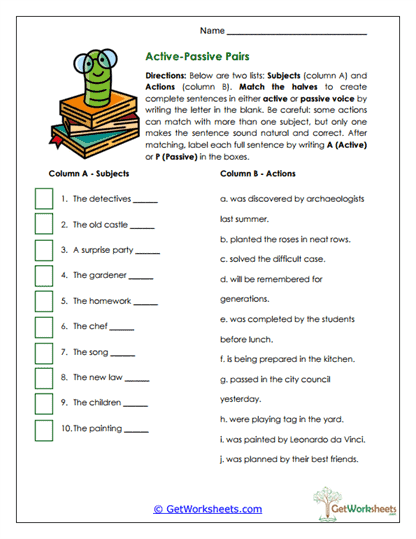
Active-Passive Pairs
This matching activity asks students to pair subjects with appropriate actions to create complete sentences before identifying whether each sentence uses active or passive voice. Learners strengthen sentence construction and grammar analysis while practicing voice recognition in a highly interactive format. The matching structure encourages careful attention to subject-action relationships and sentence meaning. It also supports reading comprehension through logical sentence building.
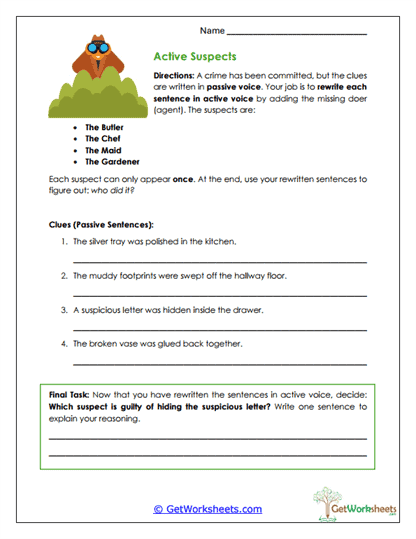
Active Suspects
Students solve mystery-themed grammar clues by rewriting passive voice sentences into active voice while identifying the implied subject responsible for each action. The activity combines deductive reasoning with sentence analysis, making grammar practice more engaging and meaningful. Learners strengthen revision skills and active voice construction while developing greater awareness of sentence clarity. The mystery format also encourages close reading and logical thinking.
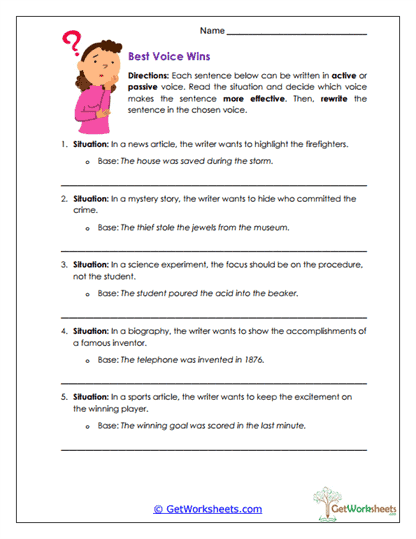
Best Voice Wins
This worksheet teaches students that active and passive voice are writing tools rather than simply right-or-wrong grammar choices. Learners examine writing situations, determine which voice is most effective, and revise sentences to match audience and purpose. The activity encourages higher-level thinking about communication and writing strategy. It also strengthens editing skills and awareness of how grammar influences reader experience.
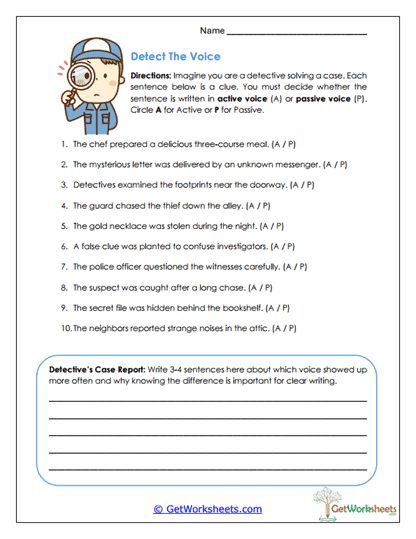
Detect the Voice
Students read detective-themed sentences and determine whether each example uses active voice or passive voice. The worksheet provides foundational practice with identifying who performs an action and who receives it. Learners strengthen grammar awareness, sentence structure understanding, and subject-verb analysis through repeated classification activities. The engaging theme helps make sentence mechanics more approachable for developing writers.
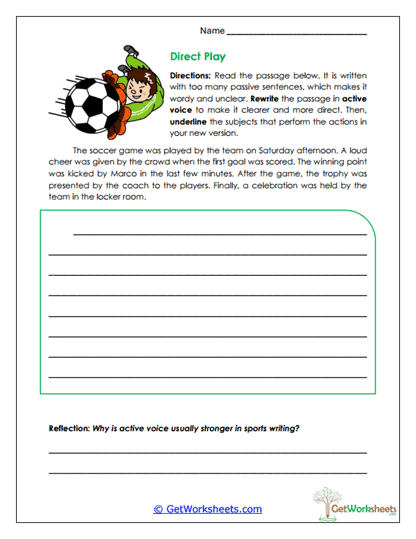
Direct Play
This sports-themed editing activity asks students to revise passive and awkward sentences into stronger active voice constructions. Learners identify who is performing each action and rewrite the paragraph for improved clarity and readability. The worksheet connects grammar instruction directly to authentic revision tasks. It also helps students recognize why active voice is often preferred in narrative and informational writing.
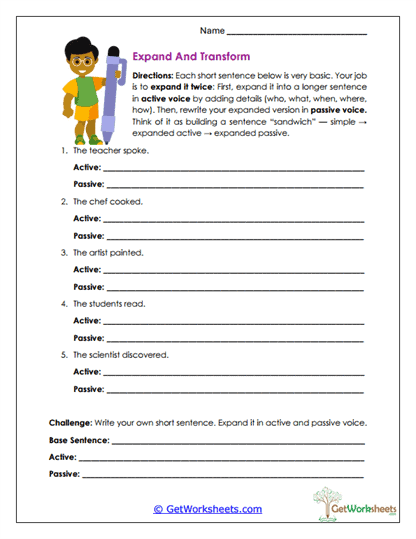
Expand and Transform
Students begin with simple sentence starters, add descriptive details, and then convert their expanded sentences into passive voice. The activity blends grammar instruction with creative writing development by encouraging learners to build richer, more detailed sentences before revising them. It strengthens sentence fluency, voice transformation, and descriptive writing skills simultaneously. The open-ended format also supports creativity and differentiated learning.
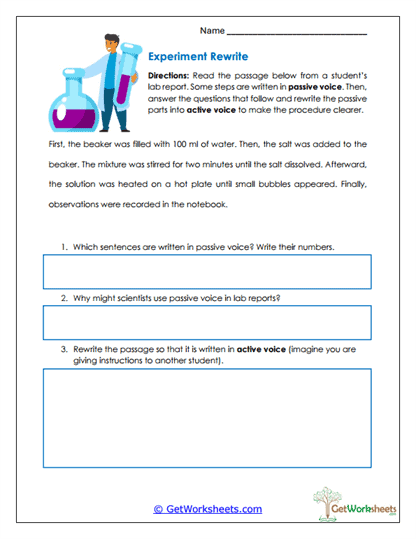
Experiment Rewrite
This science-focused worksheet explores how active and passive voice function in laboratory reports and procedural writing. Students identify passive voice within a scientific passage, discuss why scientists often use it, and rewrite portions in active voice. The activity connects grammar instruction to real-world academic writing while strengthening revision and analysis skills. It also helps learners understand how audience and purpose influence sentence structure choices.
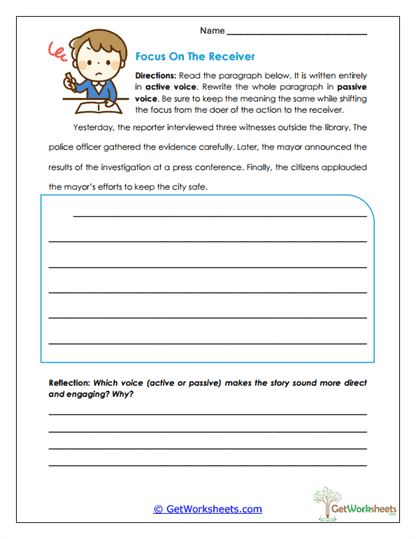
Focus On The Receiver
Students rewrite an entire paragraph from active voice into passive voice while preserving the original meaning. The worksheet helps learners understand how passive constructions shift emphasis toward the receiver of an action rather than the actor. By working with connected text instead of isolated sentences, students develop deeper revision and writing-analysis skills. The activity also encourages reflection about the effects of different sentence styles.
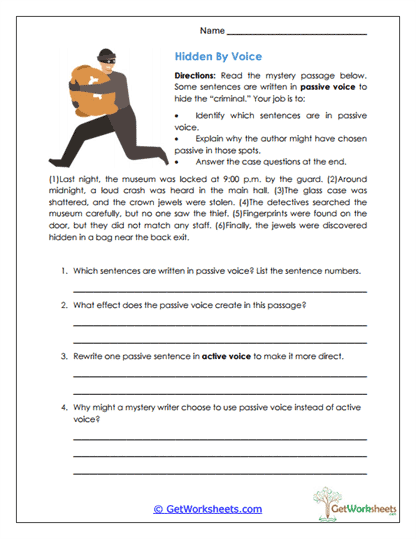
Hidden By Voice
This reading and grammar activity asks students to identify passive voice within a mystery passage and analyze how it contributes to suspense and tone. Learners rewrite selected examples in active voice and compare the effects of each version. The worksheet combines literary analysis with sentence mechanics, helping students see grammar as an intentional writing tool. It also strengthens close reading and evidence-based reasoning skills.
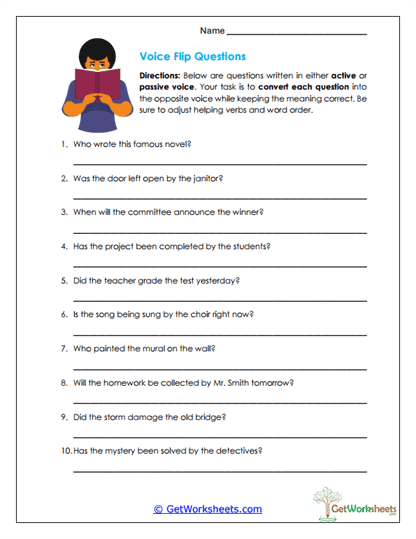
Voice Flip Questions
Students practice transforming questions from active voice to passive voice and vice versa while maintaining their original meaning. The activity focuses specifically on interrogative sentence structures, helping learners develop precision with word order, helping verbs, and sentence mechanics. This advanced practice strengthens editing and grammatical accuracy. It also expands students' understanding of how voice functions across different sentence types.
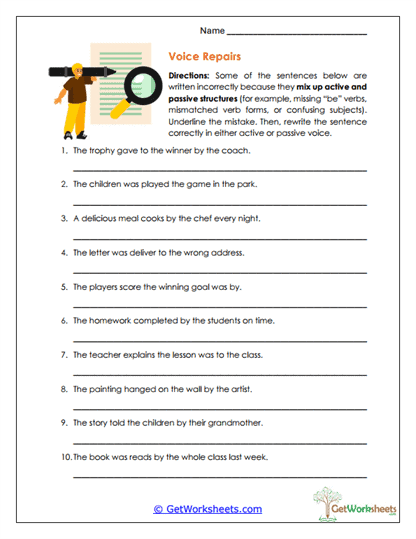
Voice Repairs
This corrective editing worksheet challenges students to locate and repair errors involving active voice, passive voice, verb forms, and sentence structure. Learners analyze flawed sentences before rewriting them correctly, strengthening proofreading and revision habits. The activity moves beyond simple identification into higher-level grammar application. It also reinforces attention to detail and confidence with sentence mechanics.
Bookmark Us Now!
New, high-quality worksheets are added every week! Do not miss out!