Sentence Combining and Expansion Worksheets
About This Worksheet Collection
Sentence combining and expansion help students turn short, repetitive ideas into writing that is smoother, clearer, and more detailed. Learners practice joining related thoughts, adding useful information, and choosing structures that show how ideas connect. These skills improve sentence fluency without encouraging unnecessary length or confusing run-ons.
This collection includes activities involving coordinating and subordinating conjunctions, relative clauses, adjective and adverb clauses, appositives, prepositional phrases, gerunds, infinitives, transitions, and narrative revision. Some worksheets guide students through combining two simple sentences, while others ask them to expand basic ideas or revise groups of choppy statements. The pages can be used during grammar lessons, writing workshops, centers, tutoring, homework, intervention, or homeschool instruction.
As students complete the collection, they strengthen clause awareness, conjunction use, punctuation, descriptive language, logical organization, and revision skills. They also learn to reduce repetition, vary sentence patterns, add meaningful details, and guide readers smoothly from one idea to the next. These abilities support stronger paragraphs, narratives, essays, and everyday written communication.
Detailed Descriptions Of These Worksheets
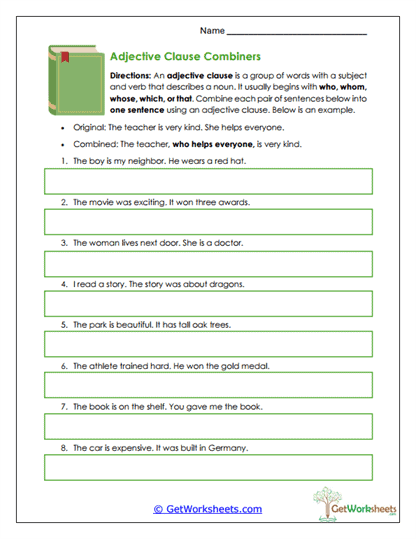
Adjective Clause Combiners
Students join related sentences by changing one idea into an adjective clause. They identify a repeated noun and select a relative word such as who, whom, whose, which, or that. The finished sentence describes the noun clearly without repeating it in a second short statement. This practice strengthens relative-pronoun use, clause formation, revision, and descriptive writing.
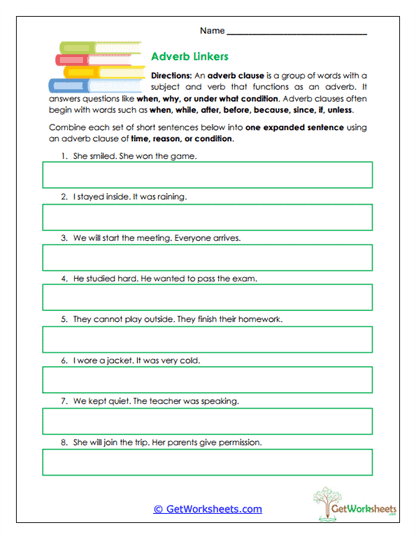
Adverb Linkers
Pairs of sentences are combined using adverb clauses that explain time, cause, sequence, or condition. Learners choose subordinating conjunctions such as when, while, because, before, if, or unless. They also decide whether the dependent clause should come first or second and punctuate the sentence accordingly. The activity helps students connect events more clearly and vary their sentence openings.
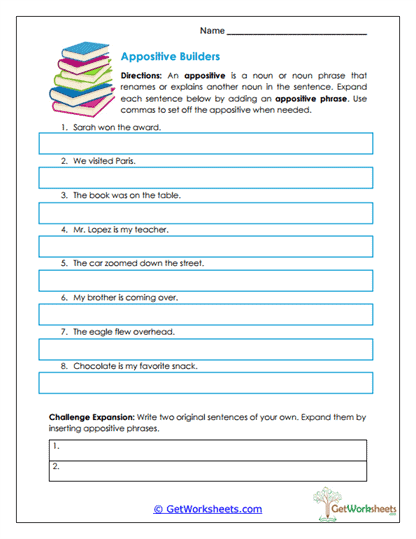
Appositive Builders
Students expand basic sentences by adding noun phrases that rename or explain important people, places, objects, or ideas. They learn to place nonessential appositives between commas so the added information fits smoothly into the sentence. This structure allows writers to provide useful background without creating another separate statement. The activity develops punctuation accuracy, noun awareness, and descriptive detail.
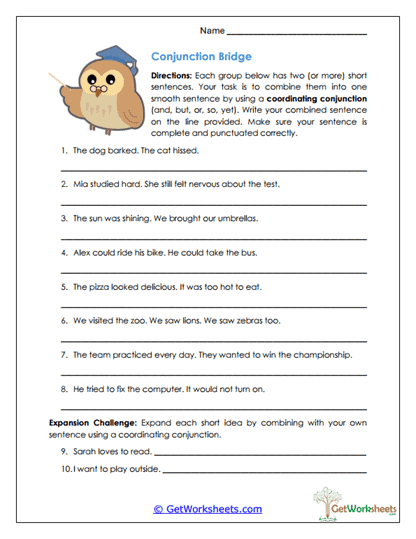
Conjunction Bridge
Groups of short ideas are rewritten as smoother combined sentences. Students select coordinating conjunctions that show addition, contrast, choice, or result and add the necessary punctuation. The task helps learners recognize which thoughts belong together and how their relationship should be expressed. It is especially helpful for reducing repetitive, choppy writing.
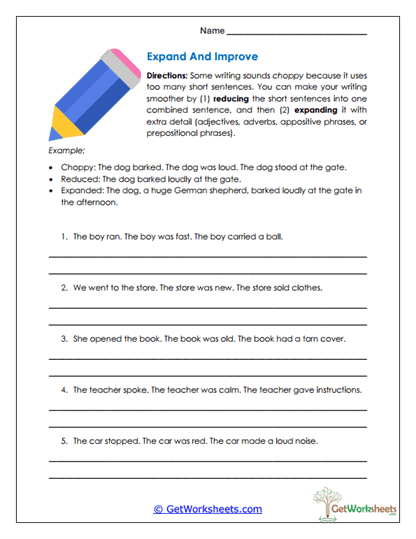
Expand and Improve
Students revise sets of short sentences by removing repeated words and adding purposeful details. They may use adjectives, adverbs, appositives, or prepositional phrases to make the final sentence more informative. The activity emphasizes that effective expansion should improve meaning rather than simply make writing longer. Learners practice editing judgment, modifier use, and sentence fluency.
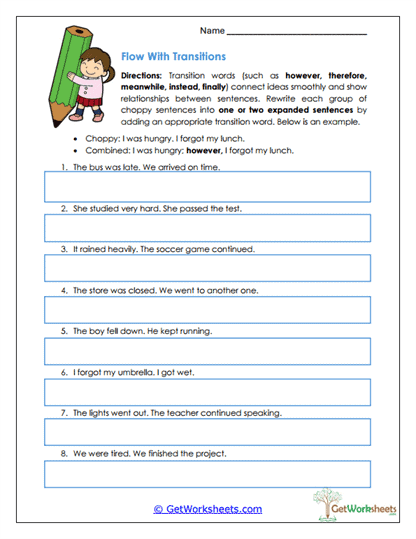
Flow with Transitions
Choppy ideas are connected with transitions such as however, therefore, meanwhile, instead, finally, or consequently. Students determine whether the relationship involves contrast, cause and effect, sequence, time, or an alternative. They then rewrite the ideas with suitable punctuation and a clearer flow. This worksheet builds skills that support both sentence-level revision and paragraph organization.
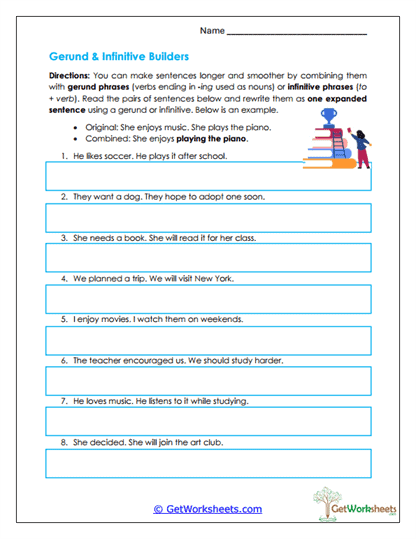
Gerund and Infinitive Builders
Related thoughts are combined using gerund phrases or infinitive phrases. Learners decide whether an -ing form or a to-plus-verb structure creates the clearest and most natural sentence. This gives them another way to connect ideas without relying entirely on conjunctions. The activity strengthens verbal recognition, phrase construction, grammatical flexibility, and revision.
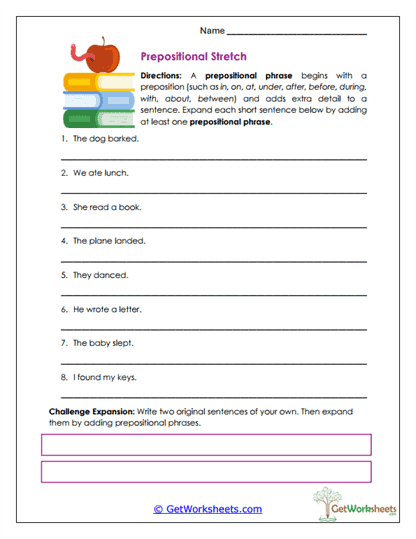
Prepositional Stretch
Students add prepositional phrases to explain where, when, how, or under what conditions an action happens. Basic sentences become more specific through details introduced by words such as in, under, during, after, with, or between. Many responses may be correct as long as the added information is logical and clear. This open-ended practice supports descriptive writing and precise elaboration.
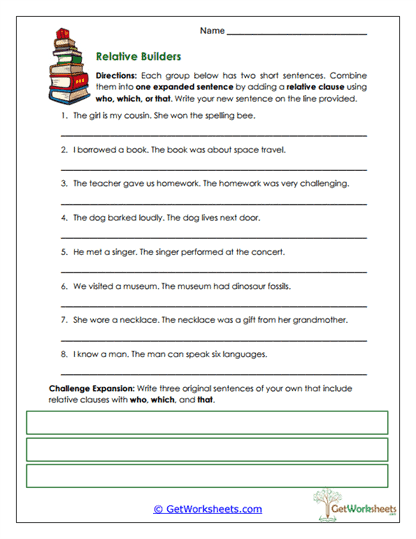
Relative Builders
Two sentences containing the same noun are combined with who, which, or that. Students use the second idea as a relative clause that adds information about the repeated person, animal, place, or object. The revision removes unnecessary repetition while preserving both original ideas. It helps learners create sentences that sound more connected and mature.
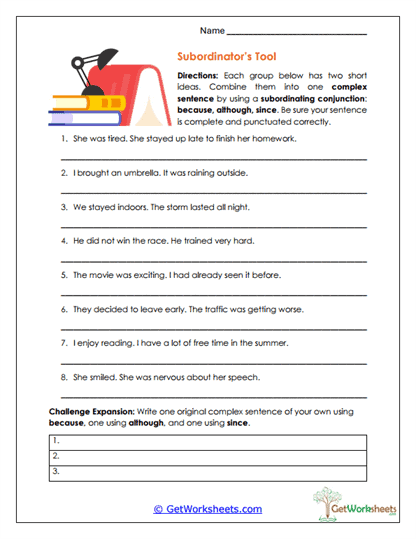
Subordinators' Tool
Students combine sentence pairs with because, although, or since. They decide whether the relationship shows a reason, contrast, or background condition before building the complex sentence. The limited conjunction choices keep the activity manageable while still requiring close attention to meaning. A writing challenge allows learners to create original examples using each connector.
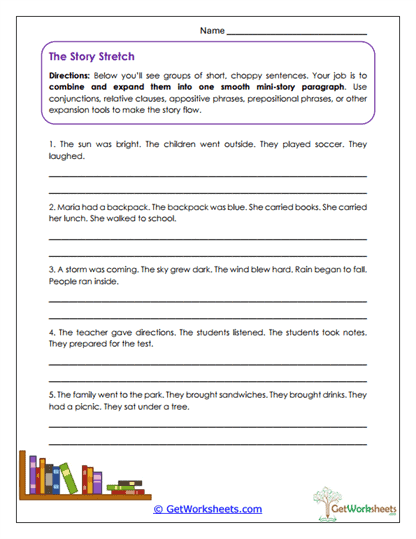
The Story Stretch
Groups of short narrative sentences are revised into smoother and more developed story writing. Students may use conjunctions, clauses, appositives, prepositional phrases, and transitions while keeping every important event or detail. More than one strong revision may be possible, which encourages flexible thinking. The activity prepares learners to revise longer narratives and paragraphs.
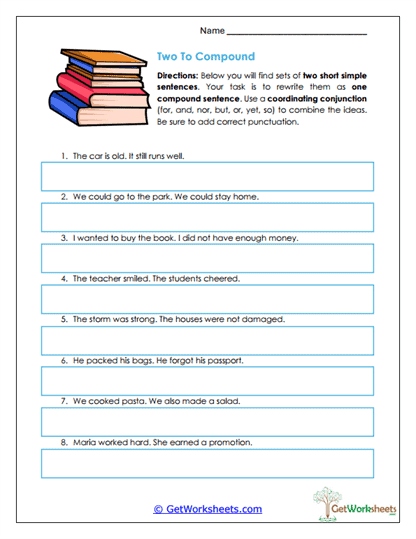
Two to Compound
Each pair of simple sentences is rewritten as one compound sentence. Students confirm that both ideas are complete thoughts, choose a logical FANBOYS conjunction, and place a comma before it. The repeated structure provides focused practice with clause relationships and punctuation. It gives learners a dependable method for creating longer sentences without producing run-ons.
Bookmark Us Now!
New, high-quality worksheets are added every week! Do not miss out!