Transitions and Sentence Flow Worksheets
About This Worksheet Collection
Transitions help readers understand how one sentence or idea connects to the next. They can show addition, contrast, cause and effect, sequence, time, examples, or conclusions. Learning to use transitions correctly helps students create writing that feels organized, logical, and smooth rather than abrupt or disconnected.
This collection develops transition skills through word sorting, sentence completion, passage practice, cause-and-effect work, contrast exercises, sequencing activities, sentence combining, and paragraph revision. Some worksheets provide word banks and guided choices, while others ask learners to replace weak connectors, improve choppy passages, or write original sentences with transitions. The pages can be used during grammar lessons, writing centers, paragraph instruction, intervention, tutoring, homework, assessment, or homeschool lessons.
As students complete the collection, they strengthen transition vocabulary, logical reasoning, punctuation, sentence fluency, paragraph coherence, and revision skills. They also practice recognizing how ideas relate, selecting more precise connecting words, organizing steps, and guiding readers through changes in thought. These skills support clearer narratives, explanations, essays, reports, and other forms of academic writing.
Detailed Descriptions Of These Worksheets
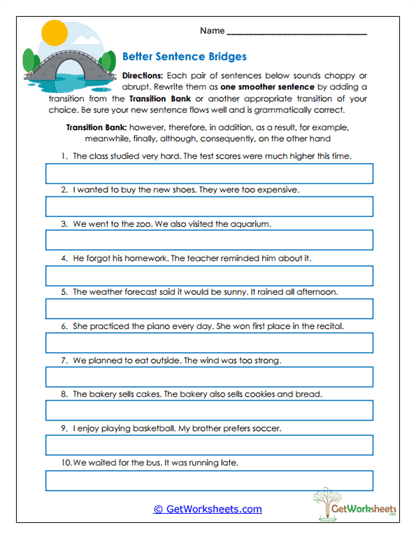
Better Sentence Bridges
Students revise pairs of short or abrupt sentences by adding transitions that make the relationship between the ideas clear. They decide whether the connection involves contrast, addition, cause and effect, sequence, or time before rewriting the pair. Correct punctuation is also required when using commas, semicolons, or sentence breaks. This activity strengthens sentence fluency and helps learners make existing writing sound more natural.
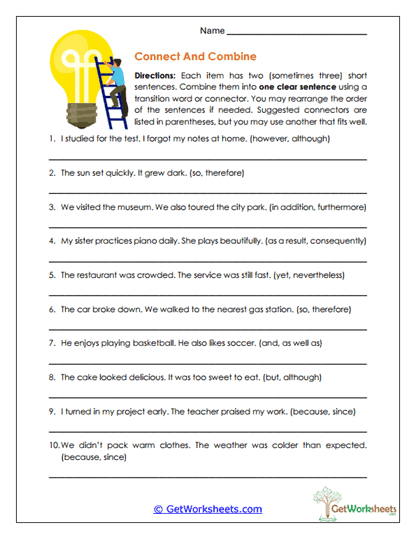
Connect and Combine
Two or three short statements are reshaped into smoother connected sentences. Students choose from transitions, conjunctive adverbs, or subordinating conjunctions and may rearrange the clauses to improve the flow. The activity requires them to preserve the original meaning while using accurate punctuation. It is especially helpful for reducing choppy writing and building flexible sentence structures.
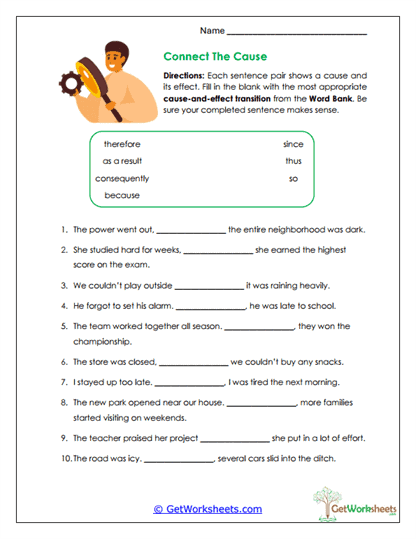
Connect the Cause
Cause-and-effect sentence pairs help learners distinguish words that introduce reasons from words that introduce results. Students choose connectors such as because, since, therefore, consequently, so, or as a result. Careful reading is needed to determine which event happened first and which one followed. This focused practice supports science explanations, history writing, and other subjects that depend on clear causal relationships.
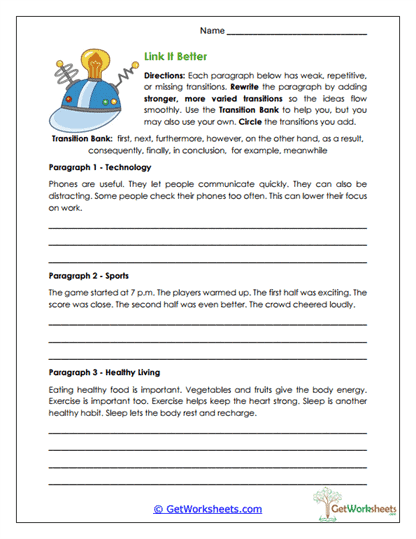
Link It Better
Short paragraphs containing weak, repetitive, or missing transitions must be revised for better flow. Students choose stronger connectors while preserving the meaning and avoiding repeated words. Familiar topics give them enough context to judge whether each sentence adds information, changes direction, explains a result, or concludes the passage. The activity develops practical paragraph-editing skills.
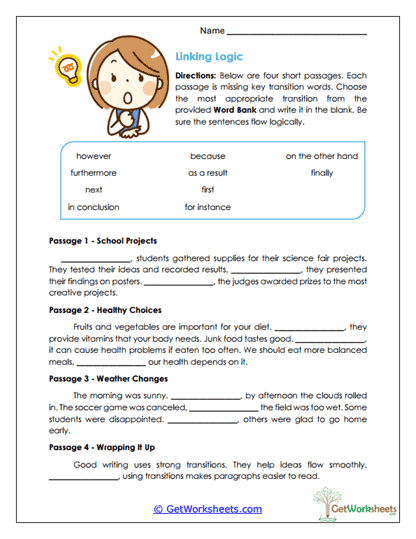
Linking Logic
Students complete several short passages by selecting transitions that fit both the individual sentence and the paragraph's overall direction. The texts include examples of sequence, contrast, explanation, cause and effect, and conclusion. Rereading the completed passage helps learners hear whether their choices create a natural flow. This page moves transition practice beyond isolated sentences and into connected writing.
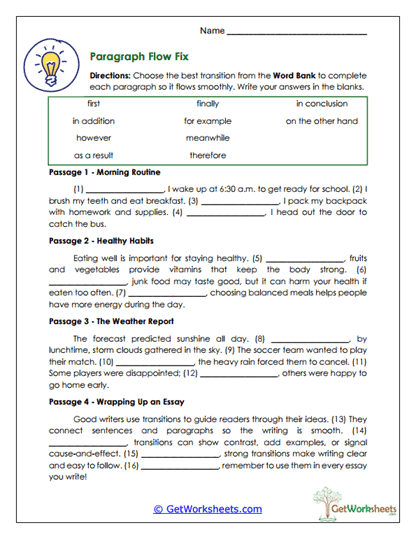
Paragraph Flow Fix
Four short paragraphs are completed with transitions showing order, addition, contrast, examples, results, and conclusions. Students use the surrounding context to determine which word best guides the reader through each idea. The passage format demonstrates how several transitions can work together across one paragraph. This practice strengthens coherence from the opening sentence to the final thought.
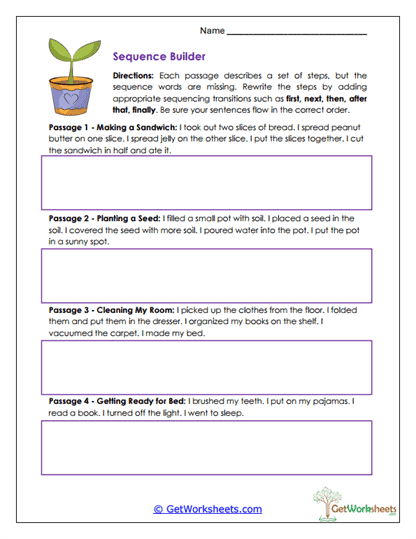
Sequence Builder
Familiar processes are organized with transitions such as first, next, then, after that, and finally. Students determine the correct order of the steps and rewrite each passage so the directions are easy to follow. The activity develops chronological reasoning and procedural writing. It also prepares learners for recipes, experiments, directions, and other forms of step-by-step explanation.
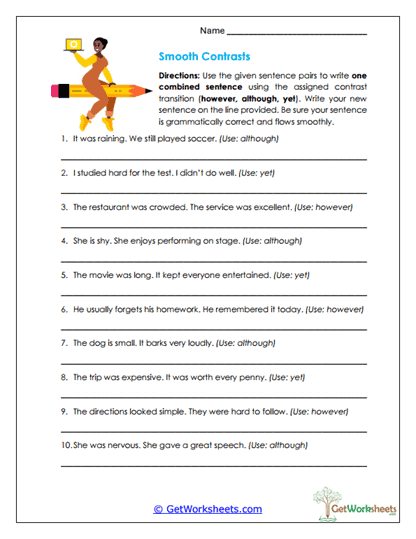
Smooth Contrasts
Opposing or unexpected ideas are combined with although, yet, or however. Students learn that these words all show contrast but require different sentence structures and punctuation. They may create complex sentences, compound sentences, or connections between independent thoughts. This activity builds sentence variety while reinforcing the grammar behind each contrast word.
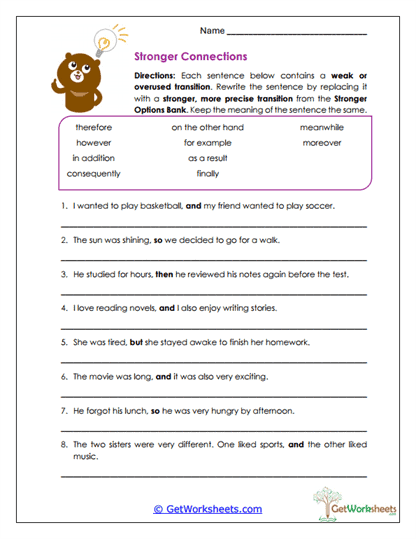
Stronger Connections
Weak or overused connectors are replaced with more precise transitions. Learners first identify the relationship between the ideas and then choose a word such as therefore, however, meanwhile, or consequently. The revision must preserve the original meaning while improving tone and flow. This page helps students move beyond repeatedly using and, but, so, and then.
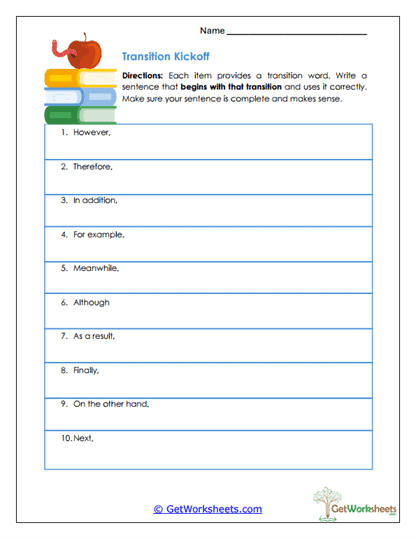
Transition Kickoff
Each provided transition becomes the beginning of an original sentence. Students must understand whether the word signals contrast, result, addition, example, sequence, or time before creating a logical context. They also apply commas after introductory transitions when needed. The open-ended format shows whether learners can use transition words independently rather than only recognize them.
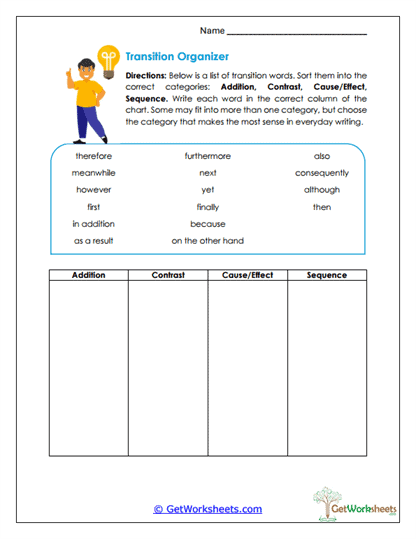
Transition Organizer
A list of transitions is sorted into categories based on purpose. Students group words that show addition, contrast, cause and effect, or sequence and discuss cases that may depend on context. The finished organizer can serve as a reference during future writing assignments. This activity expands vocabulary and reinforces that transitions are not interchangeable.
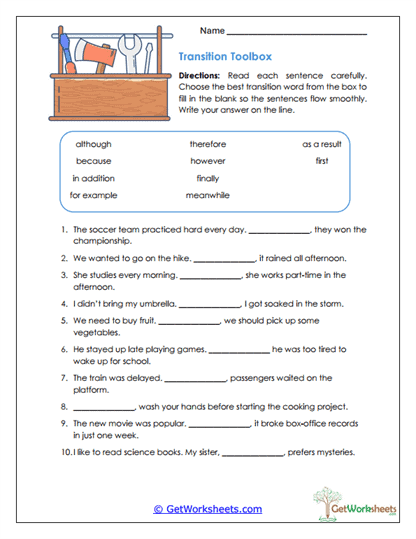
Transition Toolbox
Students use a transition bank to complete sentences with connectors that accurately show relationships among ideas. They examine whether each blank calls for addition, contrast, cause and effect, sequence, or an example. The supported format allows learners to focus on meaning while building confidence with new vocabulary. This page provides a strong introduction to choosing logical and precise transitions.
Bookmark Us Now!
New, high-quality worksheets are added every week! Do not miss out!