Sentence Diagramming Worksheets
About This Worksheet Collection
Sentence diagramming gives students a visual way to see how words, phrases, and clauses work together. By placing subjects, verbs, objects, modifiers, and connecting words on specific lines, learners can separate the sentence core from added details. This process makes grammar relationships easier to understand and helps students analyze sentences more carefully.
This collection begins with basic subject-verb diagrams and gradually introduces direct objects, indirect objects, adjectives, adverbs, prepositional phrases, appositives, compound sentences, complex sentences, relative clauses, and compound-complex structures. Some worksheets focus on one sentence part at a time, while others ask students to map several connected clauses. The pages can be used during direct instruction, guided grammar practice, intervention, tutoring, homework, review, enrichment, or homeschool lessons.
As students complete the collection, they strengthen subject and verb recognition, object identification, modifier placement, clause analysis, conjunction knowledge, and sentence-structure awareness. They also practice separating essential sentence parts from extra information and showing exactly which words modify or connect to others. These skills support stronger reading comprehension, editing, punctuation, and more precise writing.
Detailed Descriptions Of These Worksheets
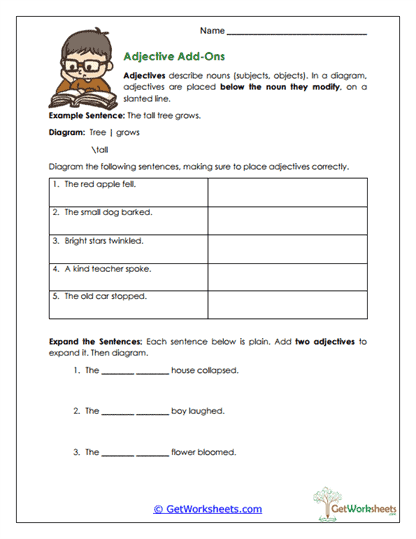
Adjective Add-Ons
Students identify adjectives and place them on slanted lines beneath the nouns they describe. They begin by finding the subject and verb so the core of the sentence remains clear. The activity also asks learners to expand plain sentences with descriptive words and diagram the new versions. This helps them see that every adjective is attached to a specific noun.
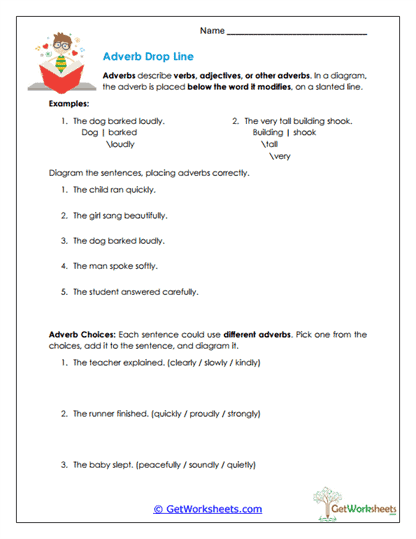
Adverb Drop Line
Adverbs are placed beneath the verbs, adjectives, or other adverbs they modify. Students determine whether each word explains how, when, where, or to what degree something happens. The diagram makes it clear that adverbs do not always describe actions. This activity strengthens careful reading and prepares learners for sentences with several layers of modifiers.
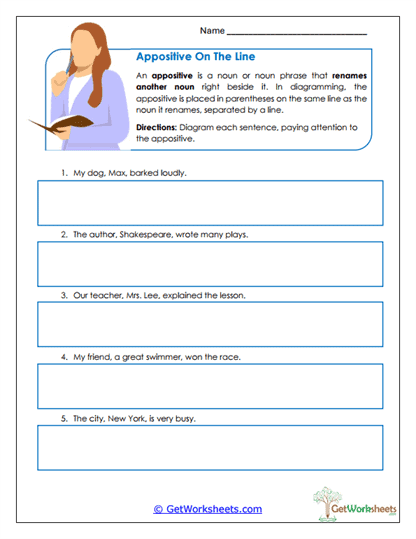
Appositive on the Line
Sentences containing appositives are diagrammed by placing the renaming word or phrase beside the noun it explains. Parentheses show that both expressions refer to the same person, place, object, or idea. Students also connect comma use with nonessential appositive phrases. The page helps learners separate the basic sentence structure from added explanatory information.
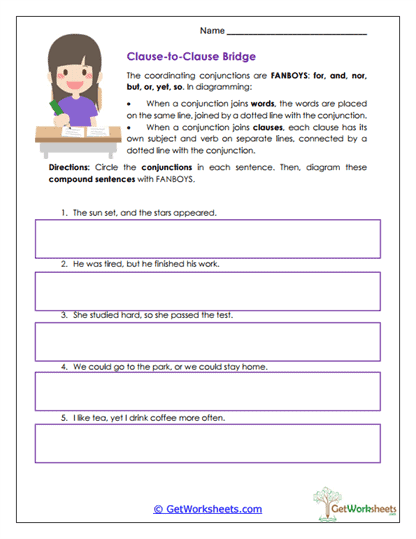
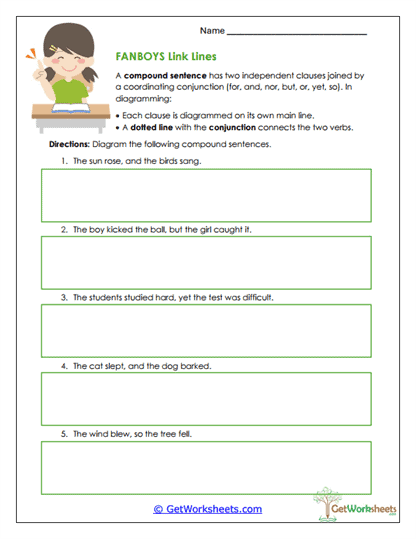
Clause-to-Clause Bridge
Two independent clauses are placed on separate main lines and linked with a dotted bridge containing a coordinating conjunction. Students circle the FANBOYS word and identify the subject and verb in each clause before drawing the diagram. The visual arrangement shows that both clauses have equal grammatical importance. It also reinforces the comma that normally appears before the conjunction.
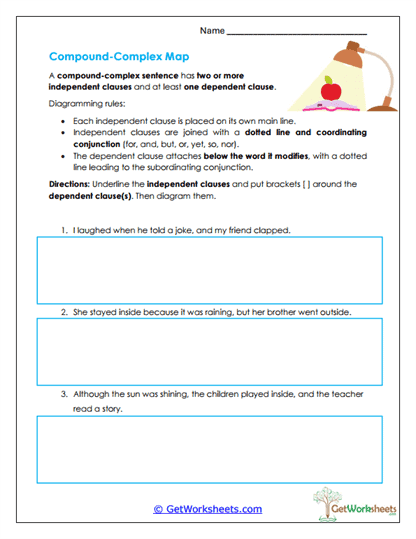
Compound-Complex Map
Advanced sentences containing at least two independent clauses and one dependent clause are broken into smaller parts. Students mark each clause before mapping the coordinating and subordinating relationships. This step-by-step process makes a long sentence easier to analyze. The activity brings together clause recognition, conjunctions, punctuation, and several earlier diagramming skills.
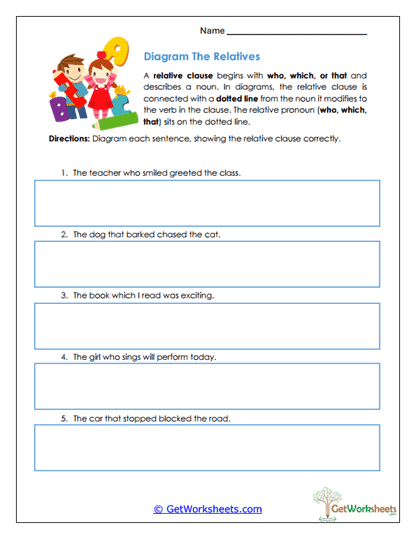
Diagram the Relatives
Relative clauses beginning with who, which, or that are placed beneath the main sentence and connected to the nouns they modify. Students identify the complete main clause before separating the embedded description. The diagram shows that the entire dependent clause functions like an adjective. This focused practice supports more advanced sentence analysis and relative-pronoun understanding.
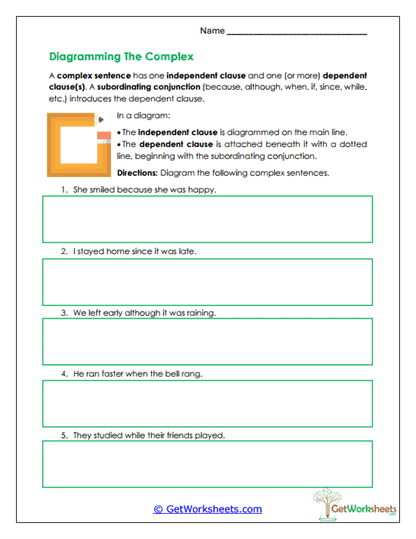
Diagramming the Complex
Students map sentences that contain one independent clause and one dependent clause. The main clause stays on the primary line, while the subordinate clause is placed below and connected through its subordinating conjunction. This arrangement makes the dependency between the ideas visible. Learners practice distinguishing complete thoughts from clauses that provide time, reason, contrast, or condition.
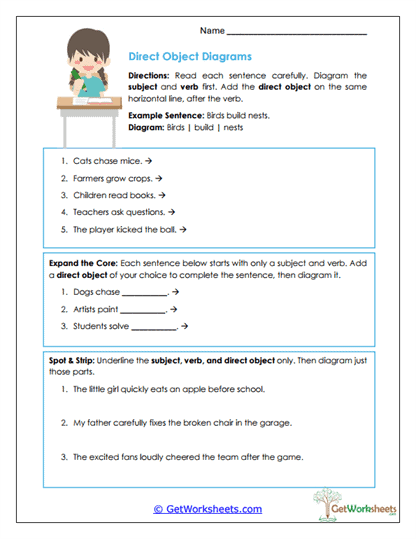
Direct Object Diagrams
A subject, action verb, and direct object are placed along the main diagram line. Students ask "whom?" or "what?" after the verb to identify the receiver of the action. Later exercises ask them to complete sentence cores and ignore modifiers that are not essential to the pattern. The page provides a natural next step after basic subject-verb diagrams.
FANBOYS Link Lines
Compound sentences are divided into two independent clauses and represented on separate main lines. A dotted connecting line holds the coordinating conjunction that joins the ideas. Students may also include direct objects and modifiers within each clause. This activity shows how familiar sentence parts work together inside a larger compound structure.
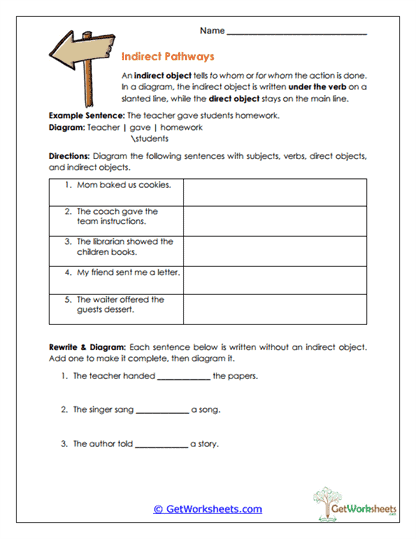
Indirect Pathways
Sentences with both direct and indirect objects are analyzed and diagrammed. Students identify the item being given, shown, sent, or offered and the person who receives it. The direct object remains on the main line, while the indirect object appears beneath the verb. This visual distinction helps learners understand the different jobs performed by the two nouns.
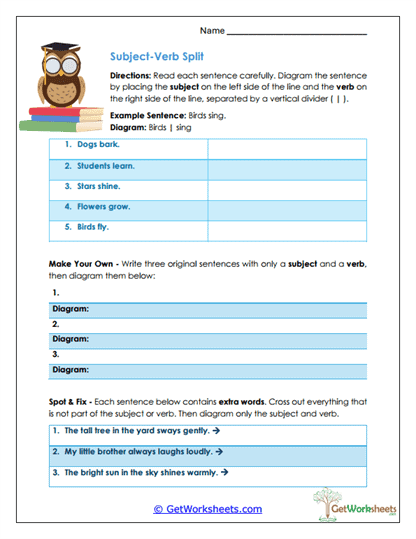
Subject-Verb Split
Short sentences introduce the basic diagramming pattern by separating the subject from the verb. Students place the naming part of the sentence on the left and the action or state-of-being word on the right. A correction activity helps them remove modifiers and focus on the essential sentence core. This simple foundation prepares learners for every later diagramming structure.
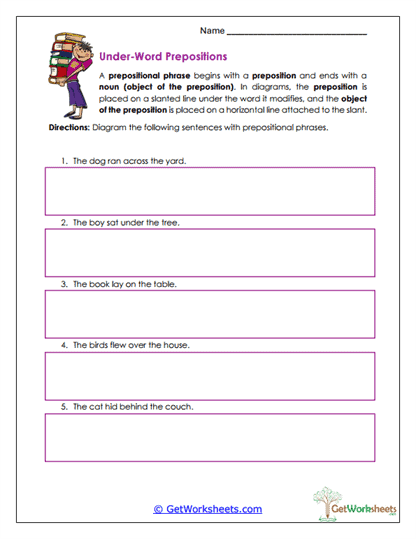
Under-Word Prepositions
Prepositional phrases are diagrammed beneath the nouns or verbs they modify. Students place the preposition on a slanted line and its object on an attached horizontal line. The main subject and verb remain on the sentence's primary line. This arrangement clearly shows how location, direction, time, and other details connect to the sentence core.
Bookmark Us Now!
New, high-quality worksheets are added every week! Do not miss out!