Complex Sentences Worksheets
About This Worksheet Collection
Complex sentences contain one independent clause and at least one dependent clause joined by a subordinating conjunction. These sentence structures help writers explain relationships involving time, cause, contrast, condition, and sequence. Learning how the clauses work together gives students more control over sentence meaning, punctuation, and variety.
This collection develops complex-sentence skills through clause identification, conjunction selection, sentence completion, classification, sentence combining, revision, error correction, cause-and-effect activities, and original writing. Some worksheets focus on recognizing independent and dependent clauses, while others ask learners to connect ideas, repair sentence errors, or create complex sentences of their own. The pages can be used during grammar lessons, writing centers, guided practice, tutoring, homework, assessment, or homeschool instruction.
As students complete the collection, they strengthen clause recognition, conjunction knowledge, punctuation, sentence fluency, logical reasoning, reading comprehension, and editing skills. They also practice expressing cause, time, contrast, and conditions more clearly while avoiding fragments, run-ons, and repetitive sentence patterns. These skills help learners create writing that is smoother, more precise, and easier for readers to follow.
Detailed Descriptions Of These Worksheets
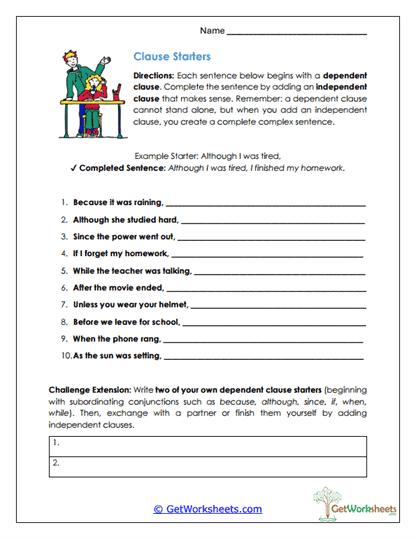
Clause Starters
Dependent-clause beginnings must be completed with independent clauses that finish each thought. Students create logical endings, check that the sentence expresses a complete idea, and place a comma after the opening clause. The activity makes it easy to hear why a dependent clause cannot stand alone. A final challenge allows learners to write their own starters for a classmate or partner to complete.
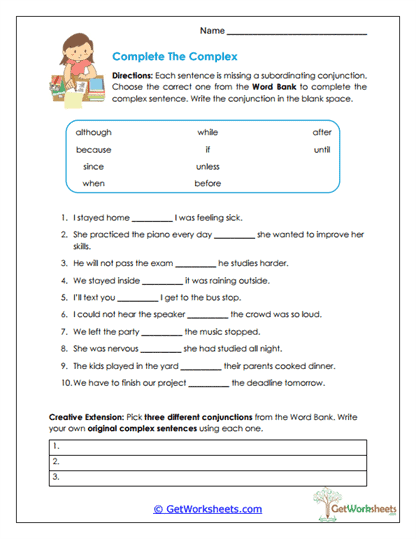
Complete the Complex
Students use a conjunction bank to finish sentences in ways that clearly express time, reason, contrast, condition, or sequence. They must consider the meaning of both clauses before selecting words such as although, because, unless, before, or until. The guided format supports developing learners while still requiring thoughtful choices. An original-writing section gives students a chance to apply the conjunctions independently.
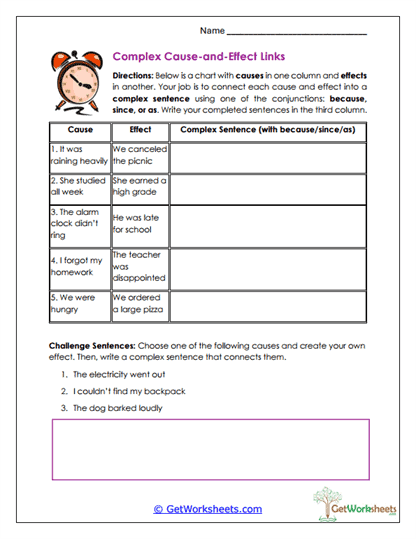
Complex Cause-and-Effect Links
Pairs of causes and effects are combined into complete complex sentences. Learners choose conjunctions such as because, since, or as and arrange the ideas so the relationship is easy to understand. The chart format keeps each cause, effect, and completed sentence organized. This activity combines grammar practice with reading comprehension and logical reasoning.
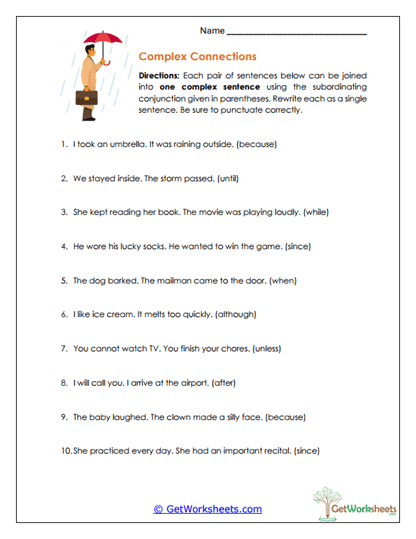
Complex Connections
Two related simple sentences are rewritten as one smooth complex sentence. Students use the conjunction provided, decide which idea should become dependent, and add punctuation based on clause order. The work helps replace short, repetitive sentences with more connected writing. It also reinforces the rule that an opening dependent clause is generally followed by a comma.
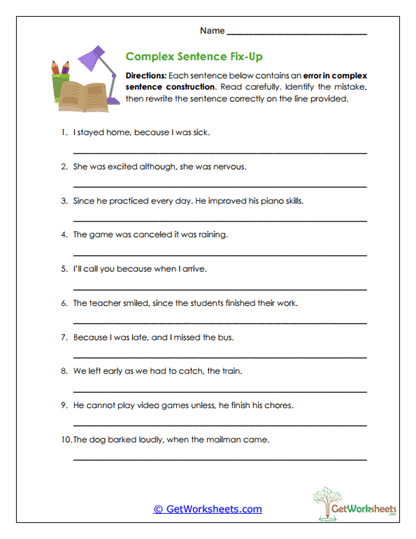
Complex Sentence Fix-Up
Incorrect complex sentences must be examined, corrected, and rewritten. Errors may involve fragments, run-ons, misplaced commas, unsuitable conjunctions, or confusing clause order. Learners identify which part can stand alone and which part depends on the main clause before repairing the sentence. This editing practice helps students apply grammar rules to the kinds of mistakes that often appear in their own writing.
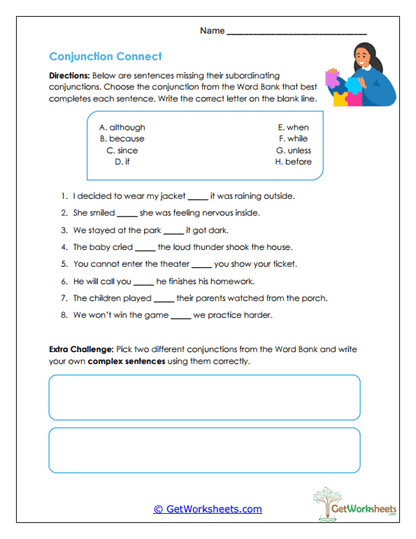
Conjunction Connect
A word bank of subordinating conjunctions helps students complete complex sentences meaningfully. Learners determine whether each pair of clauses shows reason, time, contrast, sequence, or condition before selecting a connector. The activity demonstrates that different conjunctions can change the relationship between ideas. Discussing alternative choices can further strengthen sentence meaning and vocabulary.
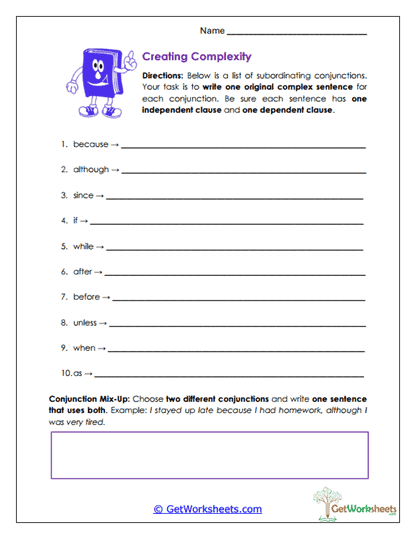
Creating Complexity
Each subordinating conjunction becomes the starting point for an original complex sentence. Students write one independent clause and one dependent clause while making sure the relationship is logical and the punctuation is correct. Because the ideas are student-created, the activity shows whether learners can apply the grammar independently. A final challenge asks them to use more than one subordinating conjunction within a sentence.
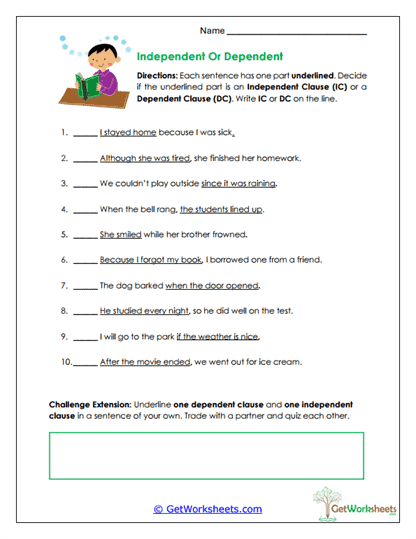
Independent or Dependent
Underlined clauses are classified according to whether they express complete thoughts or rely on another clause. Students use meaning, sentence structure, and conjunction clues to decide between independent and dependent. Reading each underlined portion aloud can help learners notice whether it sounds finished. The extension moves from classification to writing original examples of both clause types.
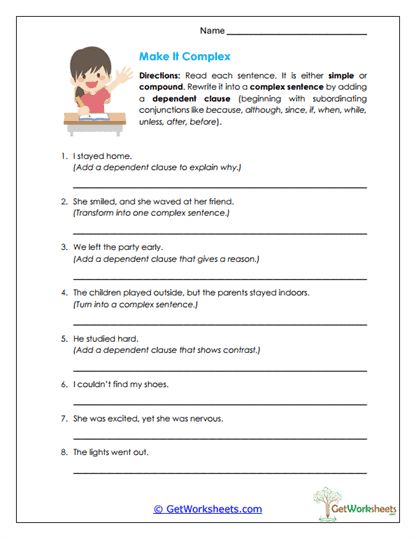
Make It Complex
Simple and compound sentences are expanded or revised to include dependent clauses. Prompts guide learners to add a reason, contrast, time relationship, or condition without changing the main idea. The activity shows how revision can make writing more informative and varied. It also gives students a safe structure for adding detail without creating fragments or run-ons.
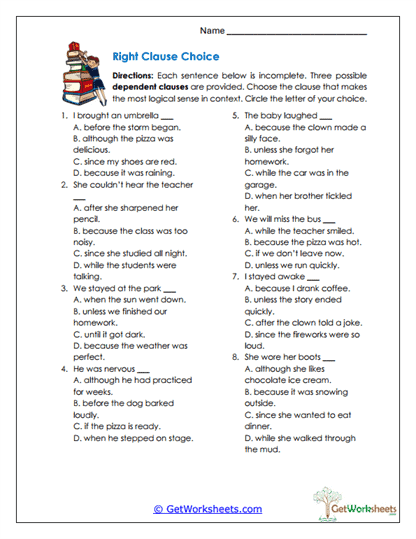
Right Clause Choice
Students compare several dependent clauses and choose the one that most logically completes each independent clause. Some choices may be grammatically possible, but only one creates the clearest relationship in context. This requires attention to meaning as well as sentence structure. The exercise strengthens careful reading, conjunction awareness, and grammatical judgment.
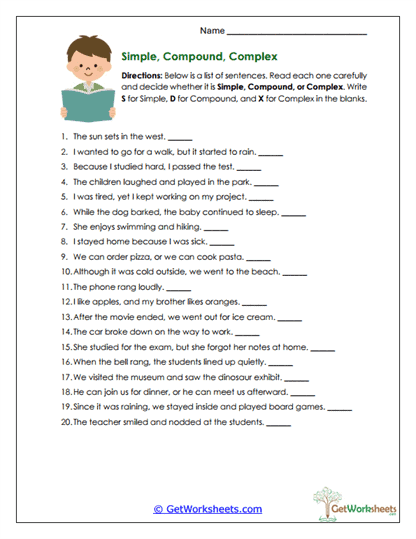
Simple, Compound, Complex
A mixed group of sentences must be labeled according to its clause structure. Learners distinguish a single independent clause from two joined independent clauses and from sentences containing dependent clauses. Conjunctions, punctuation, and the number of complete thoughts provide important clues. This classification practice helps students compare sentence patterns and use greater variety in their own writing.
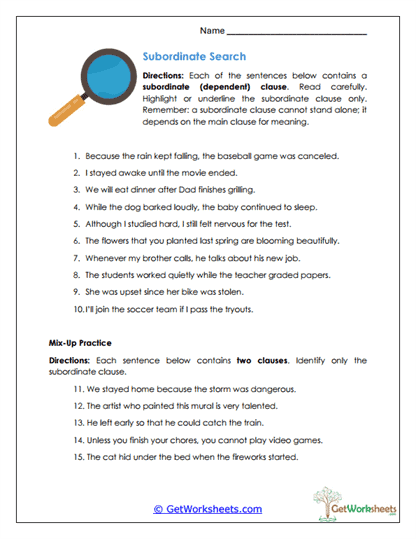
Subordinate Search
Students locate and mark the dependent clause within each complex sentence. They use subordinating conjunctions and the unfinished meaning of the clause to separate it from the independent main idea. Later examples provide fewer obvious clues, requiring closer attention to structure and meaning. This focused analysis builds a strong foundation for punctuation, editing, and sentence construction.
Bookmark Us Now!
New, high-quality worksheets are added every week! Do not miss out!